

Saved Bookmarks
| 1. |
S is a monochromatic point source emitting light of wavelength l = 500 nm. A thin lens of circular shape and of focal length 0.10 m is cut into two identical halves L_(1) and L_(2) by a plane passing through a diameter. The two halves are placed symmetrically about the central axis SO with a gap of 0.5 mm. The distance along the axis from S to L_(1) and L_(2) is 0.15 m, while that from L_(1) and L_(2) to O is 1.30 m. The screen at O is normal to SO. If the third intensity maximum occurs at point A on the screen, find the distance OA. |
|
Answer» Solution :KEY IDEA The two pieces `L_(1)` and `L_(2)` act as independent lenses. `S_(1)` is the IMAGE of source S due to lens `L_(1)` and `S_(2)` that due to lens `L_(2)`. `S_(1)` and `S_(2)` serve as the two coherent light sources which produce interference pattern on the screen. Calculation: Given f = 0.10 m and u = - 0.15 m. The image distance v is OBTAINED by using the lens formula `(1)/(v)-(1)/(u)=(1)/(f)` which gives `(1)/(v)=(1)/(f)+(1)/(u)=(1)/(0.10)+(1)/(+0.15)=(1)/(0.30)` or v = 0.30 m. Rays from S that pass through the optical center `O_(1)` of lens `L_(1)` and through `O_(2)` of lens `L_(2)` go through undeviated. THEREFORE, triangles `SO_(1)O_(2)` and `S S_(1)S_(2)` are SIMILAR. Hence, 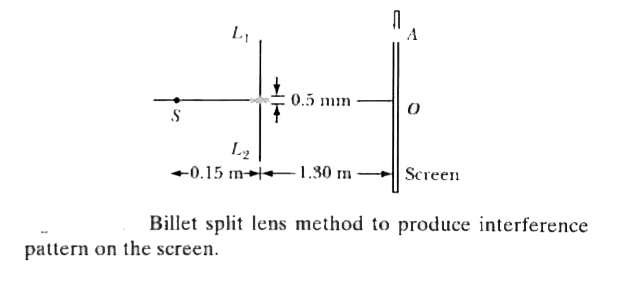 `(S_(1)S_(2))/(O_(1)O_(2))=(|u|+|v|)/(|u|).""(35-44)` However, `O_(1)O_(2)=0.5` mm (given). Therefore, `d=S_(1)S_(2)=((0.15+0.30)m)/((0.15)m) xx 0.5 m m=1.5 m m.` 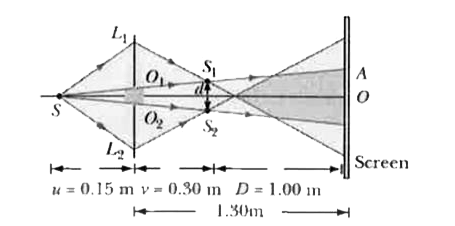 The distance of the vertical plane containing `S_(1)` and `S_(2)` from the screen is D = 1.30 - 0.30 = 1.00 m. The distance of the nth maximum from the central point O is given by `y_(n)=(n lambda D)/(d)` Since the third-order (n = 3) maximum occurs at A, we have `y_(3)=OA=(3 lambda D)/(d)=(3 xx 500 xx 10^(-9) xx 1.00)/(1.5 xx 10^(-3))` `=1.0 xx 10^(-3) m = 1.0 m m`. Note: What happens if the gap `O_(1)O_(2)` is reduced? If the gap `O_(1)O_(2)` is reduced, it follows from Eq. 35-44 that `S_(1)S_(2)= d` is ALSO reduced as u and v remain unchanged. Hence, OA increases. |
|