

Saved Bookmarks
| 1. |
Show mathematically that the rotation of a coll in a magnetic field over one rotation Induces an alternating emf of one cycle. |
|
Answer» Solution :Induction of emf by changing relative orientation of the coil with the magnetie FIELD: Consider a rectangular coil of N turns kept in a uniform magnetic field `vecB` figure (a). The coil rotates in anti-clockwise direction with an angular VCLOCITY o about an axis, perpendicular to the field. At time =0, the plane of the coil is perpendicular to the field and the flux linked with the coil has its maximum value `phi_(m)` = BA (where A is the area of the coil). 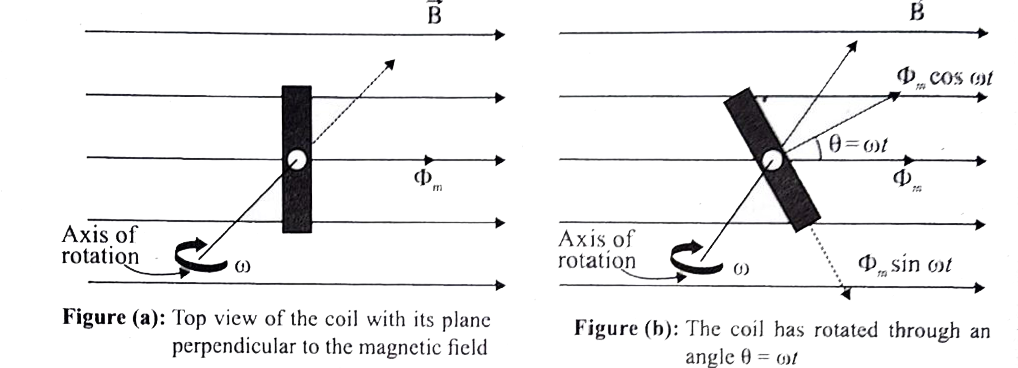 In a time t seconds, the coil is ROTATED through an angle `theta (=omegat)` in anti-clockwise direction. In this position, the flux linked is `phi_(m) cos omegat,` a COMPOUND of `phi_(m)` normal to the plane of the coil figure (b)). The component parallel to the plane `(phi_(m) sin omegat)` has no role in electromagnetic induction. Therefore, the flux at the flux linkage linkage at this deflected position is `N phi_(B)=N phi_(m) cos omegat`. According to Faraday.s law, the emf inducded at that instant is 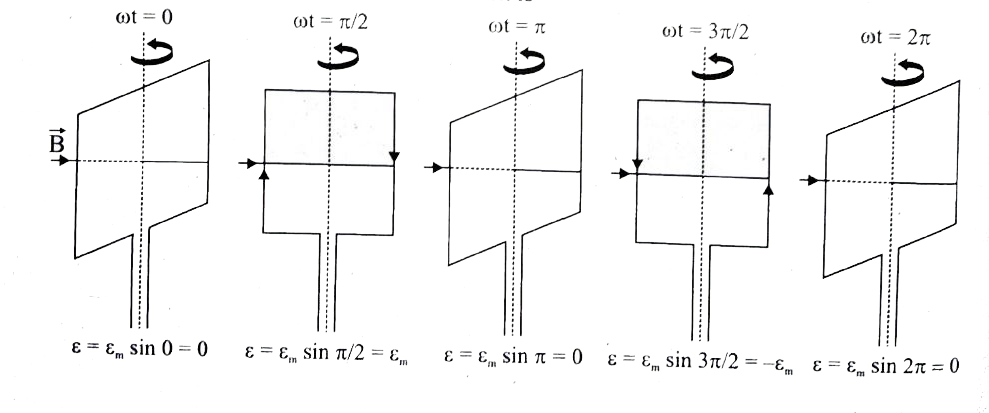 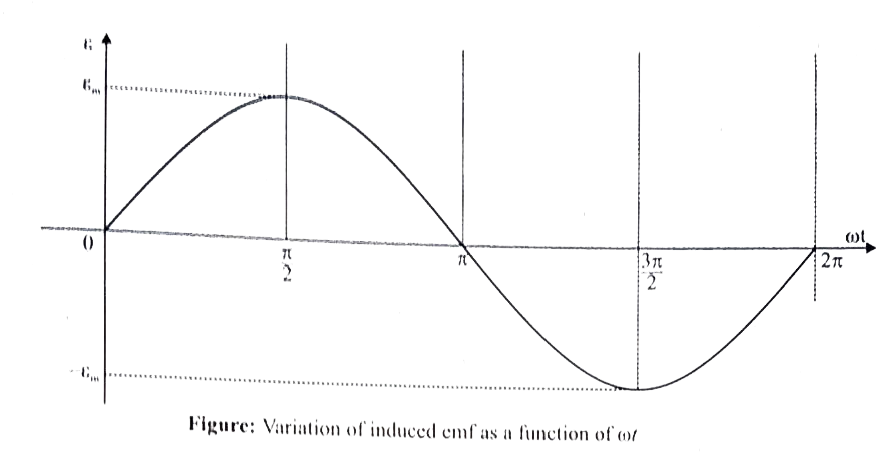 When the coil is rotated through `90^(@)` from initial position, `sin omegat=1`. Then the maximum value of induced emf is `epsi_(0) m=N phi_(m)omega= NBA omega "since "phi_(m)=BA` Therefore, the value of induced emf at that instant is then GIVEN by `epsi=epsi_(m) sin omegat` It is seen that the induced emf varies as sine function of the time angle wt. The graph between induced emf and time angle for one rotation of coil will be a sine curve and the emf varying in this manner is called sinusoidal emf or alternating emf. |
|