

Saved Bookmarks
| 1. |
Show that linear SHM is the projection of a uniform circular motion on any diameter. |
Answer» Solution :Consider a PARTICLE which moves with a constant angular speed `OMEGA` around a circular path of radius A. Let the path lie in the x-y plane with the centre at the origin O. The INSTANTANEOUS POSITION Q of the particle is called the REFERENCE point and the circle in which the particle moves is called the reference circle. 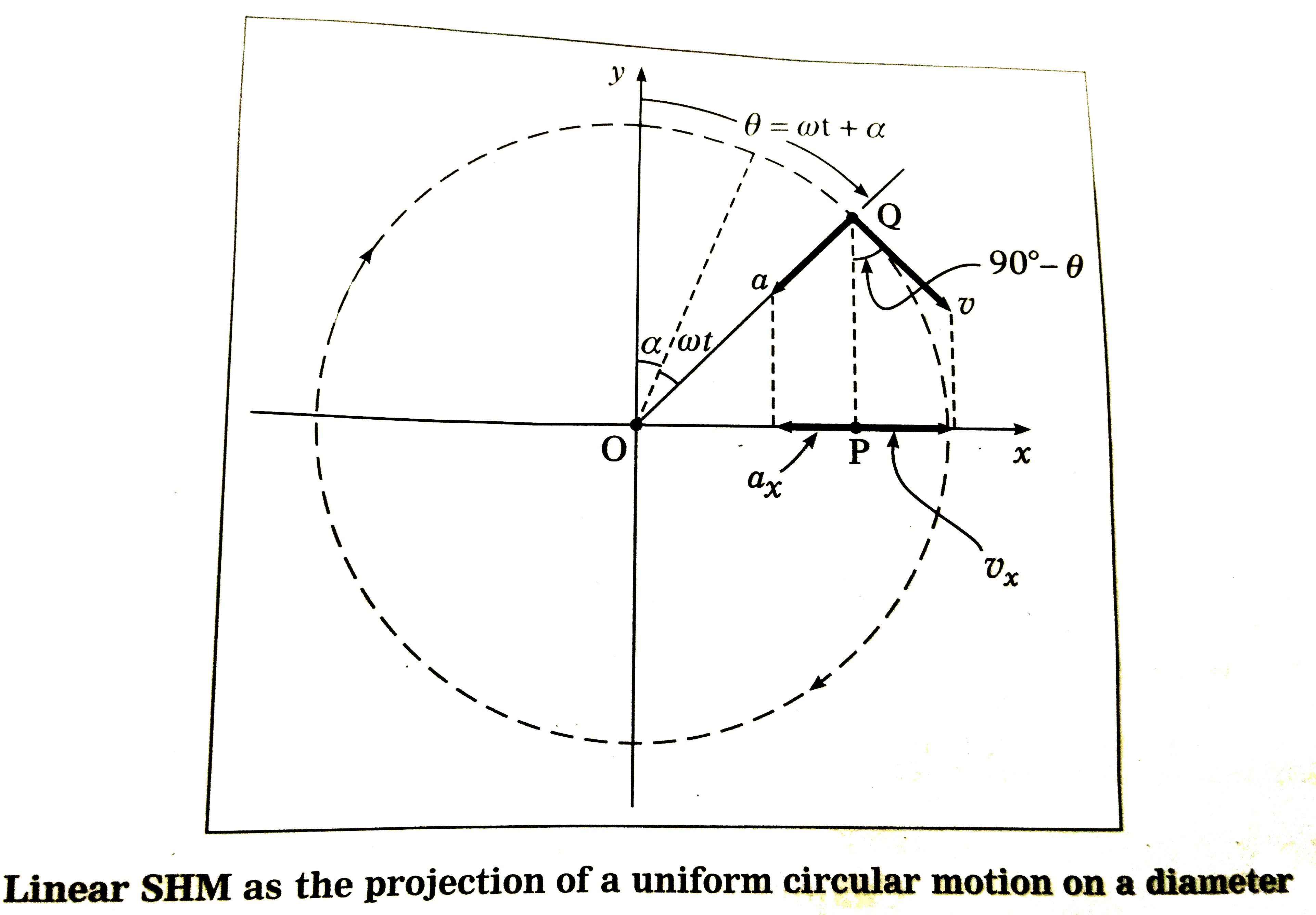 The perpendicular projection of Q onto the x-axis is P. Then as, the particle travels around the circle, P moves to-and-fro along the x-axis. Line OQ makes an angle `prop` with the y-axis at t=0. At time t, this angle becomes `theta=omegat+alpha`. The projection P of the reference point is described by the x-coordinate, `x=OP=OQ sin angle OQP." Since "angle OQP=omega t+alpha,` `x=A" sin "(omega t+alpha)` The tangential velocity of the refrence particle is `v=omega A.` Its x-component at time t is `v_(x)=omega A" sin "(90^(@)-theta)=omega A cos theta` `therefore v_(x)=omega A cos (omega t +alpha)` Tbe centripetal accelertation of the reference particle is `a=-omega^(2)A,` so that its x-component at time t is `a_(x)= a sin angle OQP` `therefore a_(x)=-omega^(2)A sin (omega t+alpha)=-omega^(2)x` These results for x, `v_(x) and a_(x)` correspond to the general expressions for displacement, velocity and acceleration of a particle executing linear SHM. Thus, linear SHM can be described as the projection of uniform circular motion onto a fixed diameter of the circular path. |
|