

Saved Bookmarks
| 1. |
Shown in the figure is network of capacitors & resistors. The potentials of some of the nodes are given. Find the |
|
Answer» Solution :At steady state, capacitor. offers infinite resistance to DC, therefore, no current PASSES through 1 1F capacitor and current passes through 1 Omega resistor across PQ. Since three identical resistors of resistance `(1)/(3)Omega`. each are connected in series. This series combination is connected in parallel with another resistor of 1Omega across PQ .thereforeThe effective resistance between P and Q will be`(1)/(2)Omega` Applying KCL at P, we OBTAIN `i_(1)+ i_(2) + i_(3) = 0` `implies(V_(P)-10)/(1)+(V_(P)-3)/(0.3)+(V_(p)-(-20))/(1)=0` `impliesV_(p)[1+(1)/(0.3)+1]=10+10-20` (a) `V_(p) = 0 `and `i__(1) = -10 amp`. `i_(2) = -10 amp`, `i_(3) = 20 amp`.The POTENTIAL difference across PQ `V_(PQ)=R_(PQ)i_(3)` `impliesV_(P)=(1//2)20=10V` Since, `V_(p) = 0, V_(Q)= 0 - 10` i.e.`V_(PQ) = +10 V` The potential difference between R and `S = V_(RS)` Since `i_(PR)= I_(PQ)//2 = I_(3)//2` (b) The energy stored in the capacitor `(0:4muF)` 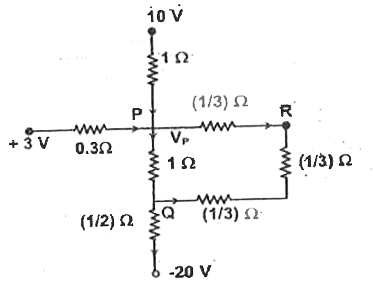 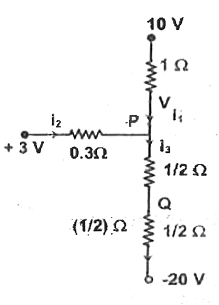 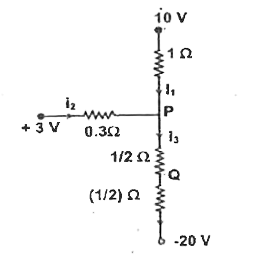 |
|