

Saved Bookmarks
| 1. |
Some equipotential surfaces are shown in the figure below, what can you say about the magnitude and the direction of the electric field ? |
Answer» Solution :First we will find the direction of the `vec(E )` noting that the `vec(E )` LINES are always perpendicular to the local equipotential surfaces and points in that direction in which the potential is decreasing . So it will be as shown below. 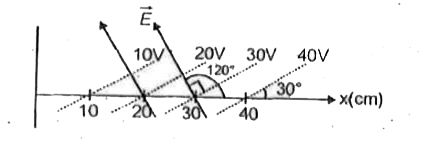 NOTE that we have drawn the `vec(E )` lines perpendicular to all equipotential surface and it si pointing in that direction in which the potential is decreasing. so the total angle `vec(E ) ` is making with the positve x-axis is `120^(@)` as shown . . 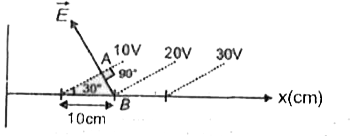 Now, how to calculate the magnitude of the ELECTRIC field for this we need to jump from one equipotential surface to ANOTHER through shortest (perpendicular ) distance then calculate, E = `("Change in potential")/("distance travelled")` Let us suppose we are jumping from 20 V line to 10V line from B to A. note that the BA line is the shortest length between the two equipotential surface . the potential difference between the two lines is (20 V-10 V) = 10 volt now, calculate the length AB = 10sin `30^(@)` cm = 5 cm = `5xx 10^(-2)` m Therefore, E `= (10V)/(5 xx 10^(-2)m)` = 200 [ V/m] Hence, the complete answer is that the `vec(E )` has the value 200 V/m and makes `120^(@)` with positve x-axis. |
|