

Saved Bookmarks
| 1. |
State briefly the underlying principle of a transistor oscillator. Draw a circuitdiagram showinghow thefeedback is accomplished byinductive coupling. Explain the oscillator action. |
|
Answer» Solution :Transistor as an oscillator: In an oscillator, the output at a desired frequency is obtained without applying any external input voltage. The common emitter npn transistor as an oscillator is shown in the following figure. A variable capacitor C of suitable range is connected in parallelto coil L to give the variation in frequency. Oscillator action : As in an amplifier, the base-emitter junction is forward biased while the base-collector junction is reverse biased. When the switch S is PUT on, a surge of collector current FLOWS in the coil `T_(2)`. The inductive coupling between coil `T_(2)` and `T_(1)` cause a current to flow in the emitter circuit i.e. feedback from input to output. As a result of positive feedback, the collector current REACHES at MAXIMUM. When there will be no further feedbackfrom `T_(2) ` to `T_(1)`, the emitter current begins to fall and collector current decreases. Therefore, the transistor has reverted back to its original state. The whole PROCESS now repeats itselt. 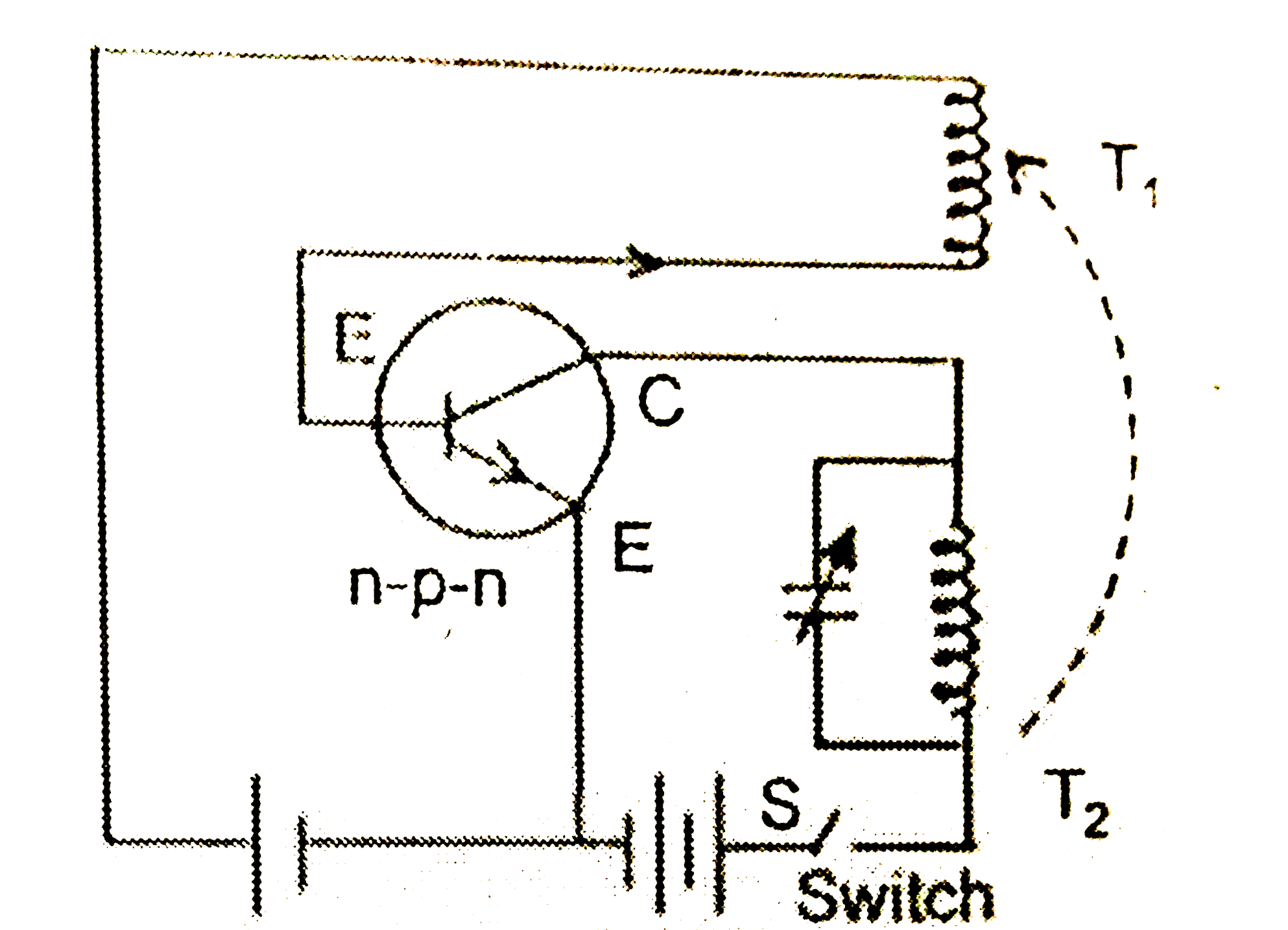
|
|