

Saved Bookmarks
| 1. |
State Coulomb's law in electrostatics. Write the law in vector form. Derive the definition of coulomb. |
|
Answer» Solution :Coulomb.s law. It states that two stationary electric point charges attract or repel each other with a force which is directly proportional to the product of MAGNITUDE of the charges and inversely proportional to the square of the distance between them. COulomb.s law in VECTOR form Let `q_(1) and q_(2)` charges be separated by a distance r. 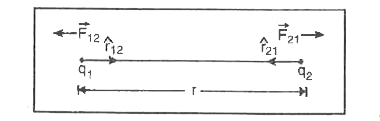 let `hatr_(12)`=unit vector pointing from `q_(1) ` to `q_(2)` `hatr_(21)=` unit vector pointing from `q_(1)" to "q_(1)` `vecF_(21)`=force exerted on `q_(2)" by " q_(2)` Then `vecF_(12)=(1)/(4piepsi_(0))(q_(1)q_(2))/(r^(2))hatr_(21)`. . . (i) and `vecF_(21)=(1)/(4piepsi_(0))(q_(1)q_(2))/(r^(2))hatr_(12)` or `vecF_(21)=-(1)/(4piepsi_(0))(q_(1)q_(2))/(r^(2))hatr_(21)`. . . (ii) Adding (i),(ii) we get `vecF_(12)+vecF_(21)=0` or `vecF_(12)=-vecF_(21)` DEFINITION of one coulomb IN vaccum, `F=9xx10^(9)(q_(1)q_(2))/(r^(2))` If `q_(1)=q_(2)=q(say),r=1m,F=9xx10^(9)N` Then, `9xx10^(9)=9xx10^(9)*(q*q)/(1)` or `q=pm1C` `therefore` One coulomb is charge which when placed before an equal and similar charge in VACUUM at 1m, repels with a force of `9xx10^(9)N`. |
|