

Saved Bookmarks
| 1. |
State Faraday's law of electromagnetic induction. Figure shows a rectangular conductor PQRS in which the conductor PQ is free to move in a uniform magnetic field B perpendicular to the plane of the paper.The field extends from x=0 to x=b and is zero for x gt b.Assume that only the arm PQ posses resistance r.When the arm PQ is pulled outward from x=0with constant speed v, obtain the expressions for the flux and the induced emf. sketch the variations of these quantities with distance 0 le x le 2b. |
|
Answer» Solution :Part I:Farady's law of induction:It states that the `emf` induced in a coil of `N` turns is directly related to the rate of charge of flux through it. `therefore epsilon=-N(d phi_(B))/(dt)` Where `phi_(B)` is the flux linked with one turn of the coil.If the circuit is closed, a current `I=epsilon/R` is setup in it. Part II : Refer to Following Fig.(a) the arm `PQ` of the rectangular conductor is moved form `x=0` outwards, the uniform magnetic FIELD is perpendicular to the PLANE and extends from `x=0` at `x=b` and is zero these situation when the arm `PQ` passes substantial resistance `r`.Consider the situation when the arm `PQ` is pulled outwards from `x=0` to `x=2b`,and is then moved back to `x=0` with constant speed `V`. Let us first consider the forward motion from `x=0` to `x=2b` The flux `Phi_(B)` linked with the circuit `SPQR` is `Phi_(B)=Blx, 0lex lt b` =`Blbb LE x lt 2b` The induced `emf` is `epsilon=-(dPhi_(B))/(dt)` =`-Blv 0le x lt b` =`0 b le x lt 2b` When the induced `emf` is non-zero.the current `I` is (in magnitude) `l=(Blupsilon)/r` The FORCE required to keep the arm `PQ` in constant motion is `IiB`. its direction is to the left.In magnitude `F=(B^(2)l^(2)upsilon)/r0 ne x lt b ` `F=0 b le x lt 2b` The joule heating loss is `P=I^(2)r` `=(B^(2)l^(2)upsilon^(2))/r 0 ne x lt b ` `=0 b le x lt 2` 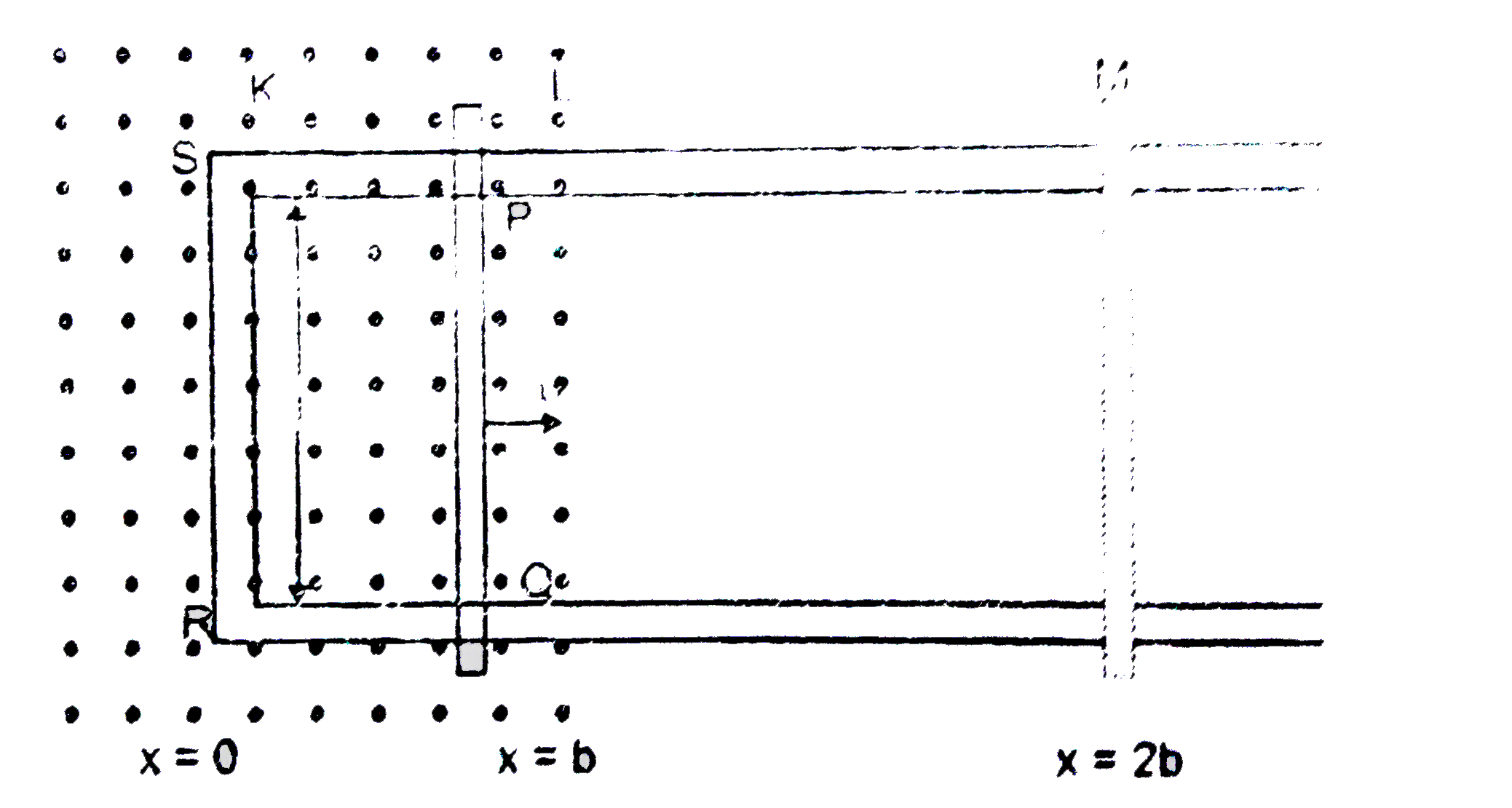 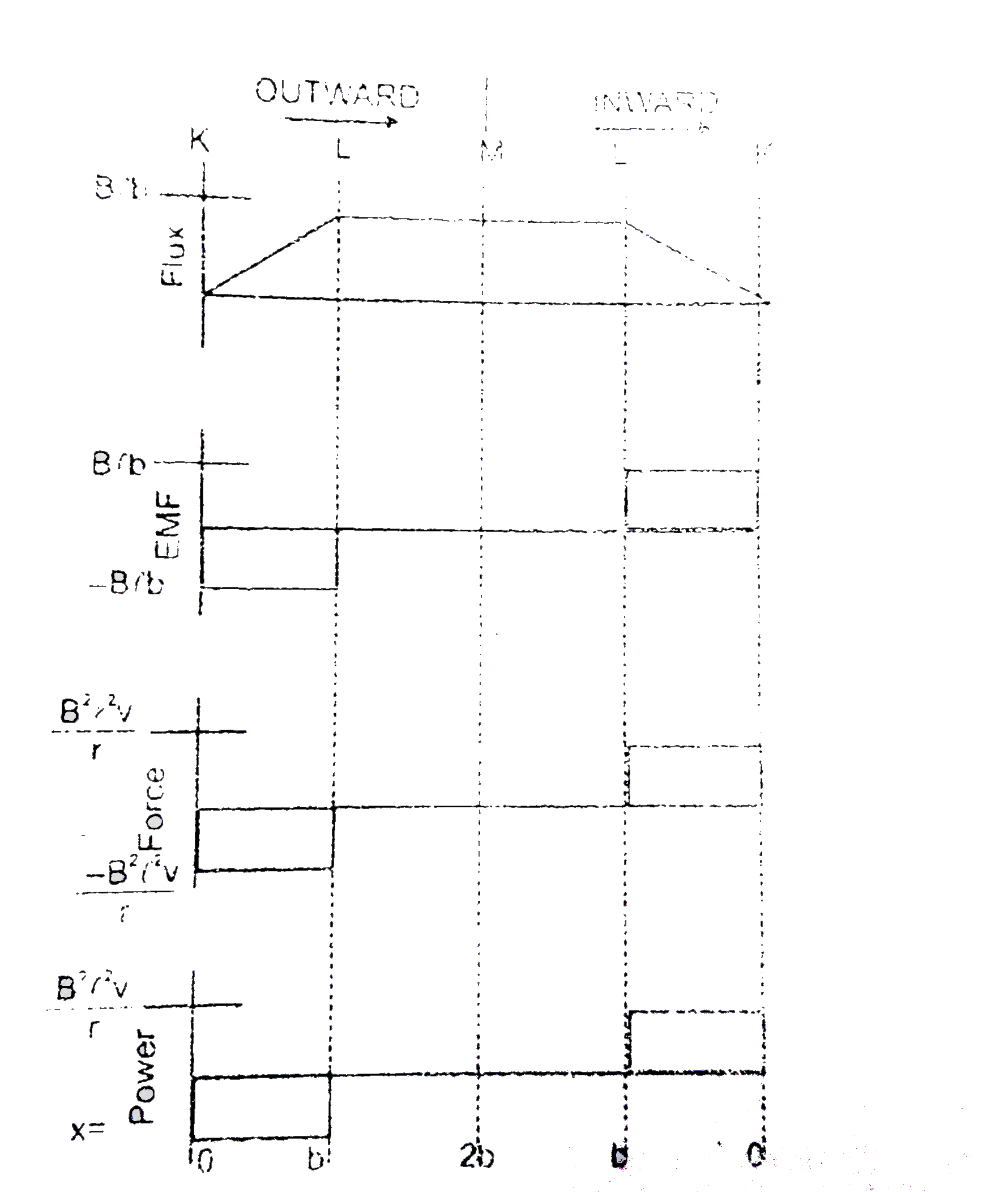
|
|