

Saved Bookmarks
| 1. |
State Gauss's law in electrostatics. Derive an expression for the electric field due to an infinitely long straight uniformlycharged wire. |
|
Answer» Solution :The total electric FLUX `(varphi)` through any closed SURFACE s in free space to `1/(in_(0))` times the total electric charge q enclosed by the surface. ` varphi= underset (s) oint vec(E). dvec(s) = q//in_(0)` TAKE a thin long wire (`l=alpha`) with linear charge density `LAMBDA`symmetric about the axis of the wire . At P, `vec(E)`is to calculated, draw an imaginary cylinder (Gaussian Surface) at distance r from the line. Charged enclosed =`q= lambda l` from Gauss'a theorem `underset(s) ointvec(E). d vec(S) = q/in_(0)=(lambda l)/in_(0).` Top face (I) BOTTOM face II and curved face III ar the segments of Gaussian surface. So `(lambdal)/(in_(0))=underset (s) oint vec(E) . d vec(S)= underset(I)intvec(E).dvec(S)+underset (II)int vec(E). d vec(S)+underset(III)intvec(E). d vec(S)` In I and II angle between `vec(E) and dvec(S)"is " 90^(@)"so ", cos90^(@) = 0" so ", vec(E). d vec(S)` for both the region is zero. Electric flux will cross through only curved surface and now `underset (III)oint vec(E). d vec(S)= (lambda l)/(in _(0)) rArr underset(III)int vec(E) ds cos0 = (lambda l)/(in_(0)) ` `underset(III) int vec(E) . d vec(S) = (lambdal)/(in_(0))` But `intds = 2 pi rl = CSA=" of cylinder"` `rArr E xx 2 pi rl = (lambda l)/(in_(0)) rArr E=lambda/(2pi in _(0)r)` 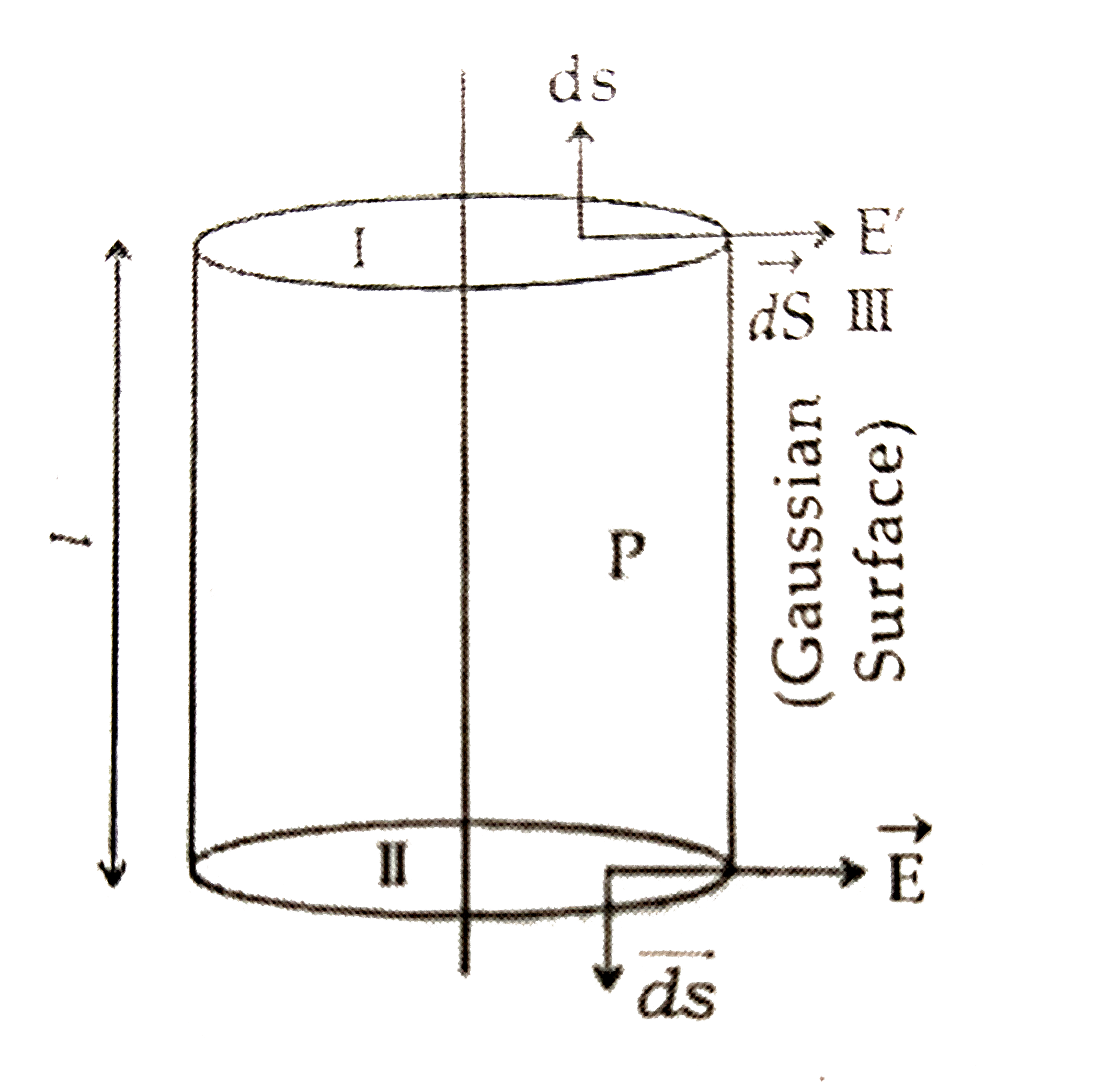
|
|