

Saved Bookmarks
| 1. |
State Gauss's law on electrostatics and derive an expression for the electric field due to a long straight thin uniformly charged wire (linear charge density ) at a point lying at a distance r from the wire. |
|
Answer» Solution :Gauss. law in ELECTROSTATICS states that the total electric flux overa closed surface in free space is `(1)/(in_(0))` times the net charge enclosed within that surface. Mathematically, for a closed surface `phi_(E)=ointvecE. hatn ds = (1)/(in_(0))(Q)` where Q = total charge enclosed. Consider an infinitely LONG straight CHARGED wire of linear charge density `lambda`. To find electric field at a point P situated at a distance r from the wire by using Gauss. law consider a cylinder of length l and radius ras the Gaussian surface. From symmetry consideration electric field at each point of its curved surface is `VECE` and is pointed outwards normally. Therefore, electric flux over the curved surface 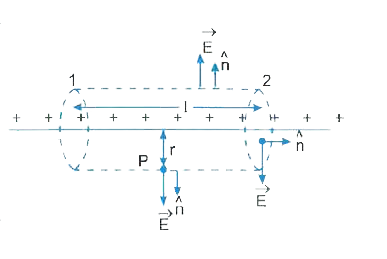 `= intvecE . hatn ds = E 2pir l` On the side faces 1 and 2 of the cylinder normal drawn on the surface is perpendicular to electric field E and hence these surfaces do not contribute towards the total electric flux. `:.` Net electric flux over the entire Gaussian surface `phi_(E)= (1)/(in_(0)) ` ( charge enclosed ) = `(lambdaI)/(in_(0))` Comparing (i) and (ii) we have `E.2 PI r l = (lambdal)/(in_(0)) implies E = (lambda)/(2 pi in_(0)r)` We know that E = `-(dV)/(dr) ` and so dV = -E dr As per question E = (10 r +5) `:. dV =- (10r +5) ` `implies int_(v_(i))^(v_(2))dV= int_(r_(1)=1)^(r_(2)=10)-(10r+5)dr` `implies V_(2)-V_(1)=[-(5r^(2)+5r)]_(1)^(10)=[-5(r^(2)+r)]_(1)^(10)=[-5(100+10)]-[-5(1+1)]` `=-550 +10 =-540 V` The - ve signifies that `V_(2) lt V_(1)` . |
|