

Saved Bookmarks
| 1. |
State the underlying princeiple of mater bridge. Draw the circuit diagram and explain how the unknown resistance of a conductor can be determined by this method. |
|
Answer» Solution :Metre bridge or slide wire bridge. It is the simplest practical application of the Wheatstone bridge that is USED to measure an unknown resistance. Principle : Its working is BASED on the principle of Wheatstone bridge. When the bridge is balanced, `(P)/(Q)=(R)/(S)` Construction : It consists of usually one metre long magnanin wire of uniform cross-section, streatched along a metre scale fixed over a wooden board and with its two ends soldered to two L-shaped thick copper STRIPS A and C. Between these two copper strips, another copper strip is fixed so as to PROVIDE two gaps ab and `a_(1)b_(1).` A source of emf `epsilon` is connected across AC. A movable jockey and a galvanometer are connected across BD, as shown in figure. After taking out suitable resistance R from the resistance box, the jockey is moved along the wire AC till there is no deflection in the galvanometer. This is the balanced condition of the Wheatstone bridge. If P and Q are the resistances of the parts AB and BC of the wire, then for the balanced condition of the bridge, we have `(P)/(Q)=(R)/(S)`. Let total length of wire AC=100cm and AB=l cm, then BC=(100-l)cm. Since, the bridge wire is of uniform cross-section, therefore, resistance of wire `prop` length of wire `(P)/(Q)=("resistance of AB")/("resistance of BC")=(sigmal)/(sigma(100-1))=(l)/(100-l)` where `sigma` is the resistance per unit length of the wire. `"Hence, "(R)/(S)=(l)/(100-l) or, S=(R(100-l))/(l).` 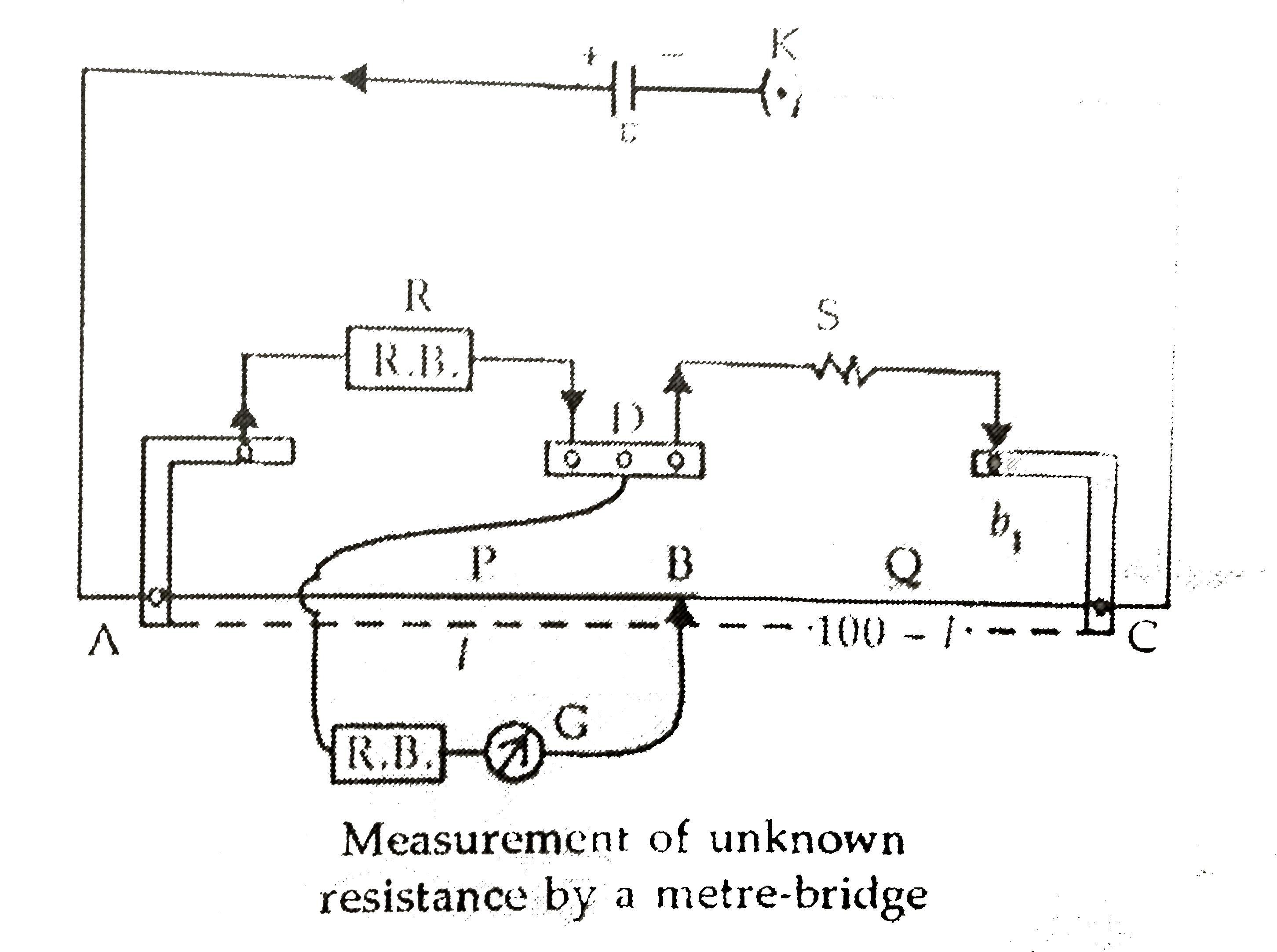
|
|