

Saved Bookmarks
| 1. |
tert-Butyl bromide reacts with aq. NaOH by S_(N)1 mechanism while n-butyl bromide reacts by S_(N)2 mechanism. Why? |
Answer» Solution :tert-Butyl readily loses `Br^(-)` ion to form STABLE tert-butyl carbocation. Therefore, it undergoes reaction by `S_(N)1` mechanism which occurs in TWO steps. In the first step, tert-butyl carbocation is formed. This step is slow and hence is the rate determining step of the reaction. In the second step, the tert-butyl carbocation is readily attacked by `OH^(-)` ion to form tert-butyl alcohol. 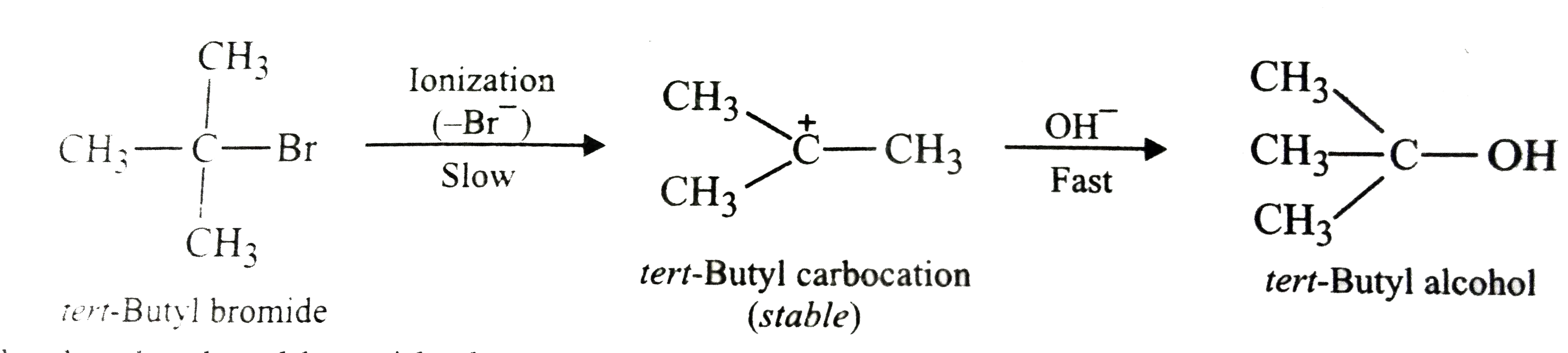 On the other hand, n-butyl bromide does not undergo ionization to PRODUCE n-butyl carbocation because it is not stable. Therefore, it prefers to undergo reaction by `S_(N)2` mechanism which occurs in one step through a transition state involving NUCLEOPHILIC ATTACK of the `OH^(-)` ion from the back side with simultaneous expulsion of `Br^(-)` ion from the front side. 
|
|