

Saved Bookmarks
| 1. |
The box of a pinhole camera, of length L, has a hole of radius a. It is assumed that when the hole is illuminated by a parallel beam of light of wavelength lambda. The spread of the spot (obtained on the opposite wall of the camera) is the sum of its geometrical spread and the spread due to diffraction. The spot would then have its minimum size (say b_("min")) when : |
|
Answer» `a = (LAMBDA^2)/L and b_("min") = ((2lambda^2)/(L))` `theta = lambda/a` As the beam travels a distance L, it spreads over a linear width, `x = (L lambda)/a` Diameter of the spot , `B = 2A + (2L lambda)/a "" ....(i)` The minimum size of the spot, `(DB)/(da) = 0 "".....(ii)` `1 - (L lambda)/(a^2) = 0` `implies a = sqrt(lambda L)"".....(iii)` Substituting a from equation (iii) in (i) `B = 2 sqrt(lambda L) = (2 L lambda)/(sqrt(lambda L))` `B_("min") = 2 sqrt(lambda L) + 2sqrt(lambda L) = 4sqrt(lambda L)` The radius of the spot, `b_("min") = 1/2(4 sqrt(lambda L)) = sqrt(4 lambda L)` 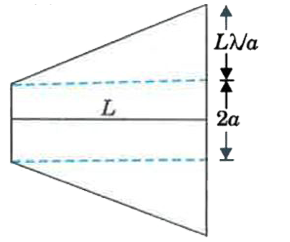
|
|