

Saved Bookmarks
| 1. |
The convex surface of a thin concaveo-convex lens of glass of refractive index 1.5 has a radius of curvature 20cm. Theconcave surface has a radius of curvature 60cm. The convex sidei is silvered and placed on a horizontal surface. Q. Where should a pin be placed on the optice axis such that its image is formed at the same place? |
|
Answer» `X=5cm` `(1)/(F)=(1)/(f_(g))+(1)/(f_(m))+(1)/(f_(g))` where `f_(x)` is th efocal length of the lens without silvering and `f_(m)` is the focal length of the mirror. `(1)/(f_(g))=(n-1)((1)/(R_(1))-(1)/(R_(2)))` `=(1.5-1)((1)/(20)-(1)/(+60))=(1)/(60)` `f_(g)=60cm` `f_(g)=R_(1)//2=20//2=10cm` `(1)/(F)=(1)/(60)+(1)/(10)+(1)/(60)=(8)/(60)` `F=(60)/(8)=7.5cm` For the IMAGE to be formed at THEPLACE of the object, `X=R=2F=7.5xx2` `=15cm` 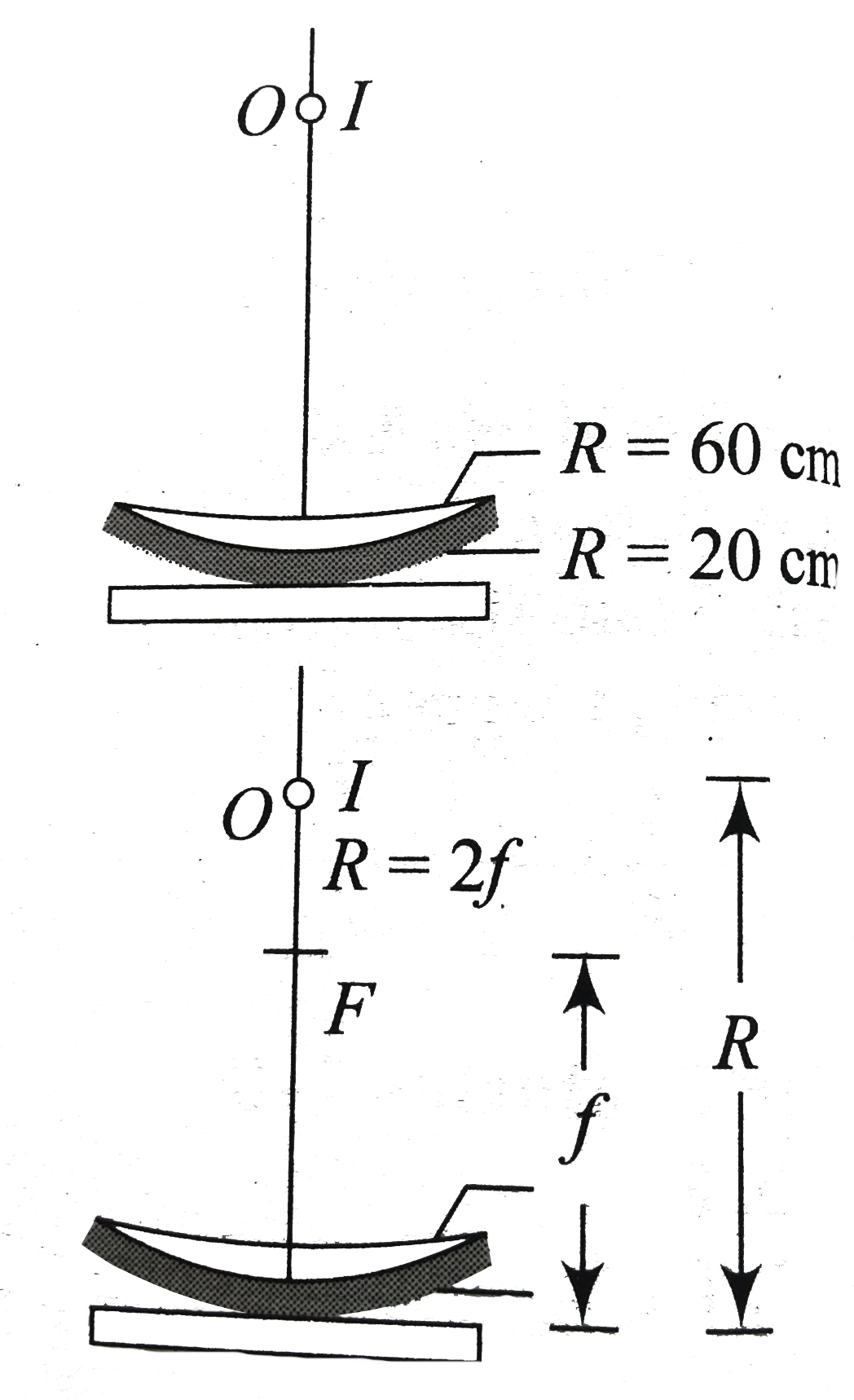 Method2: We use the relation `(n_(2))/(x_(2))-(n_(1))/(x_(1))=(n_(2)-n_(1))/(R)` For the object and the image to coincide, the rays fall normal on the reflecting surface. i.e., on the silvered face of the lens. Then, the rays retrace backward and meet at the object point again (optical reversibility). For the refraction at the upper surface of the lens, `n_(1)=1.0, n_(2)=1.5, x_(1)=20, R=+60` `(x_(2)=+20 ` ensures that the rays fall on the silvered face normally. ) `(1.5)/(20)-(1.0)/(x_(1))=(1.5-1.0)/(+60)` `(1.0)/(x_(1))=(1.5)/(20)-(0.5)/(60)=(3.0)/(60)` `x_(1)=15cm` 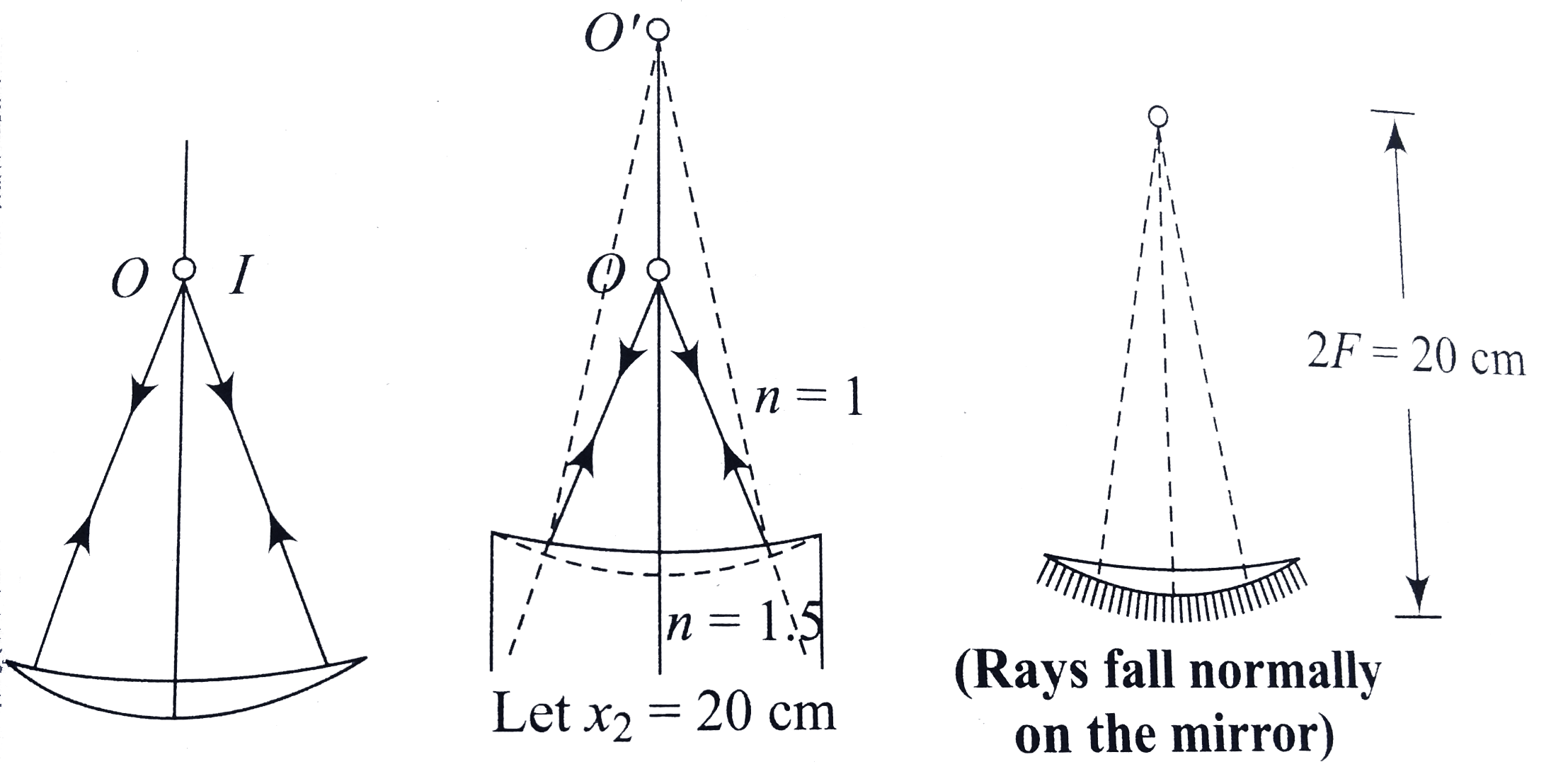 Method 3: We use lensmaker's FORMULA and the equation `(1)/(f)=(1)/(x_(2))-(1)/(x_(1))` The given optical arrangement can be visualised as a convex lens of focal length 60cm and a concave mirror of focal length 10cm kept in contact as shown in the figure. If the rays fall normally on the mirror after the refraction through the lens, they will retrace backward and meet at the point of the pin again. For the lens, `x_(1)=?` `x_(2)=+20` (for normal incidence on the mirror ) `f=-60` (using cartesian-coordinate sign convention) `(1)/(-60)=(1)/(+20)-(1)/(x_(1))` 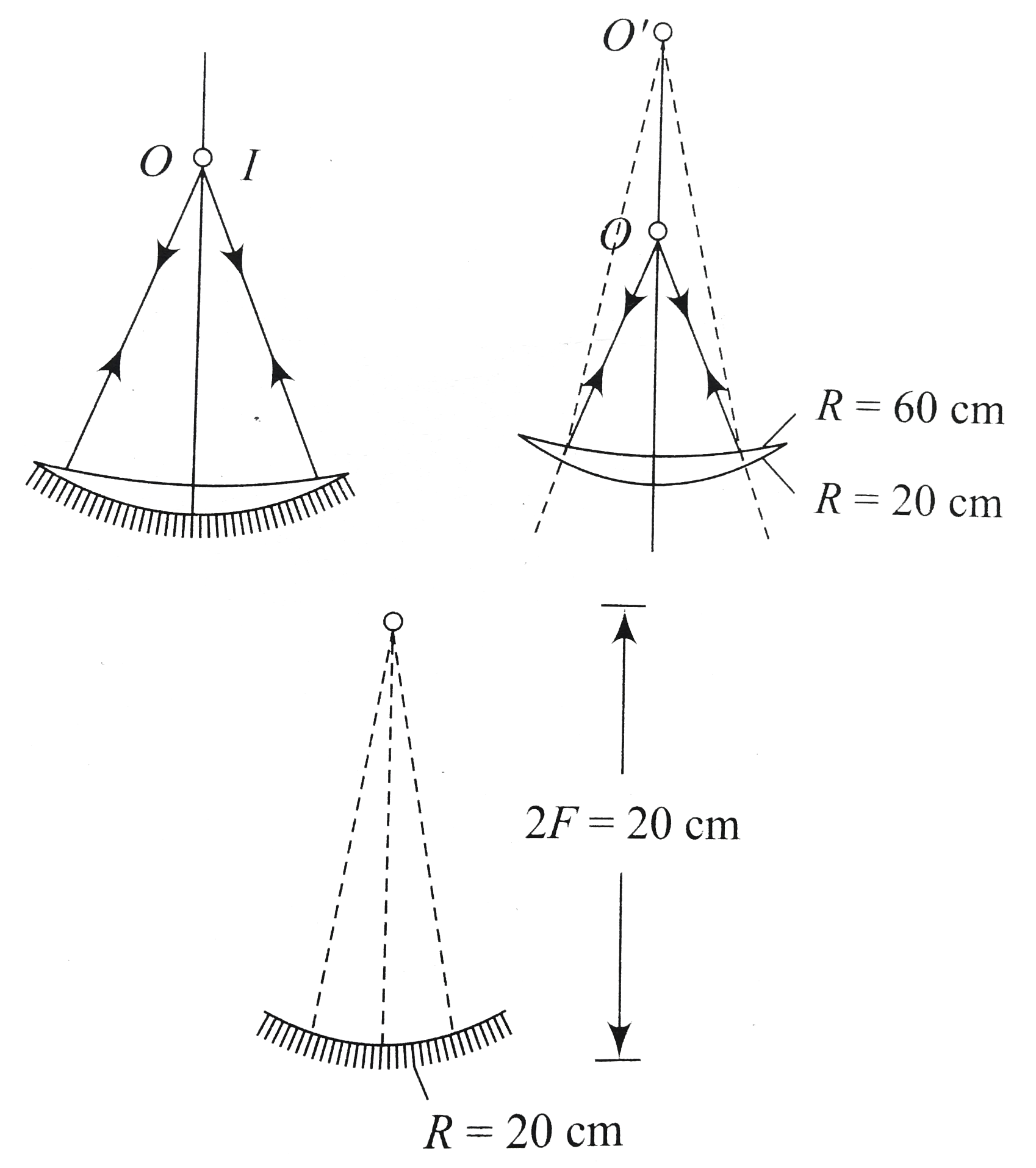
|
|