

Saved Bookmarks
| 1. |
The cross-section of a tank kept on a vehicle is shown in Fig. The rectangular tank is open to the atmosphere , During motion of the vehicle , the tank is subjected to a constant linear acceleration , a = 2.5 m//s^(2) . How much fluid will be left inside the tank if initially the tank is half filled . The vessel is 5 m wide and 2 m high . |
|
Answer» Solution :Using Eq, we can find the angle that the fluid will make with the horizontal `tan theta = (2.5)/(10) = (1)/(4)` Let.s assume that the dimensions of tank in the plane perpendicular to the PAGE is d . From geometry , it is easy to see that free surface on right - hand side will go down and the same will rise on left - hand side . Thus, if we assume that fluid on right-hand side has not TOUCHED the floor , we will have fluid taking a shape as shown in Fig . The cuboid part will have volume `x xx 5 xx d` , where x is the height above the bottom . The Wedge part will have the volume `1//2 xx h xx 5 xx d` , where h can be found in the following manner : `((h)/(5))= tan theta = ((1)/(4))` Thus , total volume will be `(1)/(2) xx (5)/(4) xx 5 xx d + x xx 5 xx d` and if we assume there is no spilling then it must be equal to the final volume , so `(1)/(2) xx (5)/(4) xx 5 xx d + x xx 5 xx d = 1 xx 5 xx d` Solving we get , x = 3/8 m . Therefore , total length `(5)/(4) + (3)/(8) = (10 + 3)/(8) = (13)/(8) lt 2` m Thus , height is less than 2 m . HENCE , water will not spill . Using Eq. we can find the angle that the fluid will make the horizontal `tan theta = (10)/(10) = 1 or theta = (pi)/(4)` In this case , fluid cannot remain inside . Fluid having an inclined free surface at `45^(@)` angle , and covering the bottom of length 5 m , will also be 5 m high . This will require the wall to be of 5 m height , which is just 2 m for the given vessel . Instead, if we think it other way round to keep in contact with the left-hand side wall , bottom will haveto be COVERED only 2 m with the fluid as shown in the Fig. 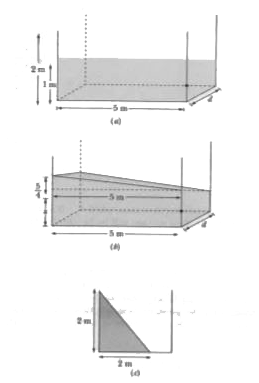 Volume of fluid inside = `(1//2) xx 2 xx 2 xx d m^(3) = 2 d m^(3)` . Thus , volume of fluid gone outside = ` 3 d m^3`. |
|