

Saved Bookmarks
| 1. |
The disk in Fig. 10-5a is rotating about its central axis like a merry-go-round. The angular position theta(t) of a reference line on the disk is given by theta=-1.00-0.600t+0.250t^(2), with t in seconds, theta radians, and the zero angular position as indicated in the figure. (a) Graph the angular position of the disk verus time from t = -3.0 s to t = 5.4 s. Sketch the disk and its angular position reference line at t = -2.0 s, 0 s, and 4.0 s, and when the curve crosses the t axis. (b) At what time t_(min)" does "theta(t) reach the minimum value shown in Fig. 10-5b? What is that minimum value? (c ) Graph the angular velocity omega of the disk versus time from t = -3.0 s to t = 6.0 s. Sketch the disk and indicate the direction of turning and the sign of omega at t = -2.0 s, 4.0 s, and t_(min). (d) Use the results in parts (a) through ( c) to describe the motion of the disk from t = -3.0 s to t = 6.0 s. |
|
Answer» Solution :(a) The angular position of the disk is the angular position `theta(t)` of its reference line, which is given by a function of time t. So we graph, the result is shown in Fig. Calculations: To sketch the disk and its reference line at a particular time, we need to determine `theta` for that time. To do so, we substitute the time. For t = -2.0 s, we get `theta=-1.00-(0.600)(-2.0)+(0.250)(-2.0)^(2)` = `1.2rad=1.2rad(360^(@))/(2pirad)=69^(@)`. This means that at t = -2.0 s the reference line on the disk is rotated counterclockwise from the zero position by angle 1.2 rad = `69^(@)` (counterclockwise because `theta` is positive). Sketch 1 in Fig. shows this position the reference line. Similarly, for t = 0, we find `theta=-1.00rad=-57^(@)`, which means that the reference line is rotated clockwise from the zero angular position by 1.0 rad, or `57^(@)`, as shown in sketch 3. For t = 4.0 s, we find `theta=0.60rad=34^(@)`. Drawing sketches for when the curve crosses the t axis is easy, because then `theta` = 0 and the reference line is momentarily aligned with the zero angular position. 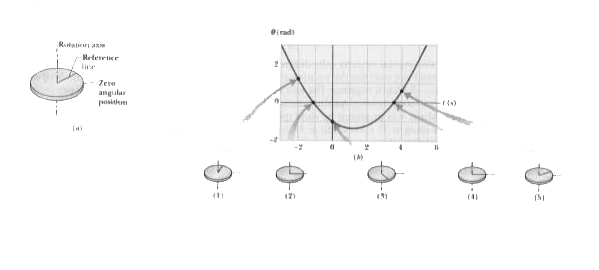 (b) To find the extreme value of a function, we take the first DERIVATIVE of the function and set the result to zero. Calculations: The first derivative of `theta(t)` is `(d theta)/(dt)=-0.600+0.500t` Setting this to zero and solving for t give US the time at which `theta(t)` is minimum: `t_(min)=1.20 s`. To get the minimum value of `theta`, we next substitute `t_(min)` into Eq. finding `theta=-1.36rad~~-77.9^(@)`. This minimum of `theta(t)` corresponds to the maximum clockwise rotation of the disk from the zero angular position, somewhat more than is shown in sketch 3. ( C) From the angular velocity `omega` is equal to `d theta//dt` as given in Eq. So, we have `omega=-0.600+0.500t`. The graph of this function `omega(t)` is shown in Fig. Because the function is linear, the plot is a straight line. The slope is 0.500 `rad//s^(2)` and the intercept with the vertical axis is -0.600 rad/s. Calculations: To sketch the disk at t = -2.0 s, we substitute that value into Eq., obtaining `omega=-1.6rad//s`. The minus sign here tells us that at t = -2.0 s, the disk is turning clockwise. Substituting t = 4.0 s into Eq. given us 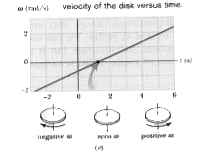 The implied plus sign tells us that now the disk is turning counterclockwise. For `t_(min)`, we already known that `d theta//dt=0`. So, we must also have `omega=0`. That is, the disk momentarily stops when the reference line reaches the minimum value of `theta` in Fig. as suggested by the center sketch in Fig. On the graph of `omega` versus t in Fig. this momentary STOP is the zero point where the plot changes from the negative clockwise motion to the positive counterclockwise motion. (d) Description: When we first observe the disk at t = -3.0s, it has a positive angular position and is turning clockwise but slowing. It stops at angular position `theta=-1.36` rad and then begins to turn counterclockwise, with its angular position eventually becoming positive again. |
|