

Saved Bookmarks
| 1. |
The volume charge density inside of sphere of radius R is given by rho = rho_(0) (1 - (r )/(R )) ,where rho_(0) is constant and r distance from centre. (a) Find total charge Q inside sphere. Electric field outside sphere at distance r from centre. (b) Electric field outside sphere at distance r from centre. (c) Electric field inside sphere at distance r from centre. (d) At what distance from centre electric field is maximum and its value? (e ) Sketch E versus r graph. |
|
Answer» Solution :To take element on spherical VOLUME , we choose a spherical shell of radius `r` and thickness `dr` Volume of element `dV = (4)/(3) pi ( r + dr)^(3) - (4)/(3) pi r^(3) = 4 pi r^(2) dr` (a) Small charge in small volume `dq = rho dV = rho_(0) (1 - (r )/(R )) 4 pi r^(2) dr` `Q = 4 pi rho_(0) int_(0)^(2) (r^(2) = (r^(3))/(R )) dr` `= 4 pi rho_(0) |(r^(3))/(3) - (r^(4))/(4 R)|_(0)^(R ) = 4 pi rho_(0) ((R^(3))/(3) - (R^(4))/(4R))` ` = (4 pi rho_(0) R^(3))/(12) = (pi rho_(0) R^(3))/(3)` (B) For apoint `(r gt R)`, whole charge is assumed to be concentrated at centre `E = (1)/(4 pi in_(0)) (Q)/(r^(2)) = (1)/(4 pi in_(0)) .(pi rho_(0) R^(3))/(3r^(2)) = (rho_(0) R^(3))/(12 in_(0)r^(2))`. `E` versus `r` will be rectangular hyperbola type . At `r = R , E = (rho_(0) R)/(12 in_(0))` (c ) For a point `(r lt R)` , change inside sphere of radius `r` `q = int_(0)^(r ) rho dV = int_(0)^(r ) rho_(0) (1 - (r )/(R)) 4 pi r^(2) dr = 4 pi rho_(0) int_(0)^(2) (r^(2) - (r^(3))/(R )) dr` `= 4 pi rho_(0) |(r^(3))/(3) - (r^(4))/(4 R)|_(0)^(R ) = 4 pi rho_(0) ((r^(3))/(3) - (r^(4))/(4 R))` `E = (1)/(4 pi in_(0)) .(q)/(r^(2)) = (1)/(4 pi in_(0)) . 4 pi rho_(0) ((r)/(3) - (r^(2))/(4 R))` `= (rho_(0))/(in_(0)) ((r)/(3) - (r^(2))/(4 R))`, `E` versus `r` will be parabola open downward. At `r = R , E = (rho_(0))/(in_(0)) ((R )/(3) - (R^(2))/(4R)) = ( rho_(0) R)/(12 in_(0))` (d) If `r gt R` i.e. outside sphere , electric field is decreasing CONTINUOUSLY as `E = (rho_(0) R^(3))/(12 in_(0) r^(2))` The electric field will be maximum inside sphere `(r lt R)`, `E =(rho_(0))/(in_(0)) ((r )/(3) - (r^(2))/(4 R))` For `E` to be maximum `(dE)/(dr) = (rho_(0))/(in_(0)) ((1)/(3) - (2 r)/(4 R)) = 0rArr r = (2 R)/(3)` `E_(MAX) = (rho_(0))/(in_(0)) [(2R)/(9) - (R )/(9)] = (rho_(0) R)/(9 in_(0))` (e ) `E` versus `r` graph 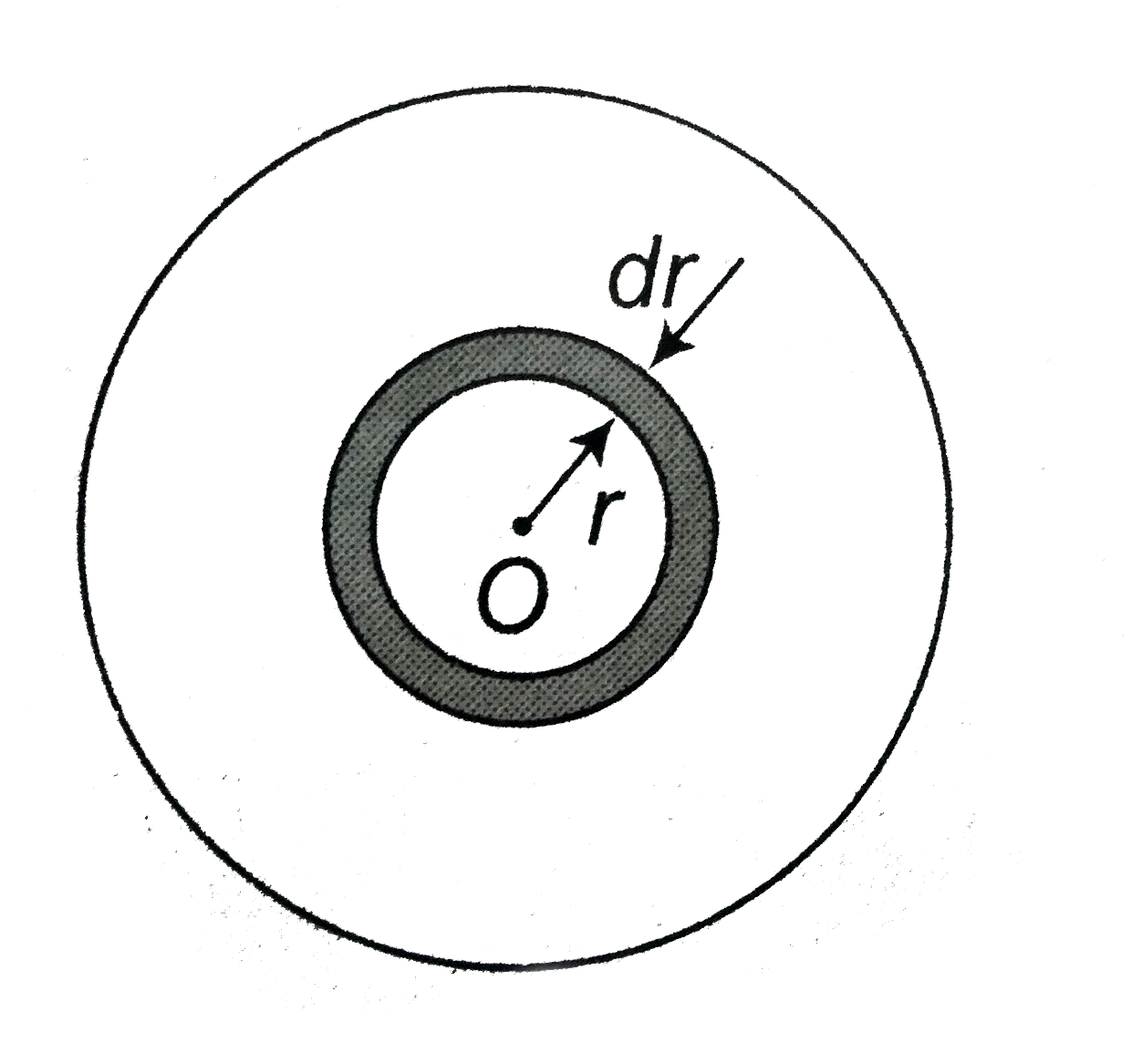 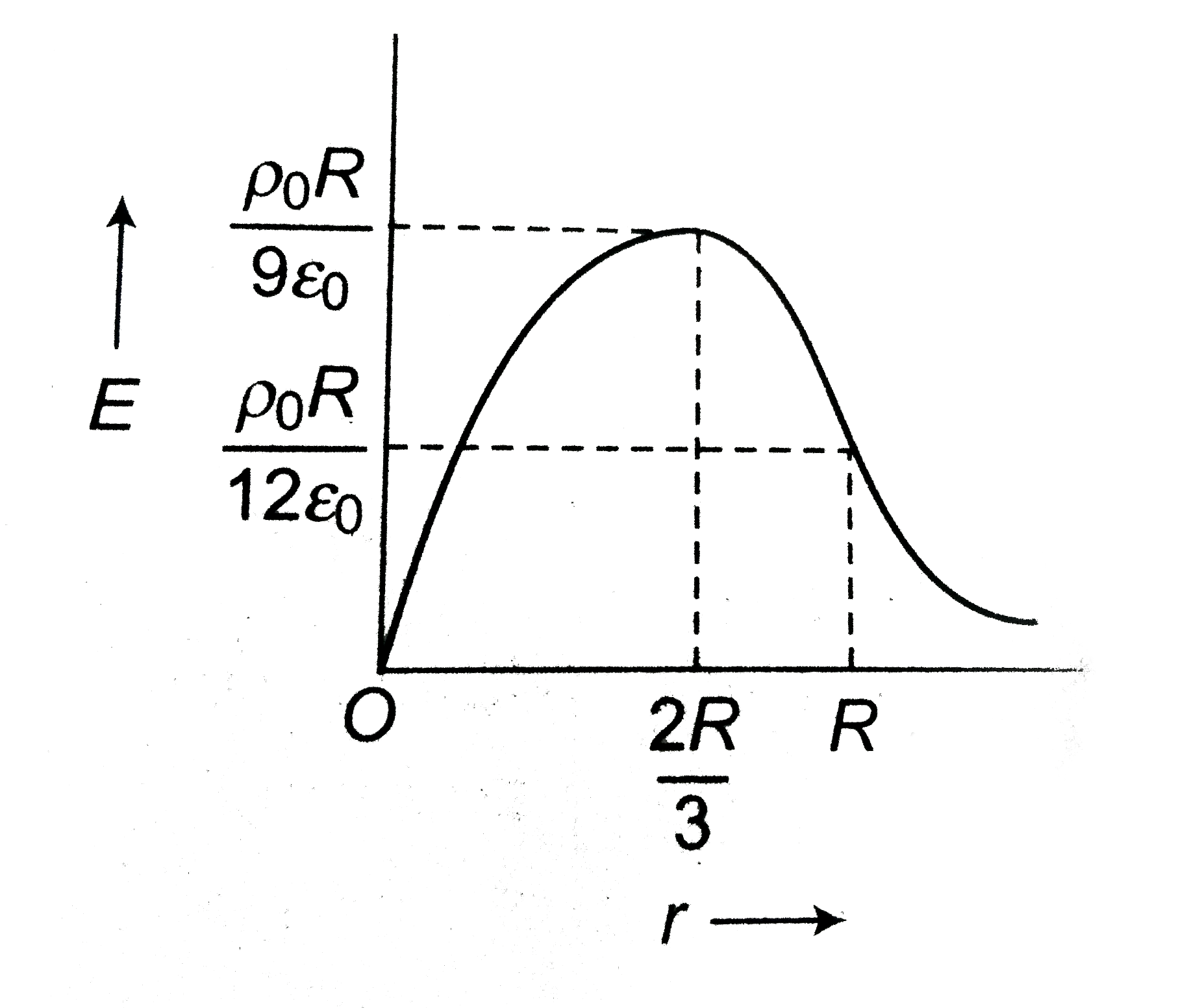
|
|