

Saved Bookmarks
| 1. |
The Young's double-slit experiment is done in a medium of refractive index 4//3. A light of 600 nm wavelength isfalling on the slits having 0.45 mm separation. The lower shift S_(2) is covered by a thin glass sheet of refractive index. 1.5. The interference pattern is observed on a screen placed 1.5 mfrom the slits as shown in Figure a. Findthe location of central maximum (bright fringe with zero path difference) on the y-axis. b. Find the light intensity of point O relative to the maximum fringe intensity. c. Now , if 600 nm light is replaced by white light of range 400 - 700 nm, find the wavelengths of the light that from maxima exaclty at point O. (All wavelength in the problem are for the given medium of refractive index 4//3 Ignoe dispersion.) |
|
Answer» Solution :GIVEN `lambda nm = 6 xx 10^(-7) m, d = 0.45 MM = 0.45 xx 10^(-3) m, D = 1.5`. Thickness of glass sheet, `t = 10.4 mu m = 10.4 xx 10^(-6)m`. Refractive index of glass sheet, `mu_(g) = 1.5`. a. LET central maximum is obtained at a distance y below point O.Then, `Delta x_(1) = S_(1) P - S_(2) P = (yd)/(D)` Path difference due to glass sheet, `Delta x_(2) = (mu_(g)/(mu_(m) - 1 )) t` New path diffenence will be zero when `Deltax_(1) = Delta x_(2)` `implies (yd)/(d) = ((mu_(g))/(mu_(m)) - 1) t` `implies y = ((mu_(g))/(mu_(m)) - 1) t (D)/(d)` Subsituting the value, we have `y = ((mu_(g))/(mu_(m))-1)t (D)/(d)` or we can say `y = 4.33 mm.` a. At O, `Delta x_(1) = 0` and `Delta x (2) = ((mu_(g))/(mu_(m)) - 1)t` `:.` Net path difference `Delta x = Delta x_(2)` Corresponding phase difference, `Detla phi` or simply ` phi = (2 pi)/(lambda) Delta x`. Substituting the values, we have `phi = (2 pi)/(6 xx 10^(-7)) ((1.5)/(4//3) -1) (10.4 xx 10^(-6)) = ((13)/(3)) pi` Now, `I (phi) = I_(max) cos^(2) ((phi)/(2))` `I = I_(max) cos^(2) ((13 pi)/(6))` `= (3)/(4) I_(max)` At O, path difference is `Delta x = Delta x_(2) = ((mu_(g)) /(mu_(m) - 1)) t` For maximum intensity at O, ` Delta x = n lambda`(here `n = 1, 2, 3,...)` `lambda = (Delta x)/(1), (Delta x)/(2), (Delta x)/(3),....` and so on `Delta x = ((1.5)/(4//3) - 1) (10.4 xx 10^(-6) m)` `= ((1.5)/(4//3) - 1) (10.4 xx 10^(-3) nm` `= 1300 nm` Maximum intensity will be corresponding to `lambda 1300 nm, (1300)/(2) nm, (1300)/(3) nm, (1300)/(4) nm,...` `= 1300 nm, 650 nm, 433.33 nm, 325 nm,...` The wavelength in the range 400 to 700 nm are 650 nm and 433.33 nm. 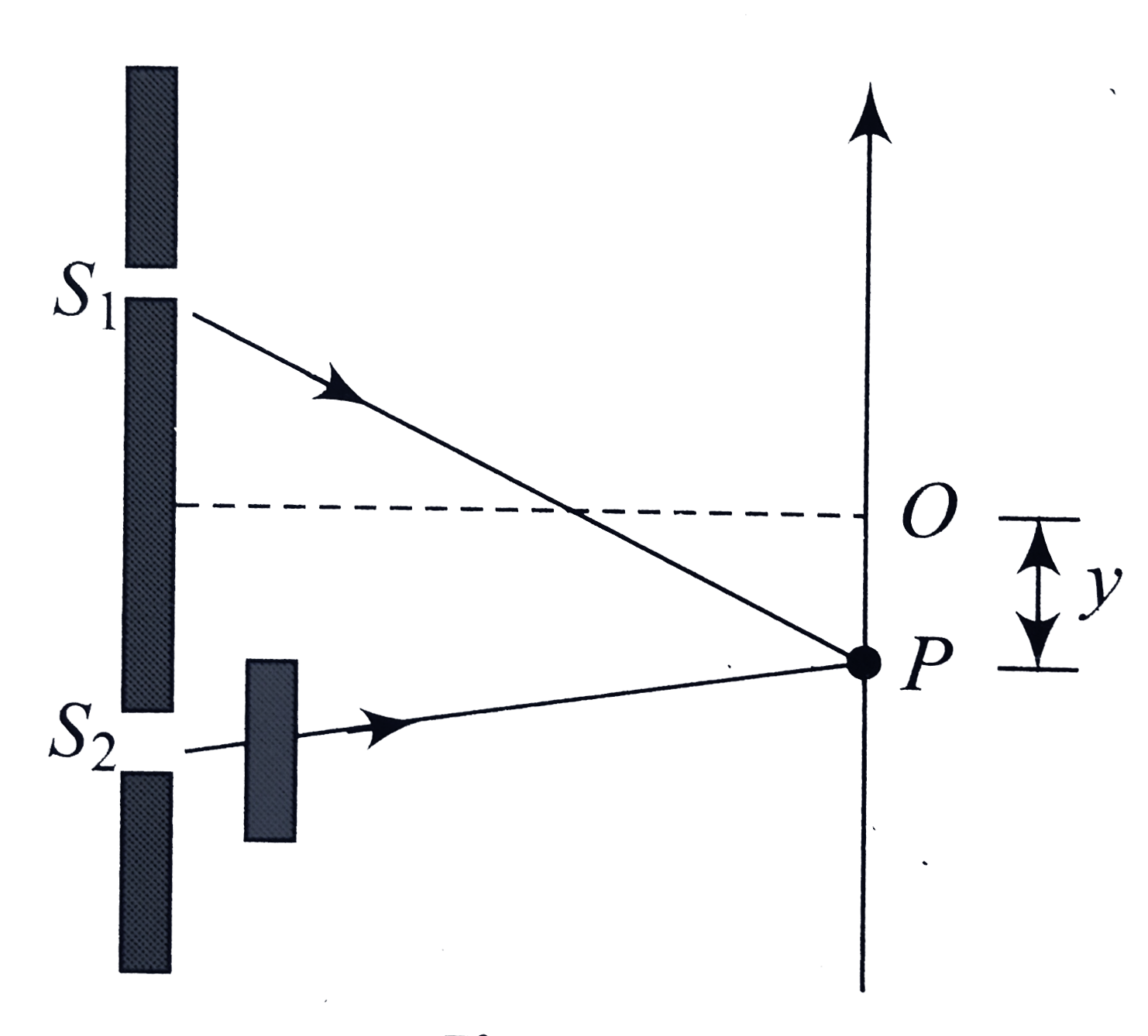
|
|