

Saved Bookmarks
| 1. |
There is a, and four charges +q, +q, -q and -q are fixed at the four corners of square. See the figure for the placement of charges. Calculate: (i) Electric potential at point O. (ii) Work done to move a charge +e from point O to point B. (iii) Work done to move a charge +e from point O to A. |
Answer» Solution :The given arrangement is shown below: 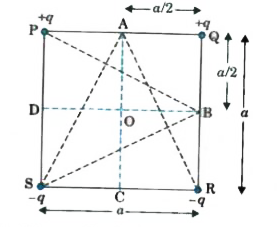 Let the distance of each point charge from O be r. Then `r=OP=OQ=OR=OS` Also, `PR^(2)=PS^(2)+SR^(2)` Here, `PS=SR=RQ=PQ=a` `therefore PR^(2)=a^(2)+a^(2) rArr PR=sqrt(2)a` `therefore r=PO=(sqrt(2)a)/(2)=(a)/(sqrt(2))` (i) Potential at the centre O is : `V_(O)=(1)/(4pi epsilon_(0))[(q)/(r )+(q)/(r )-(q)/(r )-(q)/(r )]=0` (ii) To find the work done to move a charge from O to B, we NEED to first find the electric potential at point B. Potential at point B will be given by: `V_(B)=(1)/(4pi epsilon_(0))[(q)/(PB)+(q)/(QB)-(q)/(RB)-(q)/(SB)]` Also, `PB^(2)+PD^(2)+DB^(2)` `=((a)/(2))^(2)+a^(2)=(5a^(2))/(4)` `rArr PB=(sqrt(5)a)/(2)` Also, `SB=PB=(sqrt(5)a)/(2) and QB=RB=(a)/(2)` `therefore V_(B)=9xx10^(9)[(q)/((sqrt(5a))/(2))+(q)/((a)/(2))-(q)/((a)/(2))-(q)/((sqrt(5)a)/(2))]=0` Since, `V_(B)=V_(O)=0` `therefore` No work will be done on moving a charge from O to B. (III) To find the work the work done to move a charge from O to A, we need to first find the electric potential at point A. Potential at point A will be given by: `V_(A)=(1)/(4pi epsilon_(0))[(q)/(PA)+(q)/(QA)-(q)/(RA)-(q)/(SA)]` Also, `RA^(2)=AC^(2)+CR^(2)=a^(2)+((a)/(2))^(2)=(5a^(2))/(2)` `rArr RA=(sqrt(5)a)/(2)` Also, `SA=RA=(sqrt(5)a)/(2) and PA=QA=(a)/(2)` `therefore V_(A)=9xx10^(9) [(a)/((a)/(2))+(q)/((a)/(2))-(q)/((sqrt(5)a)/(2))-(q)/((sqrt(5)a)/(2))]` `=9xx10^(9)[(2q)/((a)/(2))-(2q)/((sqrt(5)a)/(2))]` `=9xx10^(9)[(4q)/(a)-(4q)/(sqrt(5)a)]` `=(9xx10^(9)xx4q)/(a)[1-(1)/(sqrt(5))]` `=(36q)/(a)xx10^(9) (1-(1)/(sqrt(5)))` `therefore` Work done in moving a charge +E from O to A will be: (this work is done by an external agent so its potential differenceis taken as final minus initial) `V_(A)-V_(O)=(W_(OA))/(e )` `rArrV_(A)-0=(W_(OA))/(e )` `rArr W_(OA)=eV_(A)=e xx (36q)/(a) xx 10^(9)(1-(1)/(sqrt(5)))` `=(36qe)/(a)xx10^(9)(1-(1)/(sqrt(5)))` |
|