

Saved Bookmarks
| 1. |
There is a hemisphere whose radius of curvature is r and inner side of it is made completely reflecting . A point source of light of power P is kept at the centre of curvature of hemisphere . Calculate the force exerted by the light falling on inner side of hemispherical surface. |
Answer» Solution :If P is power of point source , then intensity of light which means energy crossing per unit area per unit time can be WRITTEN as `P//4pir^2` . Let us select a small are `DeltaA` at angle `THETA` with the vertical radius of hemisphere as shown in the following figure: 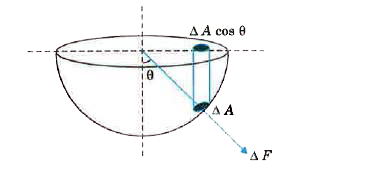 Amount of energy falling on this area will be `(PDeltaA)/(4pir^2)` per unit time . Hence , amount of linear momentum imparted to the surface per unit time can be written as `(PDeltaA)/(4pir^2c)` . Since surface is COMPLETELY reflecting and hence it will reflect back the light and hence rate of change of linear momentum will be double to this value , hence equal to `(2PDeltaA)/(4pir^2c)` . From Newton.s second law , we known that rate of chane of linear momentum is equal to the force exerted , and hence force exerted by the light on the surface area `DeltaA` selected can be written as follows : `DeltaF=(2PDeltaA)/(4pir^2c)` We can see that horizontal component of this force `DeltaF sin theta` will be balanced by the force on corresponding area selected on hemisphere due to symmetry , and hence CONTRIBUTION to the net force by this selected area will be `DeltaF COS theta` and direction will be vertically downward as per figure . Net vertical downward force applied by the light on this hemisphere can be calculated by summig up forces on such small areas selected . `F=sumDeltaFcostheta=sum(2PDeltaAcostheta)/(4pir^2c)` `F=(2P)/(4pir^2c)sumDeltaAcostheta""...(i)` In the above expression , we can see that `DeltaA cos theta` is projected area of selected are `DeltaA` as shown in figure . We can understand that total projected area will be `pir^2` and hence force can bewritten as follows : `F=(2P)/(4pir^2c)pir^2=P/(2c)` |
|