

Saved Bookmarks
| 1. |
There is one cylindrical vessel whose height and diameter are both equal to D. An observer's eye is placed in such a manner that bottom edge of the vessel is just visible to eye. There is a point P at the bottom of container at a distance x from the centre of container as shown in the figure. Up to what height the liquid of refractive index mu should be poured in the vessel so that point P is visible to the eye? |
Answer» Solution :From the FIGURE GIVEN below we can understand that he need to put liquid up to a height so that after REFRACTION from liquid up to a height sothat after refraction from liquid light ray from POINT P is refracted along the line of vision . Line of vision of eye is at `45^(@)` because we know that height and diameter of vessel both are equal to D . LET h be the height of liquid poured. 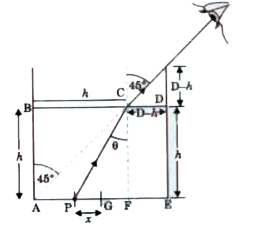 We can see in the figure that the angle of incidence of light ray from point P is equal to `theta`. Let us apply Snell.s law at point C in the diagram . `mu sin theta = sin 45^(@)` `sin theta = (1)/(mu sqrt2)"" ... (i)` Further from the figure we can write the following : PF = PE - FE `implies PF = (D//2 + x) - (D - h)` `impliesPF = x + h - D//2 ... (ii)` Further from the figure we can write the following : `tan theta = (PF)/(CF)` `implies tan theta = (x + h - (D)/(2))/(h) "" ... (iii)` Now from equation (i) we can write the following : `tan theta = (1)/(sqrt(2 mu^(2) - 1)) "" ... (iv)` From equation (iii) and (iv) we can write the following : From equation (iii) and (iv) we can write the following : `(x + h- D/2)/(h) = (1)/(sqrt(2mu^(2) - 1))` `implies "" (2x + 2h - D)/(2h) = (1)/(sqrt(2mu^(2) - 1))` `implies (2x - D) (sqrt(2 mu^(2) - 1)) + 2h (sqrt(2mu^(2) - 1)) = 2h` `implies (2x - D) (sqrt(2mu^(2) - 1)) = 2h (1- sqrt(2mu^(2) - 1))` `impliesh = ((2x - D) (sqrt(2mu^(2) - 1)))/(2 (1 -sqrt(2mu^(2) - 1)))` |
|