

Saved Bookmarks
| 1. |
This problem is quite challenging in setting up but takes only a few of algebra to solve. We deal with not only uniformly circular motion but also a ramp. However we will not need a tilted coordinate system as with other ramps. Insttead we can take a freeze frame of the motion and work with simply horizontaly and vertical axes. As always in this chapter, the starting point will be to apply Newton's second law, but that will required us to identify the force component that is responsible for the uniform circular motion. Curved portions of highways. are always banked (tilted) to prevent cars from sliding off the highway. When a highway is dry, the frictional force between thetires and the road surface may be enough to prevent sliding. When the highway is wet, however, the frictional force may be neglifible, and baking is then essential. fig represents a car of mass m as it moves at a constant speed v to 20m/s around a banked circular track of radius R=190m. (It is a normal car, rather than a race car, which meas that any vertical force from the passing air is negligible). If the frictional force from the track is negligible, what bankangle theta prevents sliding? |
|
Answer» Solution :Here the track is banked so as to TILT the normal force `vecF_(N)` on the car toward the center of the circle. Thus `vecF_(N)`, now has a centripetal component of magnitude `F_(Nr)`,directed inward along a radiua axis r. We want to find the value off the bank ANGLE `theta` such that this centripetal component keeps the car onthe circular track witout need of friction. Radial calculation: As fig shows (and as you should verity), the angle that force `vecF_(N)` makes with the verical is equal to the bank angle `theta` of the track. Thus, the radial component `F_(Nr)` is equal to `F_(N)sin theta`. We can now write Newton.s second law for components along the r axis `(F_("net",r)=ma_(r))` is `-F_(N)-sin theta m(-(v^(2))/R)` We cannot solve this equation for the value of `theta` because it also contains the unknowns `F_(N)` and m. Vertical calculations: We NEXT consider the forces and acceleration along the y axis in fig. The vertical component of the normal force is `F_(Ny)=F_(N) cos theta`, the gravitational force `vecF_(g)` on the car has the magnitude mg and the acceleration of the car along the y axis is ZERO. Thus we ca write Newton.s second law for components along the y axis `(F_("net",y)=ma_(y))` as `F_(N)cos theta-mg=m(0)` From whcih `F_(N)cos theta=mg` Combining results: Equation also contains the unknowns `F_(N)` and m but note that dividing EQ. by eq neatly eliminates both those unknowns. Doing se replacing `(sin theta)//(cos theta)` with `tan theta`, and solving for `theta` then yield `theta=tan^(-1)(v^(2))/(gR)` `="tan"^(-1)((20m//s)^(2))/((9.8m//s^(2))(190m)=12^(2)` 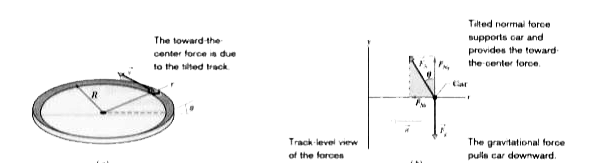
|
|