

Saved Bookmarks
| 1. |
Three concentric, thin, spherical, metallic shells have radii 1, 2, and 4 cm and they are held at potentials 10, 0 and 40 V respectively. Taking the origin at the common centre, calculate the following: (a) Potential at r = 1.25 cm (b) Potential at r = 2.5 cm (c) Electric field at r =1.25 cm |
Answer» 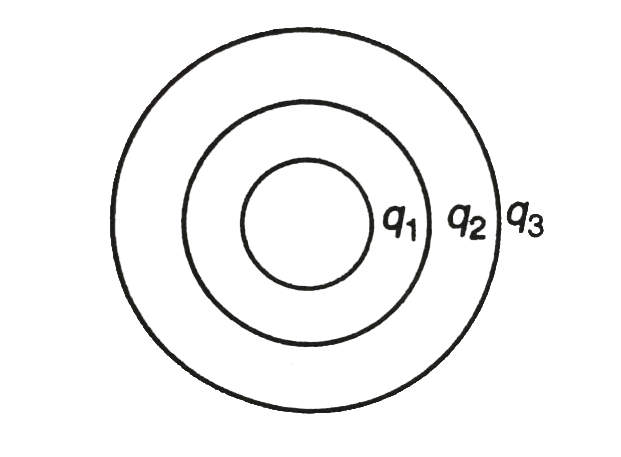 `=10=(9xx10^9)/10^-2[q_1/1+q_2/2+q_3/4]` =0(9xx10^9)/10^-2[q_1/2+q_2/2+q_3/4]` and `40=(9xx10^9)/10^-2[q_1/4+q_2/4+q_3/4]` SOLVING these equations we get `q_1=+200/9x10^-12C,q_2=-200xx10^-12` and `q_3=3200/9xx10^-2C` a. At `r=1.25cm` `V=(9xx10^9)/10^-2[((200/9)x10^-12)/1.25(200xx10^-12)/2+((3200/9)x10^-12)4]` `=6V` b. Potential at `r=2.5 cm` `V=(9xx10^9)/10^-2[((200/9)xx10^I-12)/2.5-(200xx10^-12)/2.5+((3200/9)xx10^-12)/4]` `=16V` c. Electric field at r=1.25` cm will be due to charge `q_1` only `:. E=1/(4piepsilon_0.q_1/r^2` ltbr. `=((9xx10^9xx(200/9)xx10^-12)/((1.25xx10^-2)^2)` `=1.28xx10^3V/m` |
|