

Saved Bookmarks
| 1. |
To know the resistance of a galvanometer by half deflection method, a battery of emf V and resistance R is used to deflect the galvanometer by angle theta . If a shunt of resistance is needed to get half deflection then, G, R and S are related by the equation : |
|
Answer» `2S (R + G) = RG` 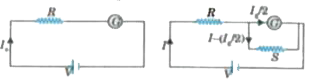 In first case Resistance R is connected in series with the galvanometer and CURRENT `(I_(g))`FLOWING through it can be written as follows: `I_(g) = V/(R + G) ` ....(i) In second case shunt S is connected in parallel to the galvanometer. TOTAL current (I) drawn from the battery can be written as follows: `I = V/(R + (GS)/(G + S)) ` ....(ii) Shunt is adjusted in such a manner that deflection in the galvanometer becomes half to that in first case. Hence `I_(g)/2` current passes through the galvanometer and`(I - I_(g)/2)`current passes through the shunt. For the same potential difference across galvanometer and shunt we can write the following equation. ` I_(g)/2 G = (I - I_(g)/2)S` ` rArr"" I_(g)/2 (G + S) = IS` Substituting values from equation (i) and (ii) we can rewrite the above expression as follows: `rArrV/(2(R+G))(G+S) = V/(R+(GS)/(G+S)) S` `rArr((G + S))/(2(R + G)) = (S(G + S))/(RG + RS + GS)` `rArrRG + RS + GS = 2RS + 2GS` ` RG = S (R + G)` Hence option (b ) is correct. |
|