

Saved Bookmarks
| 1. |
Total internal reflection in a prism What is the relationship between A and n so, that no rays come out of second face ? |
|
Answer» Solution :(1) Here we want to choose the refractive index of the prism such that a RAY will always undergo TOTAL internal reflection . NOTE that this total internal reflection can occur only when the light ray goes from DENSER to rarer medium. In other words, this will occur only when the ray is INCIDENT on the second surface. (2) The situation implies that for the smallest angle `r_(2)` also, the total internal reflection should occur. (3) `r_(1)+r_(2)=A`. So, when `r_(2)` is minimum `r_(1)` is maximum. The angle of incidence `i` is also maximum by Snell.s law. But the maximum angle of incidence can be `90^(@)`. This problem implies that if a total internal reflection occurs when angle of incidence is `90^(@)`, then total internal reflection will occur at all the angles Calculation : Applying Snell.s law at the first surface `1xxsin90^(@)=nsinr_(1)` `r_(1)=sin^(-1)((1)/(n))` `r_(2)=A-sin^(-1)((1)/(n))` But for total internal reflection at the second surface : `r_(2) gt theta_(c )` `sinr_(2) gt 1sintheta_(c )((1)/(n))` `A-sin^(-1)((1)/(n)) gt sin^(-1) ((1)/(n))` Thus, the condition becomes `n gt cosec((A)/(2))`. Note : Many optical instruments such as binoculars periscopes, and telescopes, use glass prisms and total internal reflection to turn a beam of light through `90^(@)` or `180^(@)`. 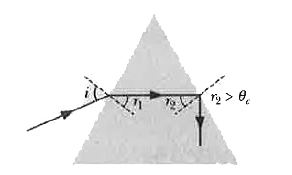
|
|