

Saved Bookmarks
| 1. |
Trace the ays of light showing the formation of an image due to a point object placed on the axis of a spherical surface separating the two media of refractive indices n_(1) and n_(2). Establish the relation between the distance of the object, the image and the radius of curvature from the central point of the spherical surface. Hence derive the expression of the lends maker's formula |
|
Answer» Solution :Refraction of shperical surface: (a) Sign conventions : (i) All distances are measured from the pole of the spherical surface. (ii) Distance measured in the direction of incident light are taken positive. (iii) Distances measured in the opposite direction of incident light are negative. Assumptions : (i) The object is a point object placed on the principal axis. (ii) APerture of the refracing surface is SMALL. (iii) Angle of incidence and angle of refraction are small. I is the real image of a point O placed on the principal axis of spherical surface with centre of curvature C, the radius of curvature R. The rays are incident from a medium of refractive index `n_(1)` to refractive index `n_(2)`. For samll aperture, NM will be taken to the length of the perpendicular from N to principal axis. 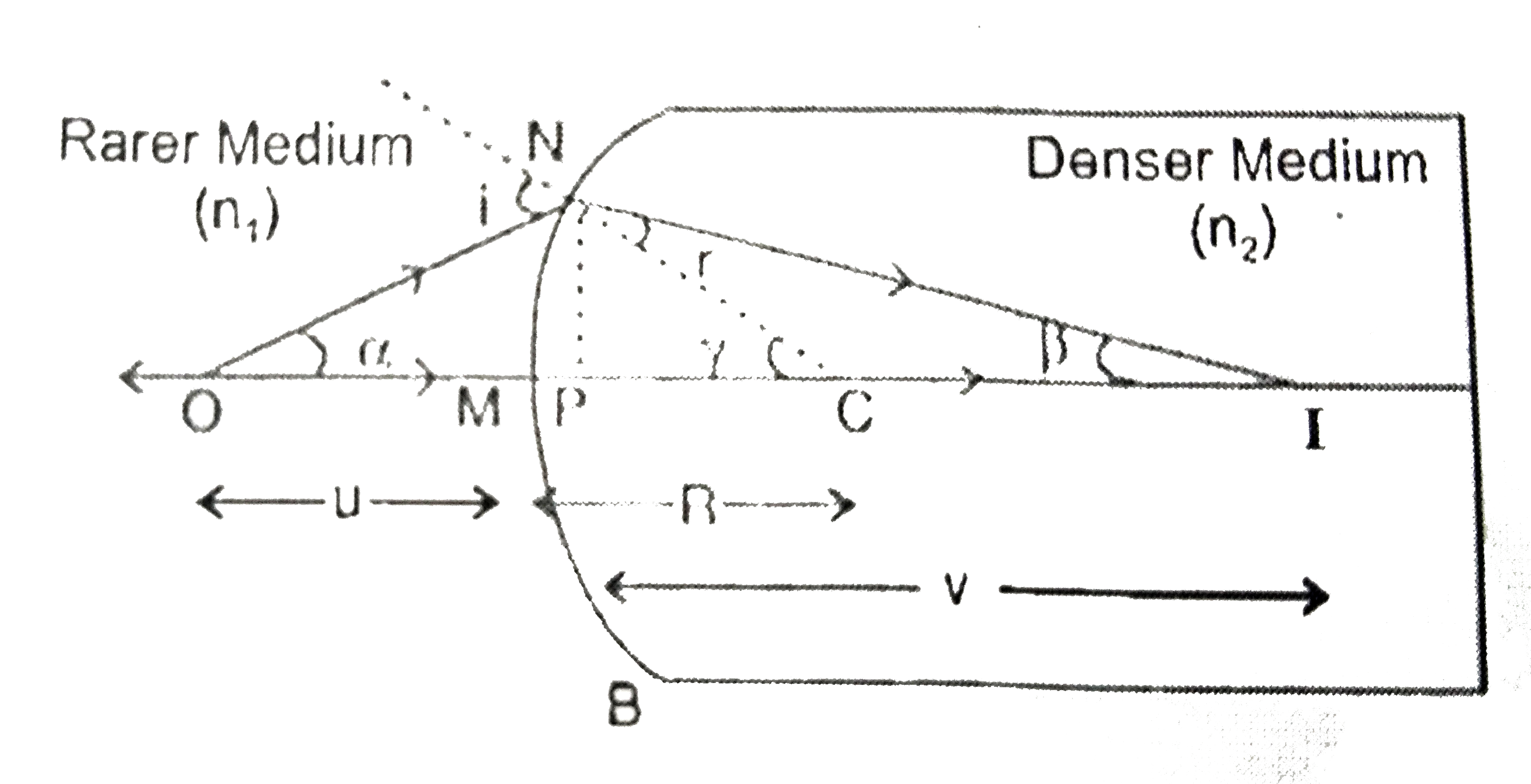 We have, For small angles `tan angleNOM = angleNOM = (MN)/(OM)` `tan angleNCM = angleNCM = (MN)/(MC)` `tan angleNIM = angleNIM = (MN)/(MI)` Exterior angle `i = angle NOM + angleNCM` `i = (MN)/(OM) + (MN))/(MC)`..(i) and `r = angleNCM - angle NIM` `r = (MN)/(MC) - (MN)/(MI)`...(ii) By Snell's law `(sin i)/(sin r)= (n_(2))/(n_(1))` For small angles, `(i)/(r) = (n_(2))/(n_(1))` `:. n_(1) i = n_(2) r` ...(iii) Putting the values of i and r in eq. (iii) `n_(1) ((MN)/(OM) + (MN)/(MC)) = n_(2) ((MN)/(MC) - (MN)/(MI))` Dividing by MN `(n_(1))/(OM) + (n_(1))/(MC) = (n_(2))/(MC) - (n_(2))/(MI) rArr (n_(1))/(OM) + (n_(2))/(MI) = (n_(2))/(MC) - (n_(1))/(MC) rArr (n_(1))/(OM) + (n_(2))/(MI) = (n_(2) - n_(1))/(MC)` Using Cartesian sign convention, `OM = - u, MI = + v, MC = + R " " :. (n_(1))/(-u) + (n_(2))/(v) = (n_(2) - n_(1))/(R)` or `(n_(2))/(v) - (n_(1))/(u) = (n_(2) - n_(1))/(R)` (b) Lens Maker's Formula : The image of point object O is formed in TWO steps. The first reflecting surface forms the image I, of the object O. The image `I_(1)` acts as a virtual object for formation of image I by the second surface. For the first surface ABC 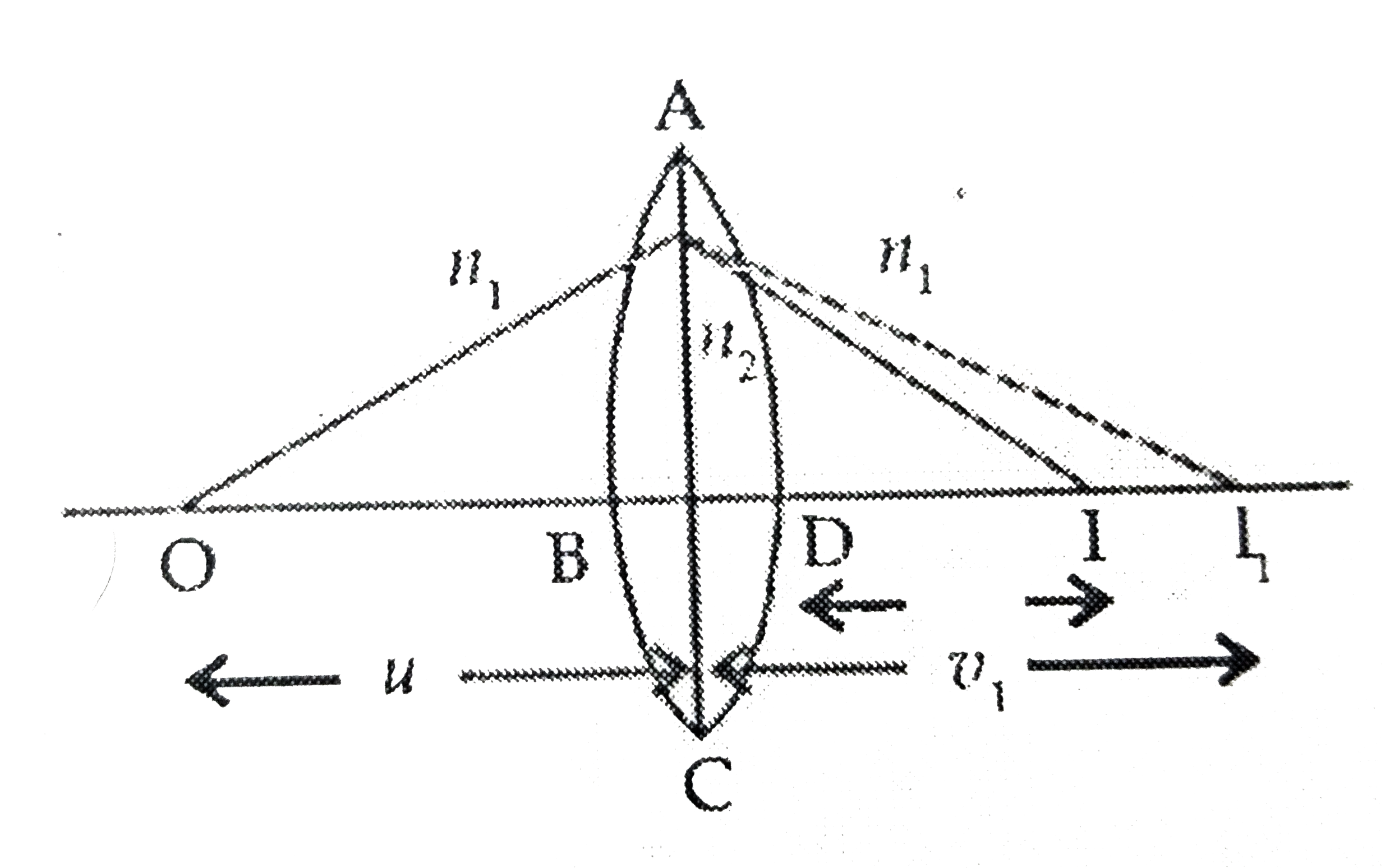 `[ :' (-n_(1))/(U) + (n_(2))/(V) = (n_(2) - n_(1))/(R)]` `(-n_(1))/(OB) + (n_(2))/(BI_(1)) = (n_(2) - n_(1))/(BC_(1))`..(i) For the second surface ADC `(-n_(1))/(DI_(1)) + (n_(2))/(DI) = (n_(2) - n_(1))/(DC_(2))` For a thin lens, `BI_(1) = DI_(1)` `:. (-n_(2))/(BI_(1)) + (n_(1))/(DI) = (n_(2) - n_(1))/(DC_(2))`..(ii) On adding eq. (i) and (ii), we get, `(-n_(1))/(OB) + (n_(1))/(DI) = (n_(2) -n_(1)) [(1)/(BC_(1)) + (1)/(DC_(2))]` If the object is at infinity `:. OB = oo` and I is at the focus of the lens `:. DI = f` (focal length of convex lens] `(-n_(1))/(oo) + (n_(1))/(f) = (n_(2) - n_(1)) [(1)/(BC_(1)) + (1)/(DC_(2))]` By the sign convention, `BC_(1) = + R_(1) and DC_(2) = - R_(2)` `:. (n_(1))/(f) = (n_(2) - n_(1)) ((1)/(R_(1)) - (1)/(R_(2))) rArr (1)/(f) = ((n_(2))/(n_(1)) - (n_(1))/(R_(2))) ((1)/(R_(1)) - (1)/(R_(2))) rArr (1)/(f) = (n_(21) - 1) ((1)/(R_(1)) - (1)/(R_(2)))` `(1)/(f) = (n-1) ((1)/(R_(1)) - (1)/(R_(2)))` where `n_(21) = n`, is the refractive index of material of the lens w.r.t. air |
|