

Saved Bookmarks
| 1. |
Twelve straight uniform wires of length a and resistance R are joined to form the edges of a cube of side a. Current enters the system at one corner andd leaves from a point on one of the edges meeting at the opposite corner at a distance Ka(ltKlt1) from it. Q. The equivalent resistance is maximum, when |
|
Answer» `K=(4)/(5)` 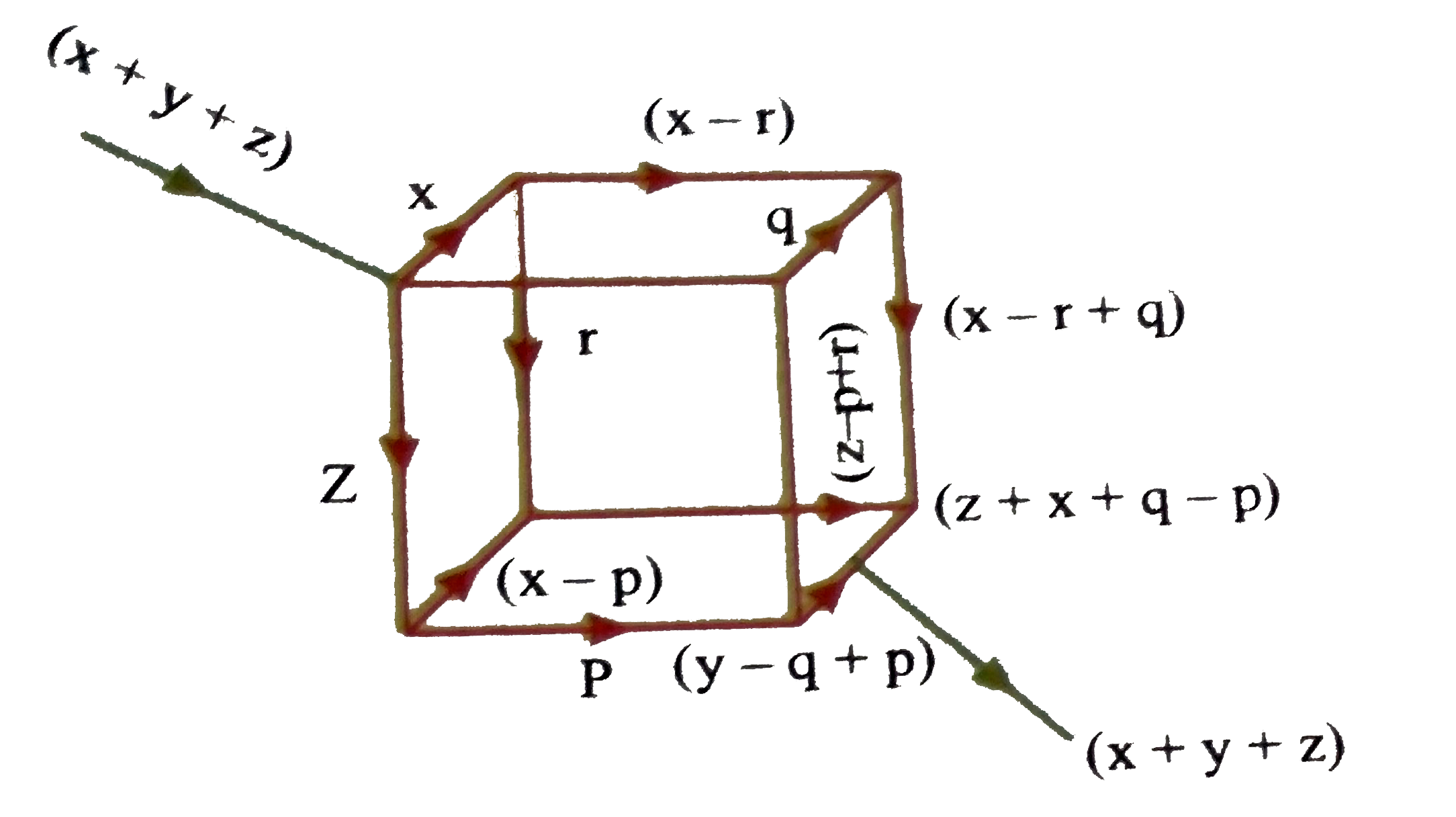 `Ry+R(y-q)-RP-RZ=0` (or) `2y-Z=p+q` ..(i) `Rx+Rr-R(z-p)-RZ=0` (or) `2z-x=r+P`.(ii) `Ry+Rq-R(x-R)-Rx=0` (or) `2X-y=q+r` ..(iii) THEREFORE `2p=3y+z-3x`..(iv) `2q=3x+y-3z`..(v) `2r=3z+x-3y`..(vi) Again `(x-r)+(x-r+q)=r+(z-p+r)` (or) `2x-z=4r-p-q` ..(vii) substituting values of p,q,r, we find `z=y` ..(viii) again `=(z-p)+(z-p+r)+K(z+x+q-p)` `=p+(1-K)(y-q+p)` this gives `K(2y+x)+8(x-y)=0` (or) `V=R[x+(x-r)+(x-r+q)+K(z+x+q-p)]` `V=R[(7x-2y)/(2)+2K(2x-)]` ..(10) `I=x+2y` ..(11) `(V)/(i)=Req=R[((7x-2y)+4K(2x-y))/(2(x+2y))]` `=(R)/(12)[10+4K-5K^(2)]` R is maximum when `K=(2)/(5)` and `R_(max)=(9R)/(10)` |
|