

Saved Bookmarks
| 1. |
Two capacitors C_(1) and C_(2) are charged seperately to potentials 20 V and 10V, respectively. The terminals of capacitors C_(1) and C_(2) are marked as (A-B) and (C-D), respectvely. A is connected with C and B is connected with D. i. Find the final potential dsifference across each eapacitors. ii. Findthe final charge in both capacitors iii. How much heat is produced in the circuit. |
|
Answer» `128muC` `142muC` `60 uJ` 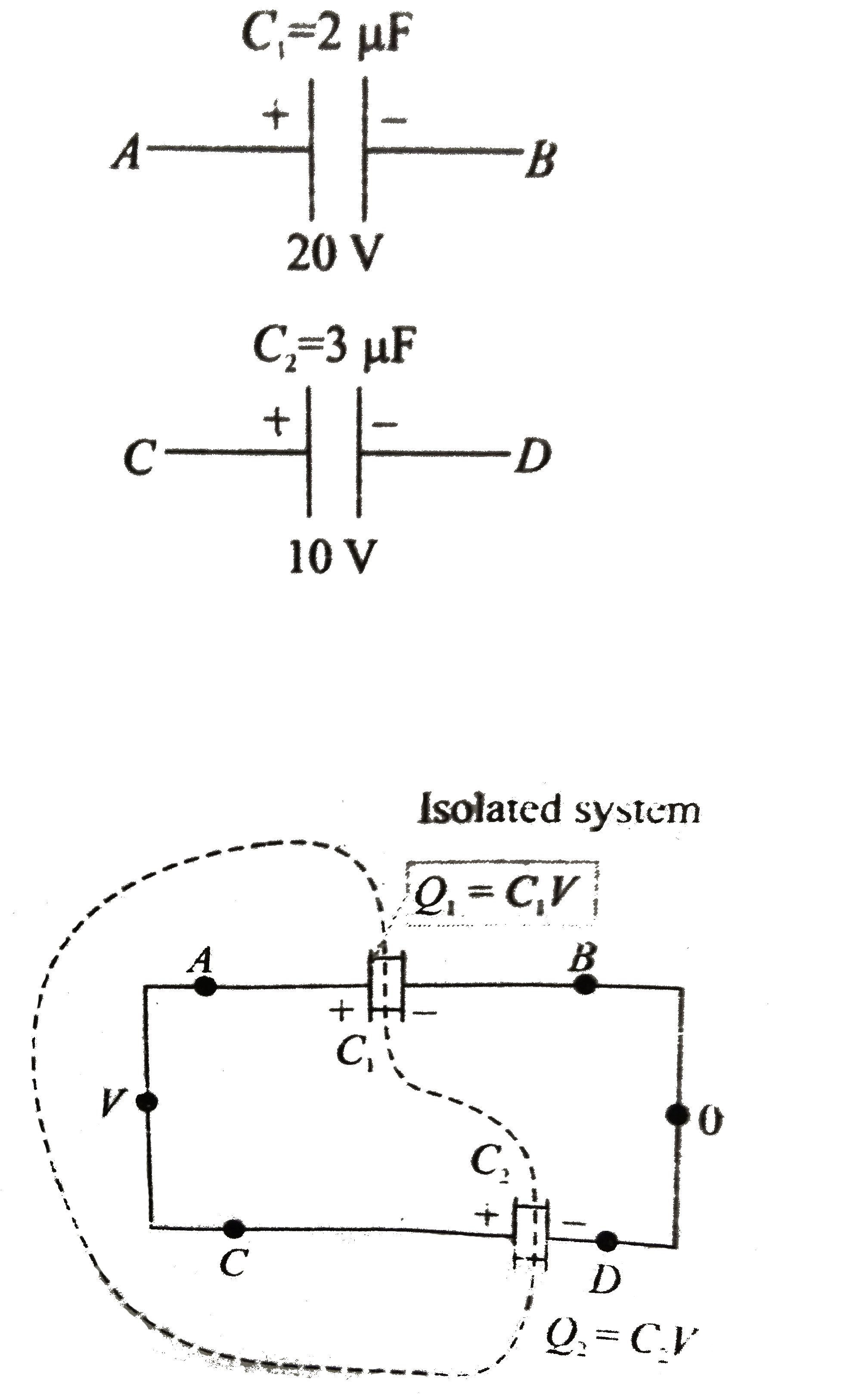 `(Q_(1))_("initial")=C_(1)V_(1)` `=2xx20=40 mu C` Initial charge in capacitor `C_(2)` is 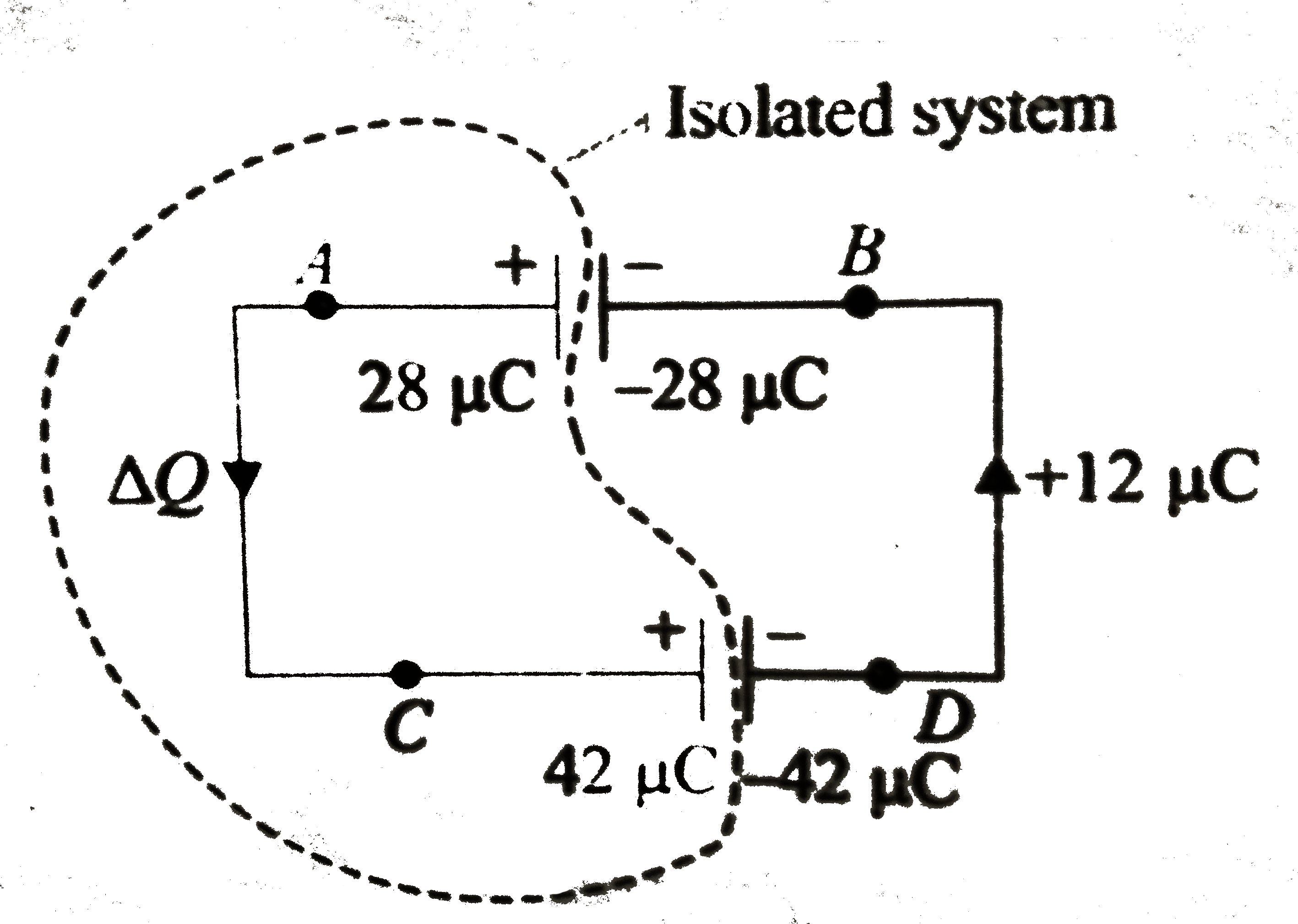 `(Q_(2))_("initial")=C_(2)V_(2)` `=3xx10=30muC` Let the potential of `B` and `D` be zero and the common potential difference across the capacitors be `V`, then the potentials at `A` and `C` will be `V`. FROMIT is clear that the left plates of capacitors `C_(1)` and `C_(2)` are forming an isolated system, i.e, they are not CONNECTED from outside. From chatrge conservation, `C_(1)V+C_(2)V=3V+2V` `=40+30` `5V=70` or `V=14 V` Final charge in capacitor `C_(1)` is `(Q_(1))_("final")=2xx14=28muC` Final charge in capacitor `C_(2)` is `(Q_(2))_("final") = 3 xx 14 = 42 mu C` The charge flowing in the ciruit in the direction from `A` to `C` is `Delta Q = 40-28=12mu C` Now final charges on each plate are SHOWN in. II. Heat produced in the circuit is `H=[1/2C_(1)V_(1)^(2)+(1)/(2)C_(2)V_(2)^(2)]-[1/2(C_(1)+C_(2))V^(2)]` `=[1/2xx2xx(20)^(2)+1/2xx3xx(10)^(2)]-[1/2xx5xx(14)^(2)]` `=400+150-490=550-490=60muJ`. |
|