

Saved Bookmarks
| 1. |
Two cells of emf E_1 and E_2 and internal resistance r_1 and r_2 are connected in parallel such that they send current in same direction. Derive an expression for equivalent resistance and equivalent emf of the combination. |
|
Answer» <P> SOLUTION :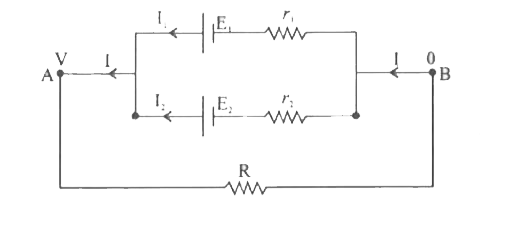 Let `I_1,I_2` representbranchcurrents . Let V be the commonpotential , so that , `I_1=(E_1-V)/r_1 , I_2=(E_2-V)/r_2` hence, `I=(E_1-V)/r_1 + (E_2-V)/r_2` i.E. `I=(E_1/r_1 + E_2/r_2) -V (1/r_1 +1/r_2)` Comparingthis with theterminalpotentialdifference, `V=E_(eq)-Ir_(eq)` i.e.,`V=E_(eq)-I/((I/r_(eq)))` For TWO cells in parallel combination, `(E_(eq))_p=(E_1/r_1 + E_2/r_2)/(1/r_1 + 1/r_2)=(E_1r_2 +E_2r_1)/(r_1+r_2)` `1/(r_(eq))_p=1/r_1 +1/r_2` , and main current= `I=E_(eq)/(R+r_(eq))` Note : (i) For n cells in parallel `V=[(sum_(i=1)^n E_i/r_i)/(sum_(i=1)^n 1/r_1)]-[I/(sum_(i=1)^n 1/r_i)]` `(E_(eq))_"parallel"=[(sum_(i=1)^n E_i/r_i)/(sum_(i=1)^n 1/r_i)]` `(1/r_(eq))_p = sum_(i-1)^n (1/r_i)` (ii) For .n. number of identical cells E-emf of each CELL r-internalresistance of each cell. `(E_(eq))_p=(n(E/r))/(n(1/r))` i.e., `(E_(eq))_p=E` and `(1/r_(eq))_p=n(1/r)` i.e. `(r_(eq))_p=r/n` Main current , `I=(nE)/(R+n/r)` and terminal potentialdifference across cells V=IR. |
|