

Saved Bookmarks
| 1. |
Two charges q_(1) and q_(2) are placed at (0,0,d) and (0,0,-d) respectively. Find icons of points where the potential is zero. |
|
Answer» Solution :In fig, we haveshown two charges `q_(1) (0,0,d) and q_(2) (0,0,d)`. For potential to be zero at (x,y,Z) we should have`(q_(1))/(4pi in_(0) sqrt(x^(2) + y^(2) + (z - d)^(2))) + (q_(2))/(4pi in_(0) sqrt(x^(2) + y^(2) + (z + d^(2)))= 0` `(q_(1))/(sqrt(x^(2) + y^(2) + (z - d^(2)))) = (-q_(2))/(sqrt(x^(2) + y^(2) + (z + d^(2))))`...(i) Clearly, total potential can be zero when `q_(1), q_(2)` have OPPOSITE signs. Sqaring both sides of (i), we GET `q_(1)^(2) [x^(2) + y^(2) + (z + d)^(2)] = q_(2)^(2) [x^(2) + y^(2) + (z - d)^(2)]` on simlifyingwe get`x^(2) + y^(2) + z^(2) + [((q_(1)//q_(2))^(2) + 1)/((q_(1)// q_(2))^(2) - 1)] (2zd) + d^(2) = 0`. This is the equaction of a sphere will center at `[0,0, -2d ((q_(1)^(2) + q_(2)^(2))/(q_(1)^(2) - q_(2)^(2)))]`. If `q_(1) = -q_(2)`, then `z = 0`. Therefore, locus of pointswhere potential is zero is the plane through MID pointof the two charges. 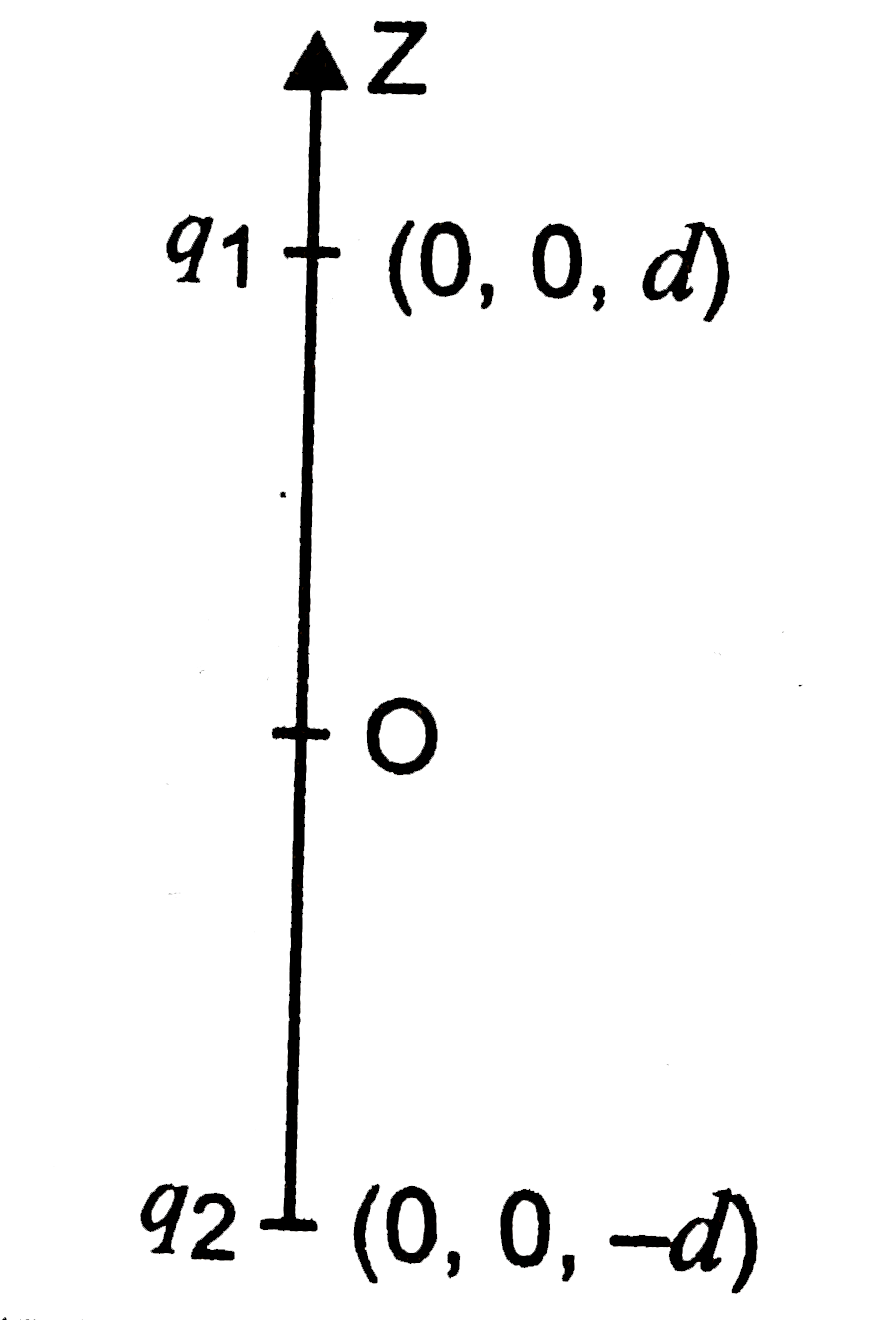
|
|