

Saved Bookmarks
| 1. |
Two charges -q and +q are located at points (0,0,-a) and (0,0,a) respectively. a. What is the electrostatic potential at the points (0,0,z) and (x,y,0)? b. Obtain the dependence of potential on the distance r of a point from the origin which r/a gt gt 1. c. How much work is done in making a small test charge from the point (5,0,0), (-7,0,0) along the x-axis? Does the answer change if the path of hte test charge between the same points is not along the x-axis? |
|
Answer» Solution :a. The configuration is similar to dipole. `V=V_(1)+V_(2) =(1)/(4pi epsi_(0)) ((q)/(z-a))+(1)/(4pi epsi_(0)) ((-q))/((z+a))` `=(q)/(4pi epsi_(0)) ((1)/(z-a) -(1)/(z+a))` `=(1)/(4pi epsi_(0)) xx q (z+a-a+a)/(z^(2)-a^(2))=(p)/(4pi epsi_(0) (z^(2)-a^(2))` 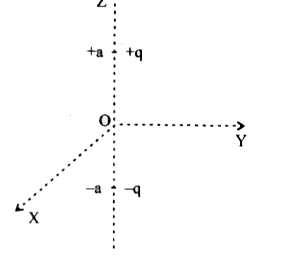 In the case of (x,y,0), it is the EQUATORIAL plane and hence potential is ZERO. (b). The denpendence on R is as `1/r^(2)` TYPE. (c). Zero. No, because work done by electrostatic field between two points in independent of the path concecting the two points. |
|