

Saved Bookmarks
| 1. |
Two coherent monochromatic point sources S_1 and S_2 of wavelength lambda = 600 nm are placed symmetrically on either side of the centre of the circle as shown. The sources are separated by a distance d = 1.8 mm. This arrangement produces interference fringes visible as alternate bright and dark spots on the circumference of the circle. The angular separation between two consecutive bright spots is Delta theta. Which of the following options is/are correct ? |
|
Answer» The TOTAL number of fringes produced between `P_1 and P_2` in the first quadrant is close to 3000 `n = d/(lambda) = (1.8 XX 10^(-3))/(600 xx 10^(-9)) = 3000` We can see that option (a) is correct. Moreover path difference at point P is integral (n = 3000) multiple of wavelength, hence there will be bright at the point `P_2`. Hence option (b) is not correct but option (c ) is correct. We shall now calculate path difference between waves arriving at point P from the two sources and for this calculation we shall assume that radius of the circle is much greater than the separation between sources. OP makes an angle `theta` with the line joining sources. Since radius is very large, we can treat lines `S_1P, OP and S_2P` almost parallel to each other. M is the foot of perpendicular drawn from `S_2`on`S_1P`. Path difference `(X) = S_2P - S_1P ~~ S_1M` Angle `MS_1S_2` is also approximately `theta`, hence in triangle `MS_1S_2` we can write the following: `cos theta = (S_1M)/(S_1S_2)` `implies cos theta = x/d implies x = d cos theta` We can differentiate the above relation. `(dx)/(d theta) = -d sin theta implies (Delta x)/(Delta theta) = - d sin theta` `implies Delta x = -(d sin theta) Delta theta` `Deltax` is the difference prodced in the path difference as we move further by an angle `Delta theta`. For consecutive fringes, difference in path difference MUST be `lambda`. Hence if we assume `Delta x` equal to `lambda`, then `Delta theta` will be the angular fringe width. Hence angular fringe width can be written as follows: `implies |Delta theta| = lambda/(d sin theta)` As we move from `P_1` towards `P_2`, value of `theta` decreases from `90` to `0`, hence `sin theta` decrease which means angular fringe width `Delta theta` increases. 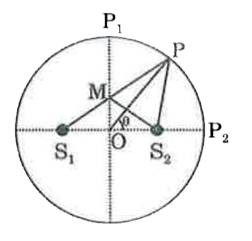
|
|