

Saved Bookmarks
| 1. |
Two equal charges are sepreated by a distance d. A third charge placed on a perpendicular bisector at x distance will experience maximum coulomb force when |
|
Answer» `x=(d)/(sqrt(2))` 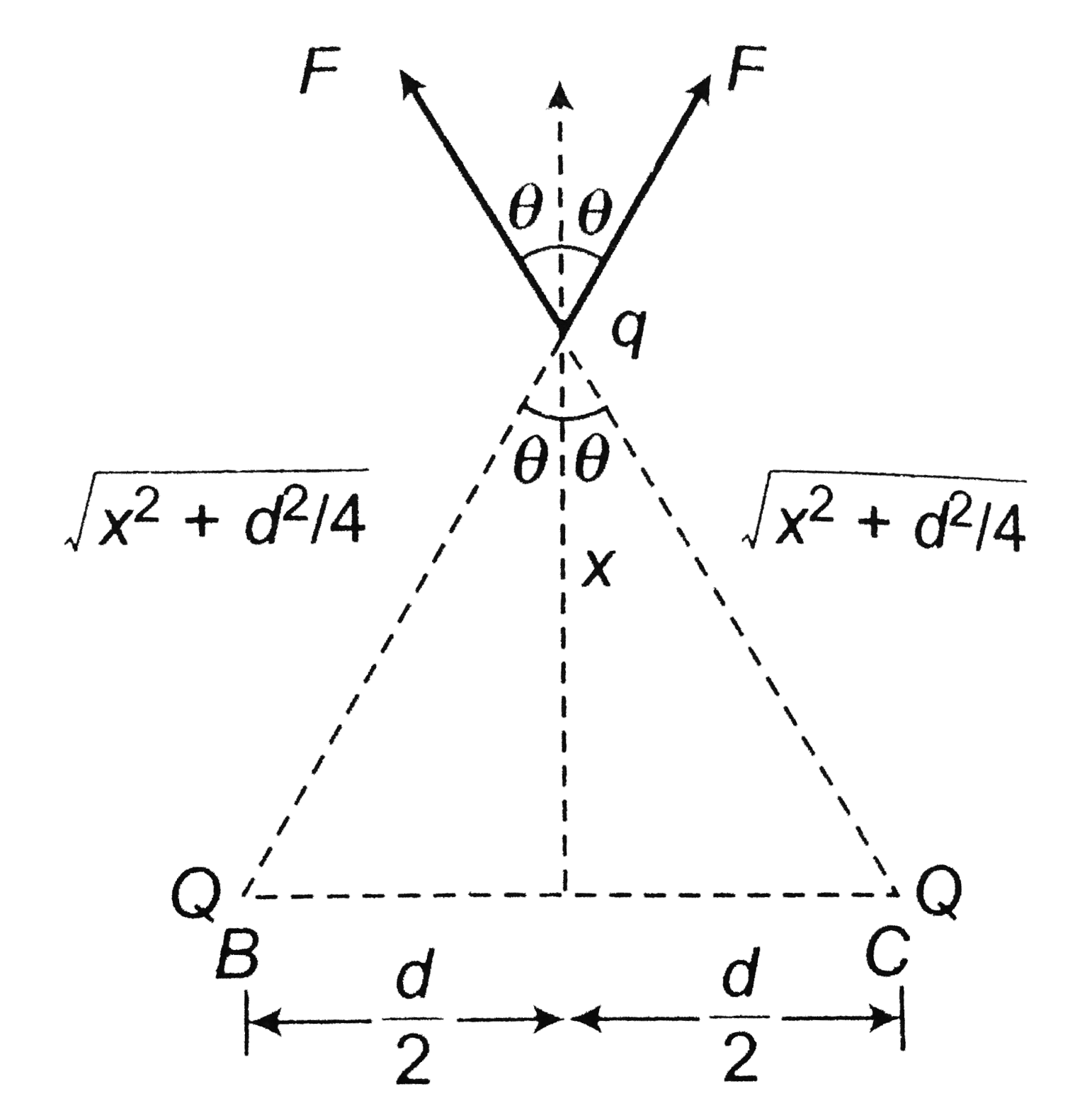 So net FORCE on it `F_(n ET)= 2F cos theta` Where `F=(1)/(4pi epsilon_(0)).(Qq)/((x^(2)+(d^(2))/(4)))` and `cos theta=(x)/(sqrt(x^(2)+(d^(2))/(4)))` `:. F_(n et)= 2xx(1)/(4pi epsilon_(0)).(Qq)/((x^(2)+(d^(2))/(4)))XX(x)/((x^(2)+(d^(2))/(4))^(1//2))` `=(2Qqx)/(4pi epsilon_(0)(x^(2)+(d^(2))/(4))^(3//2))` For `F_(n et)` to be maximum `(dF_(n et))/(dx)=0` `e.(d)/(dx)[(2Qqx)/(4pi epsilon_(0)(x^(2)+(d^(2))/(4))^(3//2))]=0` or `[(x^(2)+(d^(2))/(4))^(-3//2)-3x^(2)(x^(2)+(d^(2))/(4))^(-5//2)]=0` i.e., `x=+-(d)/(2sqrt(2))` |
|