

Saved Bookmarks
| 1. |
Two fixed, identical conducting plates (a and (3), each of surface area S are charged to - Q and q, respectively, where Q > q > 0. A third identical plate (lambda ), free to move Is located on the other side of the plate with charge q at a distance d as per figure. The third plate is released and collides with the plate f_3 . Assume the collision is elastic and the time of collision is sufficient to redistribute charge amongst beta and gamma. (a) Find the electric field acting on the plate gammabefore collision. (b) Find the charges on betaand gammaafter the collision. (c) Find the velocity of the plate gammaafter the collision and at a distance d from the plate beta |
|
Answer» Solution :(a) Net electric field at plate `gamma`before collision is vector sum of electric field at plate `gamma`due to plate a and p. The electric field at plate `gamma` due to plate `alpha` is, `vecE_(1) = -Q(S(2epsilon_(0))(-hati))` The electric field at plate `gamma` due to plane `beta` is, `vecE_(2) = q/(S(2epsilon_(0))(-hati)` `THEREFORE` Hence, the net electric field at plate `gamma` before collision is, `vecE = vecE_(1) + vecE_(2) = (q-Q)/(S(2epsilon_(0))(hati)` `therefore (Q-q)/(S(2epsilon_(0))` to the field, If `Q gt q` (b) During collision plates `beta` and `gamma`are in contact with each other, hence their POTENTIALS become same. Suppose charge on plate `beta`is `q_(1)`and charge on plate `gamma`is `q_2`. At any point O in between the two plates, the electric field must be zero. Electric field at O due to plate `alpha`, `vecE_(a) = Q/(S(2epsilon_(0))(-hati)` Electric field at O due to plate `beta` `vecE_(2) = q_(1)/(S(2epsilon_(0))(hati)` Electric field at O due to plate `gamma` `vecE_(y) = q_(2)/(S(2epsilon_(0))(-hati)` As the electric field at O is zero, therefore, `(Q + q_(2))/(S(2epsilon_(0)))= q_(1)/(S(2epsilon_(0))` `therefore Q + q_(2) = q_(1)` 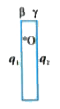 On solving eq. (1) and (2) we get, `q_(1) =(Q+ q/2)` = Change on plate `beta` `q_(1) = (q/2)` = charge on plate `gamma` (c) Let the velocity be v at the distance d from plate `beta` after the collision. If m is the mass of the plate `gamma`, then the gain in K.E. over the round trip must be equal to the work done by the electric field. `vecE_(2) = Q/(2epsilon_(0)S)(-hati) + (Q+q/2)/(2epsilon_(0)S)hati=(q/2)/(2 epsilon_(0)S)hati` Just before collision, electric field at plate: `gamma` is `vecE_(1) = (Q-q)/(2epsilon_(0)S) hati` and `vecF_(2) = vecE_(2).q/2 =(q/2)^(2)/(2epsilon_(0)S)hati` Total work done by the electric field is round trip MOVEMENT of plate `gamma` `W = (F_(1) + F_(2))d` `=((Q-q/2)^(2)d)/(2epsilon_(0)S)` If m is the mass of plate `gamma` , the K.E. gained by the plate =`1/2mv^(2)` According to work energy principle, `1/2mv^(2) = W RARR 1/2mv^(2) = ((Q-q/2)^(2)d)/(2epsilon_(0)S)` `thereforev= (Q-q/2)(d/(mepsilon_(0)S))^(1//2)` |
|