

Saved Bookmarks
| 1. |
Two identical plano-convex lenses L_(1)(mu_(1)-1.4) and L_(2)(mu_(2)-1.5) of radii of curvature R=20cm are placed as shown in Figure. Q. Findthe position of the image of theparallel beam of light relative to the commonprincipal axis. |
|
Answer» `100//7cm` `(1)/(f_(1))=(mu-1)((1)/(R)-(1)/(oo))rArrf_(1)=50cm` `(1)/(f_(2))=(mu-1)[(1)/(oo)-(-(1)/(R))]rArrf_(2)=40cm` The equivalent focal LENGTH F of the combination is given by `(1)/(f)=(1)/(f_(1))+(1)/(f_(2))rArrf=(200)/(9)CM` Hence, the image of the parallel beam is formed on the common principal axis at a distance of 22.22cm from the combination on the right side. b. Image formed by `L_(1)` is at a distance of 50cm behind the lens. This image lies on the principal axis of `L_(1)` and will act as an object for `L_(2)` For `L_(2)`, object distance, `u=+50cm` `f_(2)=+40cm` `(1)/(UPSILON)-(1)/(u)=(1)/(f)rArrmu=(200)/(9) cm` Magnification caused by `L_(2), m=(upsilon)/(u)=(4)/(9)` For `L_(2)` object `I_(1)` is at a distance of 4.5mm above its principal axis. Hence, distance of image `I_(2)` of the object (virtual) `I_(1)` is at a distance `(4//9)xx4.5=2mm` above the principal axis of `L_(2)` `[:. "height of image" `=mxx` "height of object" ]` Hence, final image is at a distance of 22.22cm behind the combination at a distance of 2.5mm below the principal axis of `L_(1)`. 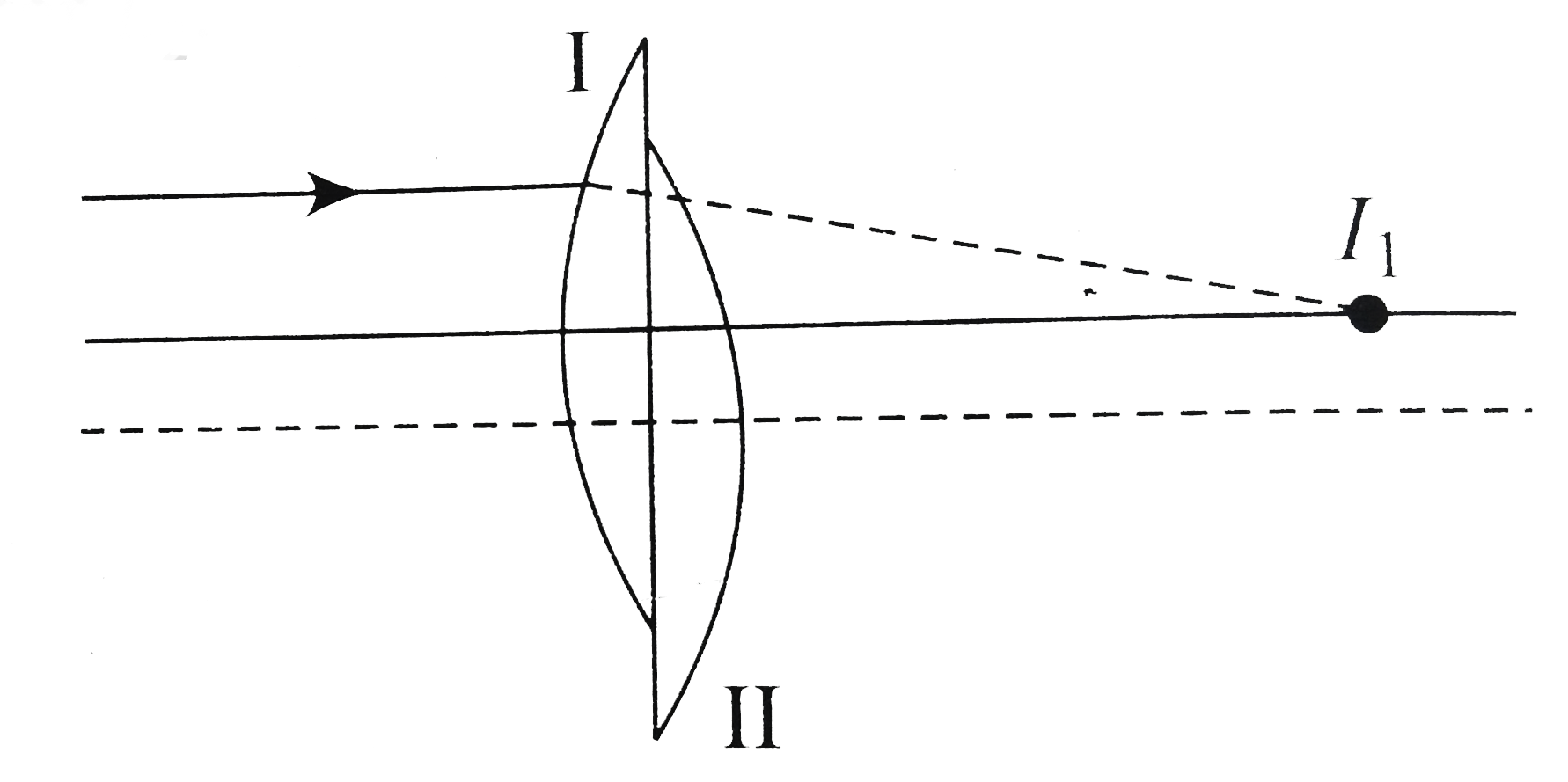
|
|