

Saved Bookmarks
| 1. |
Two inductors of self inductances L_(1) and L_(2) of reistances R_(1) and R_(2) (not shown in the diagram) respectively, are connected in the circuit as shown in the figure. At the instant t=0, key K is closed,obtain the condition for which the galvanometer will show zero deflection at all times after the key is closed. |
|
Answer» Solution :Since there is no current through `BD` therefore points `B` and `D` are at same potential, `V_(B)=V_(D)` Potential difference, `V_(AB)=V_(AD)` `L_(1)(di_(1))/(dt)+i_(1)R_(1)=L_(2)(di_(2))/(dt)+i_(2)R_(2)`………`(1)` Similarly, `V_(BC)=V_(DC)` `i_(1)R_(3)=i_(2)R_(4)` ........`(2)` From equation `(1)` and `(2)` `L_(1)(R_(4))/(R_(3))(di_(2))/(dt)+i_(2)(R_(1))/(R_(3))=L_(2)(di_(2))/(dt)+i_(2)R_(2)` `(L_(1)(R_(4))/(R_(3))-L_(2))(di_(2))/(dt)=i_(2)[R_(2)-(R_(1))/(R_(3))]`........`(3)` At `t=0`, `i_(2)=0` `:. L_(1)(R_(4))/(R_(3))-L_(2)=0` as `(di_(2))/(dt) ne 0` `:. (L_(1))/(L_(2))=(R_(3))/(R_(4))`..........`(4)` At `t=oo`, `(di_(2))/(dt)=0`, `RARR i_(2)=((epsilon)/(R_(2)+R_(4)))=`constant `rArr R_(2)-(R_(4)R_(1))/(R_(3))=0` `:. (R_(1))/(R_(2))=(R_(3))/(R_(4))`.......`(5)` From `(4)` and `(5)` `(L_(1))/(L_(2))=(R_(1))/(R_(2))=(R_(3))/(R_(4))` 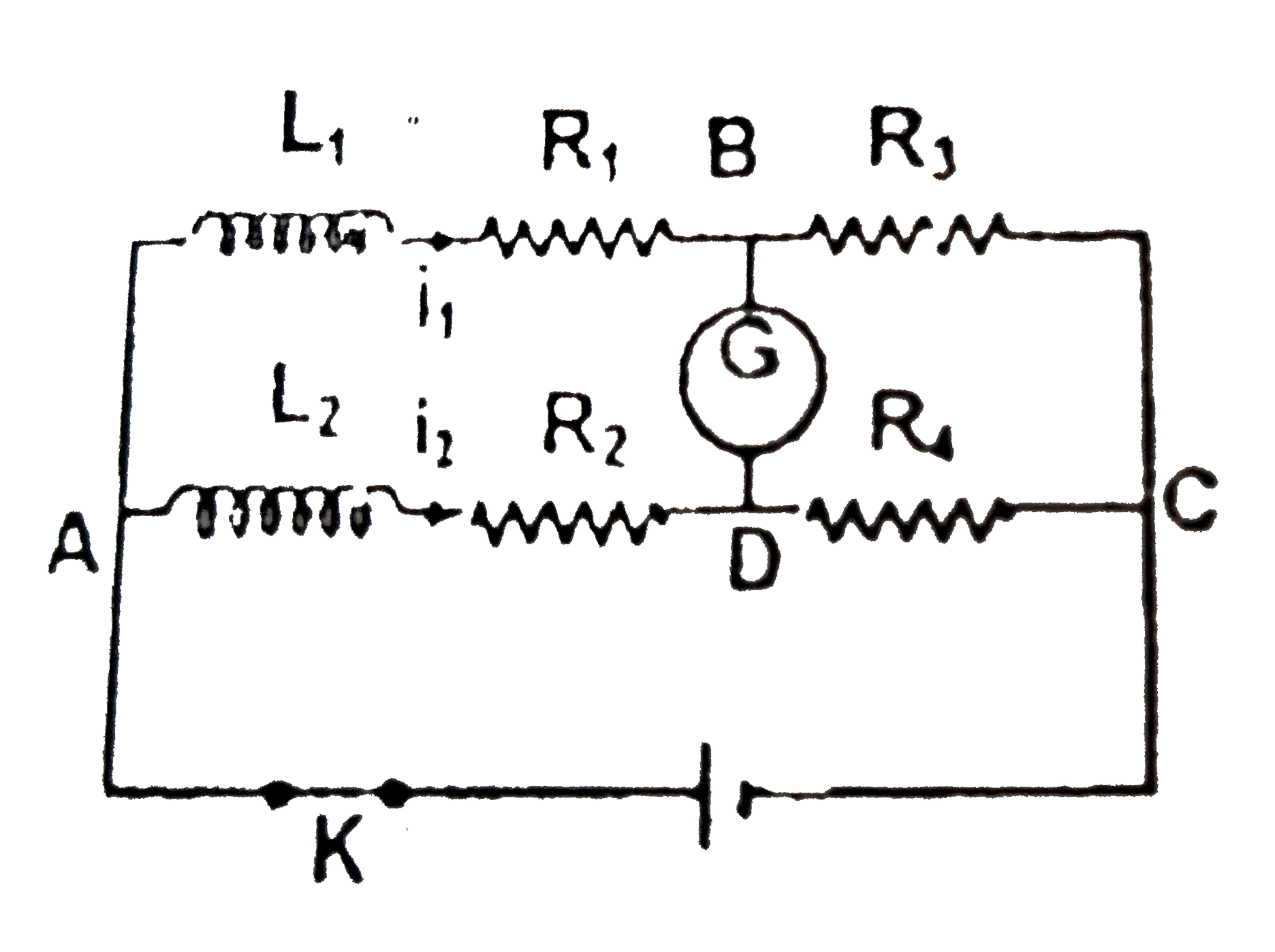
|
|