

Saved Bookmarks
| 1. |
Two long parallel conducting rails are placed in a uniform magnetic field. On one side, the rails are connected with a resistance R. Two rods MN and M'N' each having resistance r are placed as showing in Fig. Now on the rods MN and M'N' forces are applied such that the rods move with constant velocity v. (ii). If in the previous problem resistance of values R_(1) and R_(2) are connected on both ends as shown in Fig. current I, flowing through resistance R_(1) is given by |
|
Answer» (a) `(BlR_(2)(v_(1)r_(2) - v_(2)r_(1)))/(R_(1)R_(2)(r_(1) + r_(2)) + r_(2)r_(1)(R_(1) + R_(2)))` 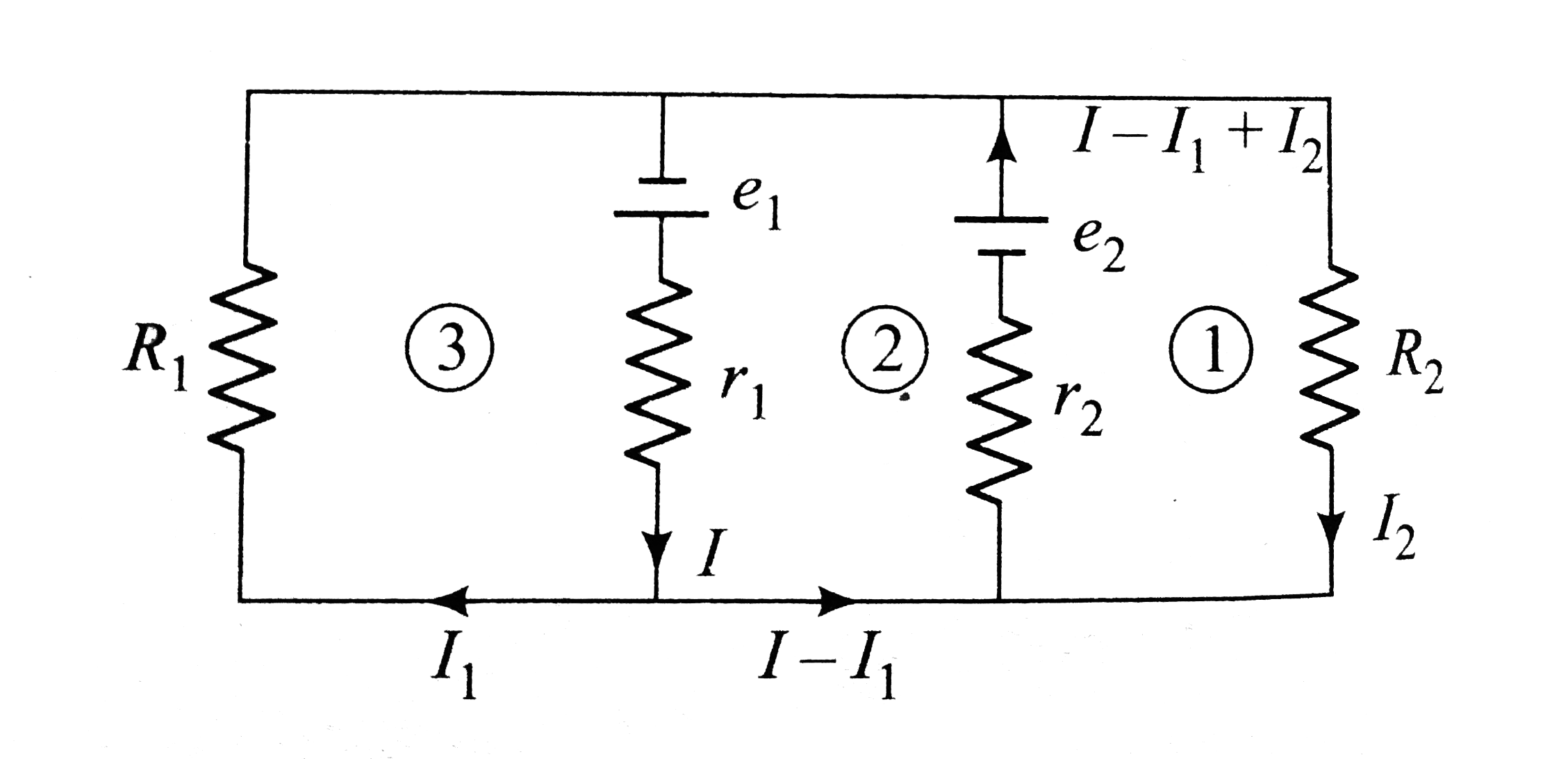 `I = (e)/(R + (r//2)) = (Blv)/(R + (r//2))` Case II ` -(I_(1) - I')R - I_(1)r + e = 0` For loop (1)(i) `r(I-(1) + U') = 2e` For loop (2)(ii) Solve to GET, `I_(1) = I' = (e)/(R )` Hence current in 'R' is zero. ltbr (ii). `e_(1) = Blv_(1), e_(2) = Blv_(2)` For (1) `rarr` `e_(2) = (I - I_(1) + I_(2))r_(2) + I_(2)R_(2)` For (2) `rarr` `e_(1) + e_(2) = (I - I_(1) + I_(2))r_(2) + Ir_(1)` For (3) `rarr` `e_(1) = Ir_(1) + I_(1)R_(1)` Solve to get `I_(1) = (BlR_(2)(v_(2)r_(2) - v_(2)r_(1)))/(r_(1)R_(2)(r_(1) + r_(2)) + r_(2)r_(1)(R_(1) + R_(2)))` |
|