

Saved Bookmarks
| 1. |
Two long parallel wires are carrying currents as shown Find magnitude and direction of magnetic field at P,Q and R. (b) (i) (ii) At what distance from left wire, magnetic field is zero on the line joining the wires. Find magnitude of magnetic field at P. (d) Two straight infinitely long and thin parallel wires are spaced d distance apart and carry a current i each. find the magnetic field at a point distance d from both wires when the currents are in the (i) same and (ii) opposite directions. |
Answer» SOLUTION :(a) 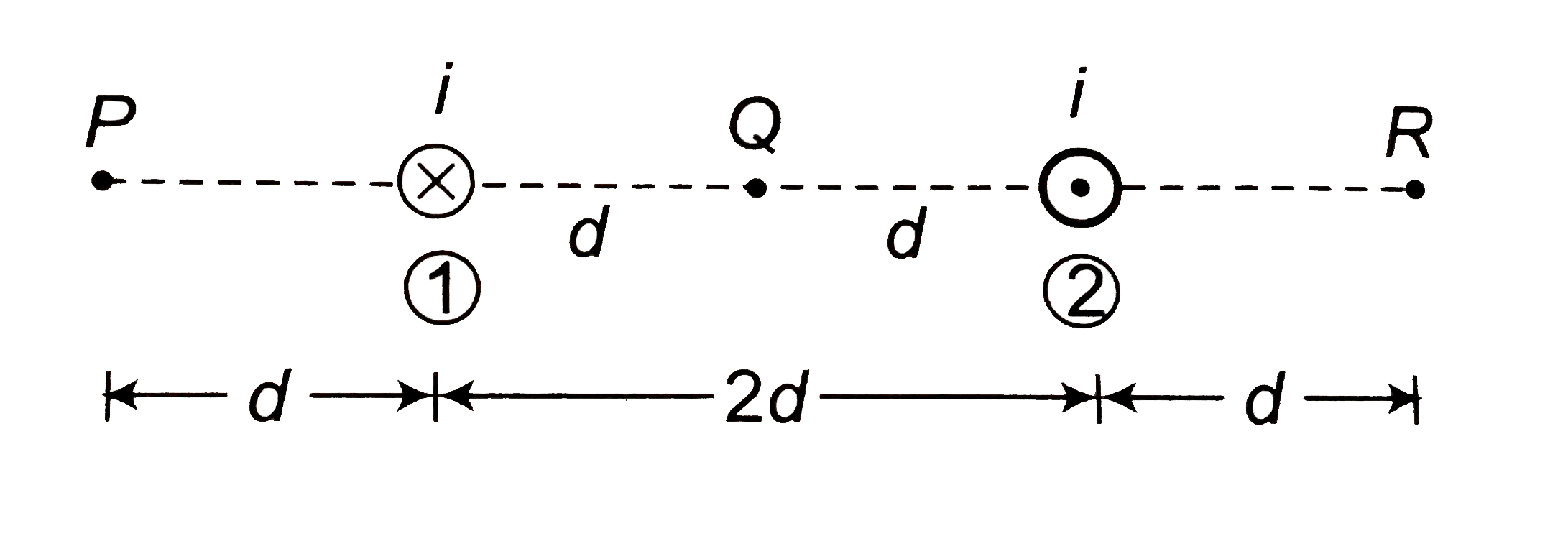 At `P:` Due to wire `①`, `B_(1)=(mu_(0)i)/(2pid)`, upward Due to wire `②`, `B_(2)=(mu_(0)i)/(2pi(3d))` downward `B_(P)=B_(1)-B_(2)=(mu_(0)i)/(2pid)(1-1/3)=(mu_(0)i)/(3pid)`, upward At `Q:` Due to wire `①` ,`B_(1)=(mu_(0)i)/(2pi(3d))`, downward Due to wire `②`, `B_(2)=(mu_(0)i)/(2pid)`, downward `B_(Q)=B_(1)+B_(2)=(mu_(0)i)/(pid)`, downward At `R:` Due to wire `①` , `B_(1)=((mu_(0)i)/(2pi(3d)))`, downward Due to wire `②` , `B_(2)=(mu_(0)i)/(2pid)`, upward `B_(R) =B_(2)-B_(1)=(mu_(0)i)/(2pid)(1-(1)/(3))=(mu_(0)i)/(3pid)`, upward (b) (i) Let magnetic field is zero at distance `x`, left wire At `P:` `B_(1)=B_(2)` `(mu_(0)i)/(2pix)=(mu_(0)(i))/(2pi(d-x)) implies 4/x =1/(d-x) implies x=(4d)/5` (ii) 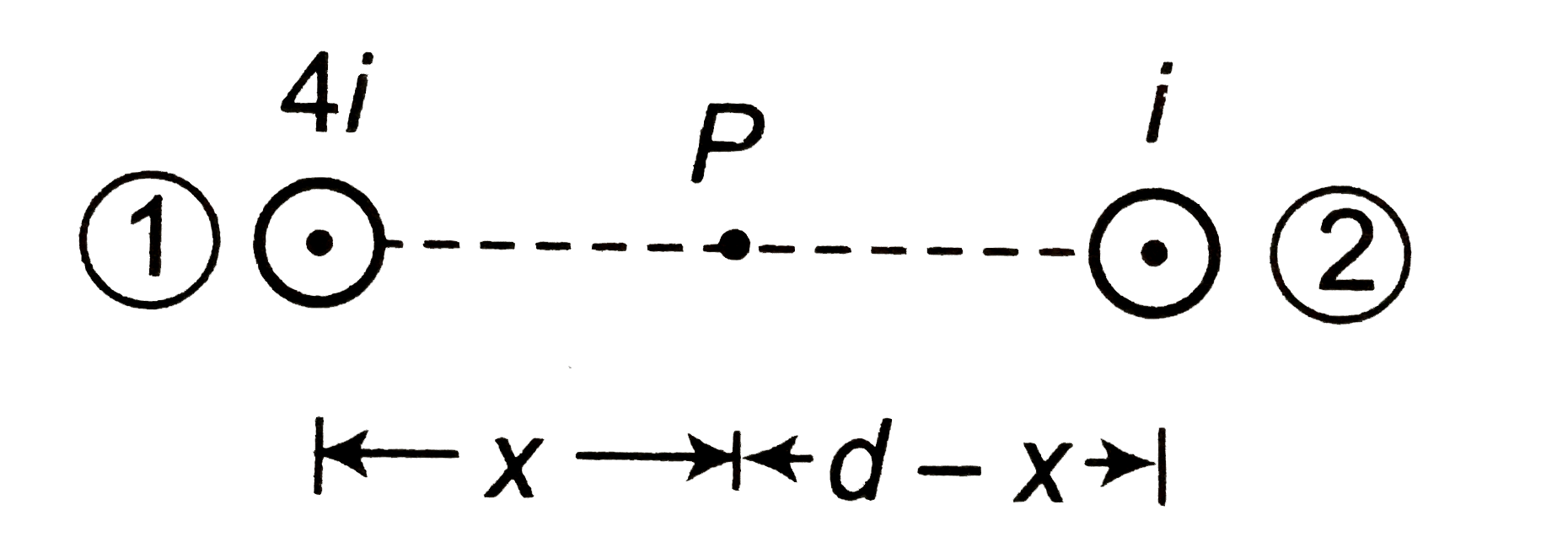 The magnetic field won't be zero between the wires because due to both wires magnetic field will be upward. The magnetic field will be zero nearer the smaller current outside `AB`. Let it be zero at distance `x` from wire `B` as shown. At `P:` Due to `①`, `B_(1)=(mu_(0)(4i))/(2pi(d+x))`, upward Due to `②` `B_(2)=(mu_(0)(i))/(2pix)`, downward `B_(P)=0 i.e., B_(1)=B_(2)` `=(mu_(0)(4i))/(2pi(d+x))=(mu_(0)(i))/(2pix) implies 4/(d+x)=1/x` `x=d/3` Magnetic field is zero at distance `d=d//3=4d//3` from left wire. (iii) 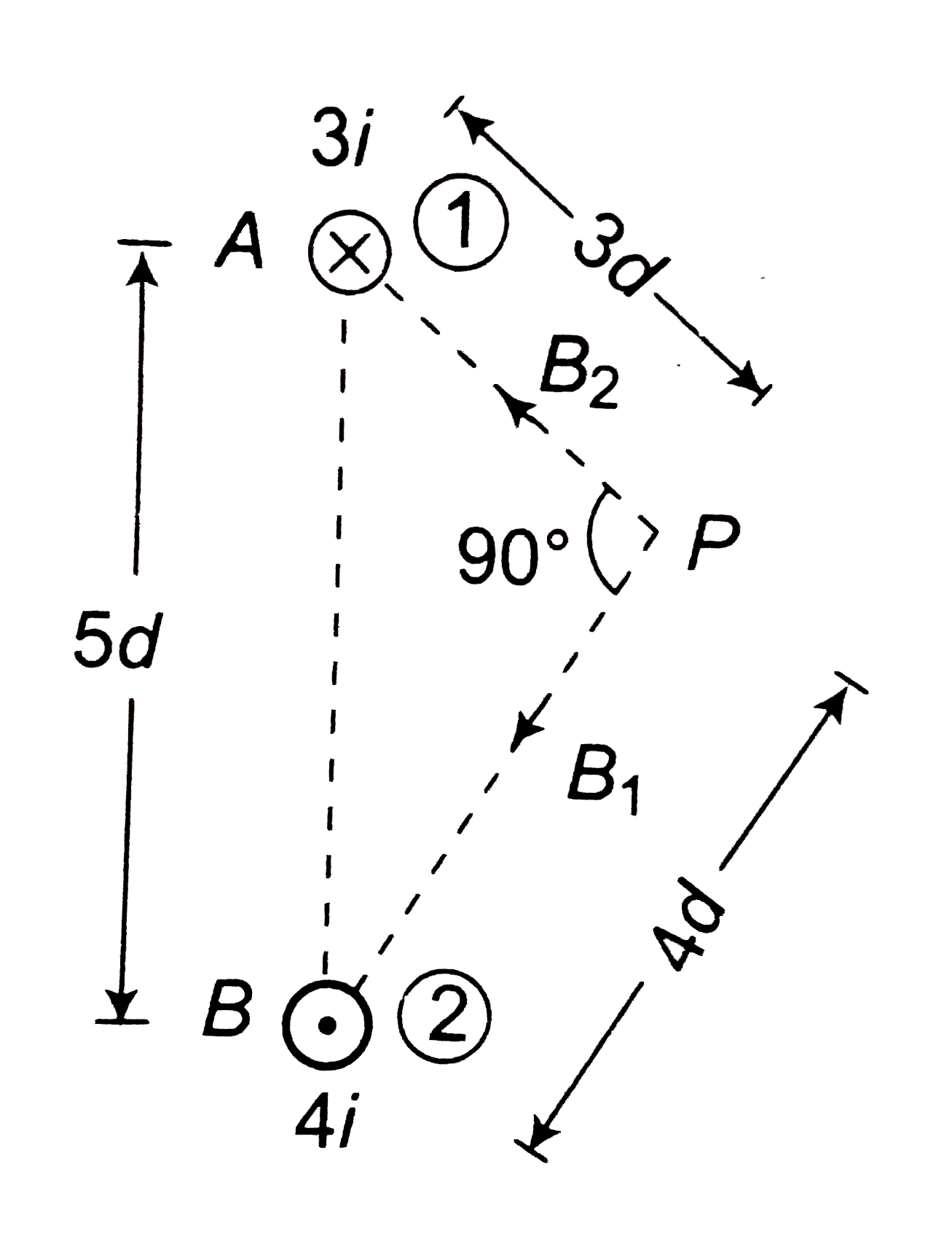 `angleAPB=90^(@)` At `P:` `B_(1)=(mu_(0)(3i))/(4pi(3d))=(mu_(0)i)/(2pid)`, along `PB` `B_(2)=(mu_(0)(4i))/(4pi(4d))=(mu_(0)i)/(2pid)`, along `PA` 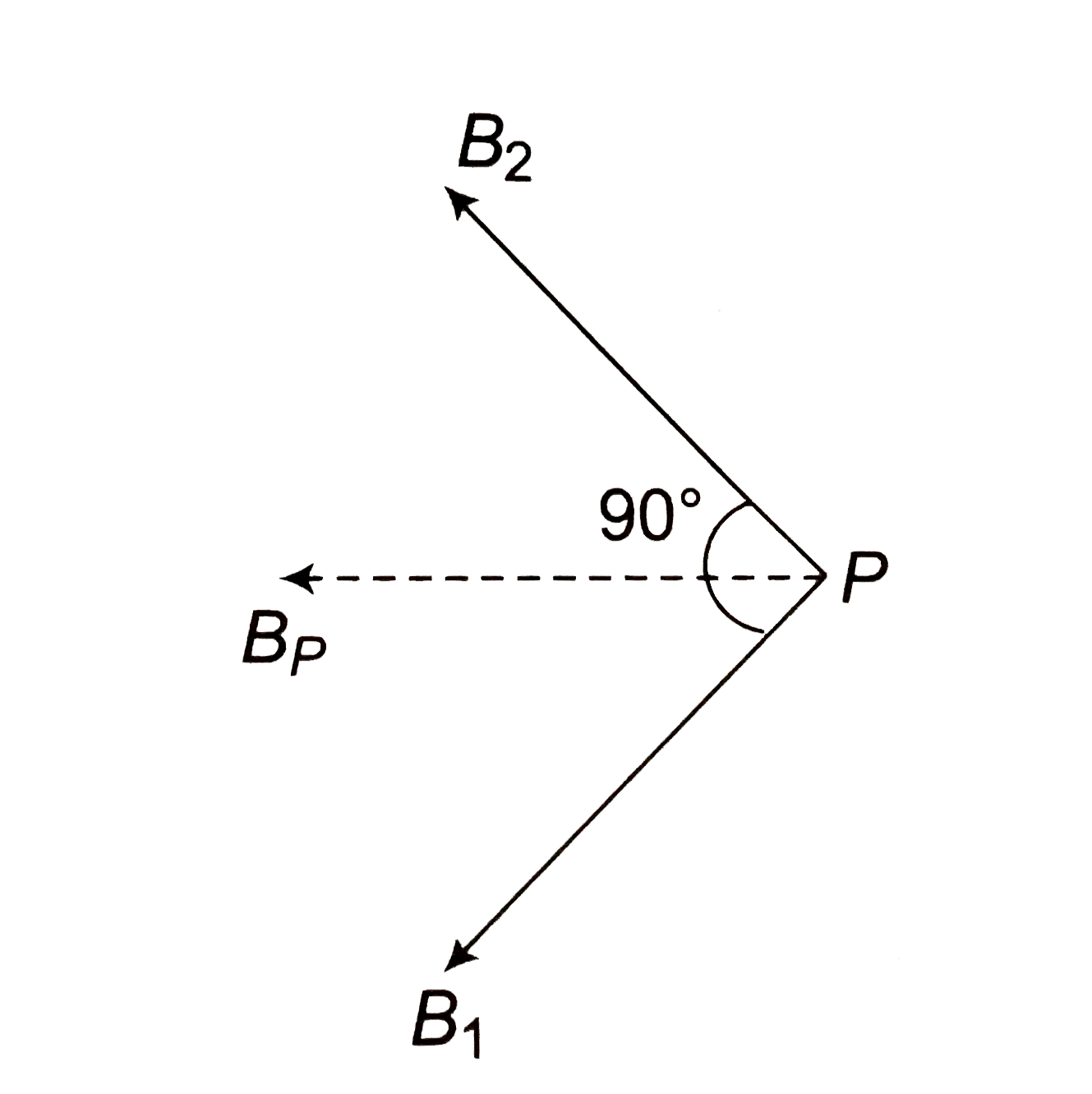 `B_(1)` and `B_(2)` are perpendicular `B_(P)=sqrt(B_(1)^(2)+B_(2)^(2))=(sqrt(2)mu_(0)i)/(2pid)=(mu_(0)i)/(sqrt(2)pid)` (d) (i) 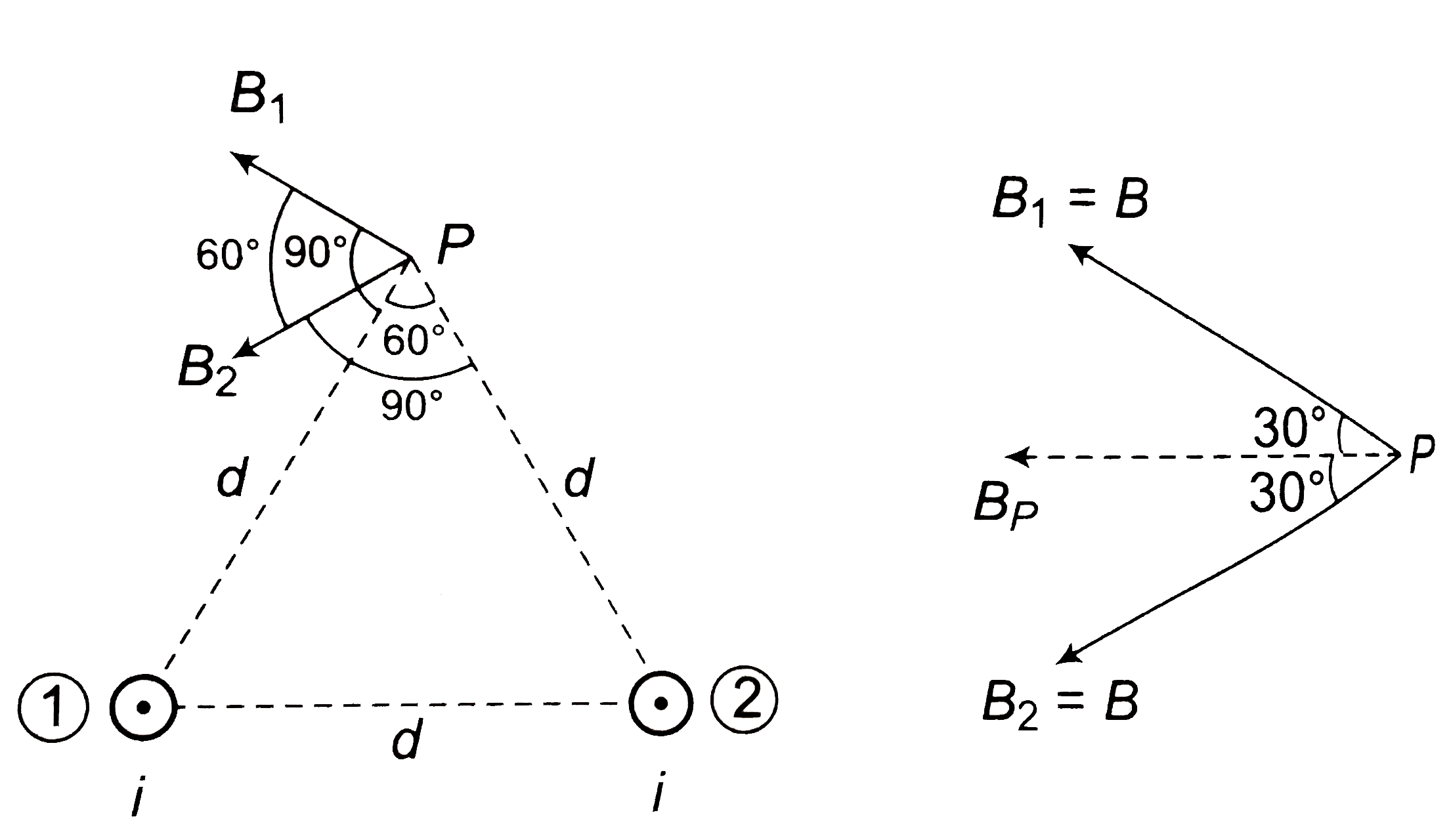 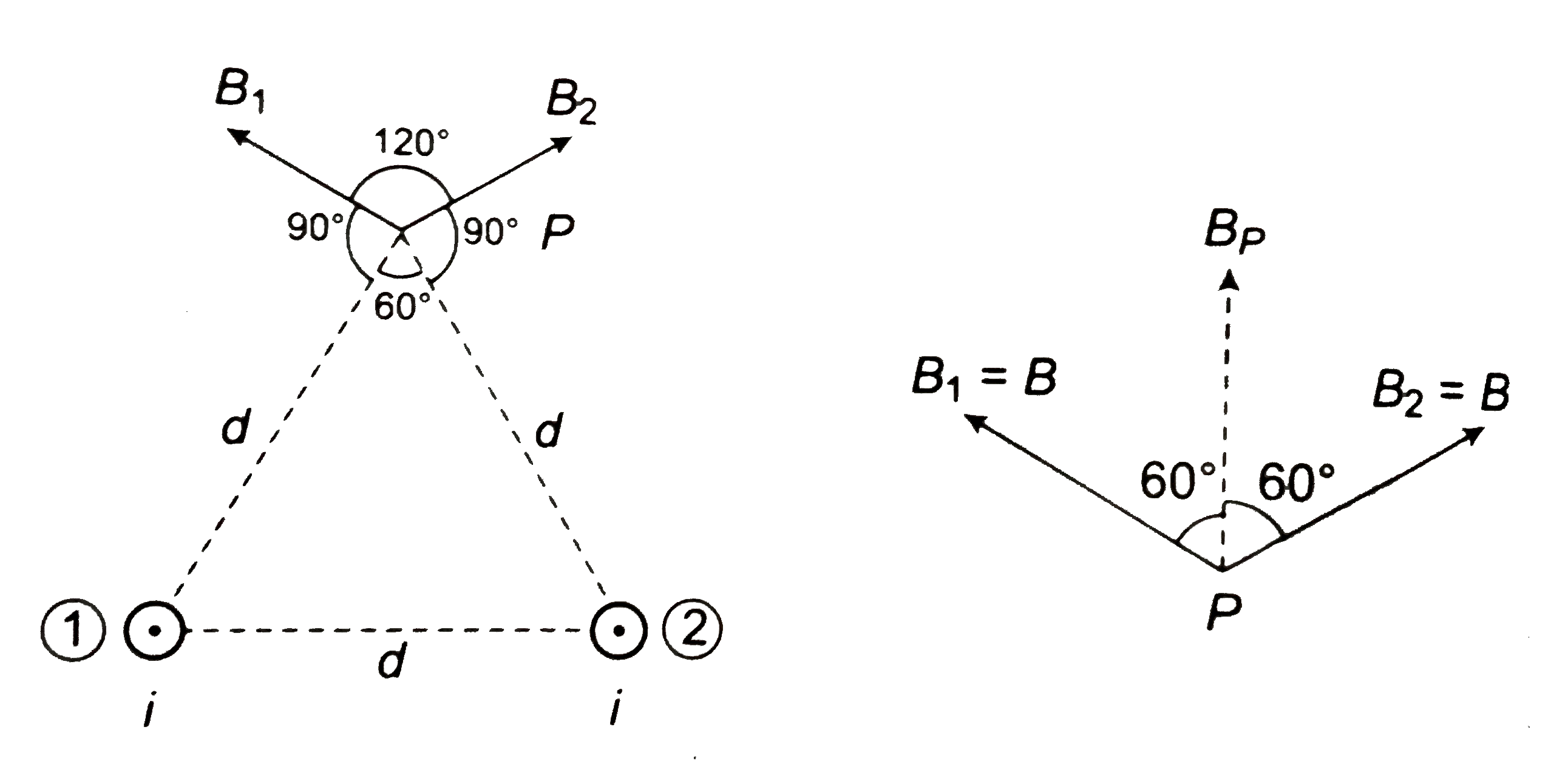 `B_(1)=B_(2)=(mu_(0)i)/(2pid)=B` `B_(P)=2Bcos30^(@)=sqrt(3)B=(sqrt(3)mu_(0)i)/(2pid)` `B_(1)=B_(2)=(mu_(0)i)/(2pid)=B` `B_(P)=2Bcos60^(@)=B=(mu_(0)i)/(2pid)` |
|