

Saved Bookmarks
| 1. |
Two particles , each having a charge Q, are fixed at y = d//2 and y = -d//2. Where should a particle of charge q be placed on x-axis from origin so that it experiences maximum force and what is it equal to ? Sketch variation of electric force experienced by q v//s x. |
|
Answer» Solution :Force on `q` to each `Q` will be same in MAGNITUDE `F_(0) =(1)/( 4 PI in_(0)) (Qq)/(((d^(2))/(4) + x^(2))` Resultant force on `q`, `F = 2 F_(0) cos theta` `= 2. (1)/( 4 pi in_(0)) (Qq)/(((d^(2))/(4) +x^(2))) (x)/(((d^(2))/(4) + x^(2))^(1//2))` `= (Qq)/(2 pi in_(0)) (x)/((d^(2))/(4) +x^(2))^(3//2)` For `F` to be maximum, `(dF)/(dx) = 0` `(Qq)/(4 pi in_(0)) (((d^(2))/(4) + x^(2))^(3//2) . 1- x.(3)/(2)((d^(2))/(4) + x^(2))^(1//2) . 2X)/(((d^(2))/(4) + x^(2)))` `(d^(2))/(4) + x^(2) - 3x^(2) = 0` `x^(2) = (d^(2))/(8)` `x = +- (d)/( 2 sqrt(2))` `F_(max) = (Qq)/( 2pi in_(0)) (d)/(2 sqrt(2)) (1)/((d^(2))/(4) + (d^(2))/(8))^(3//2)` `= (Qq)/( 2 pi in_(0)) (d)/(2 sqrt(2)) (1)/((3D^(2))/(8) .(sqrt(3) d)/(2 sqrt(2)))` ` = (4 Qq)/( 3 sqrt(3) pi in_(0) d^(2))` `F v//s x` graph : when `q` is at right of `O` , force on it will be along ` + x` axis (assuming `+ve`) , graph will above x-axis. When `q` is the left of `O`, force will be along-x-axis (assuming `-ve`) , graph will be below x-axis. `x = 0 , F = 0` `x = +- (d)/(2 sqrt(2)) , F = F_(max)` `x rarr prop , F rarr 0` 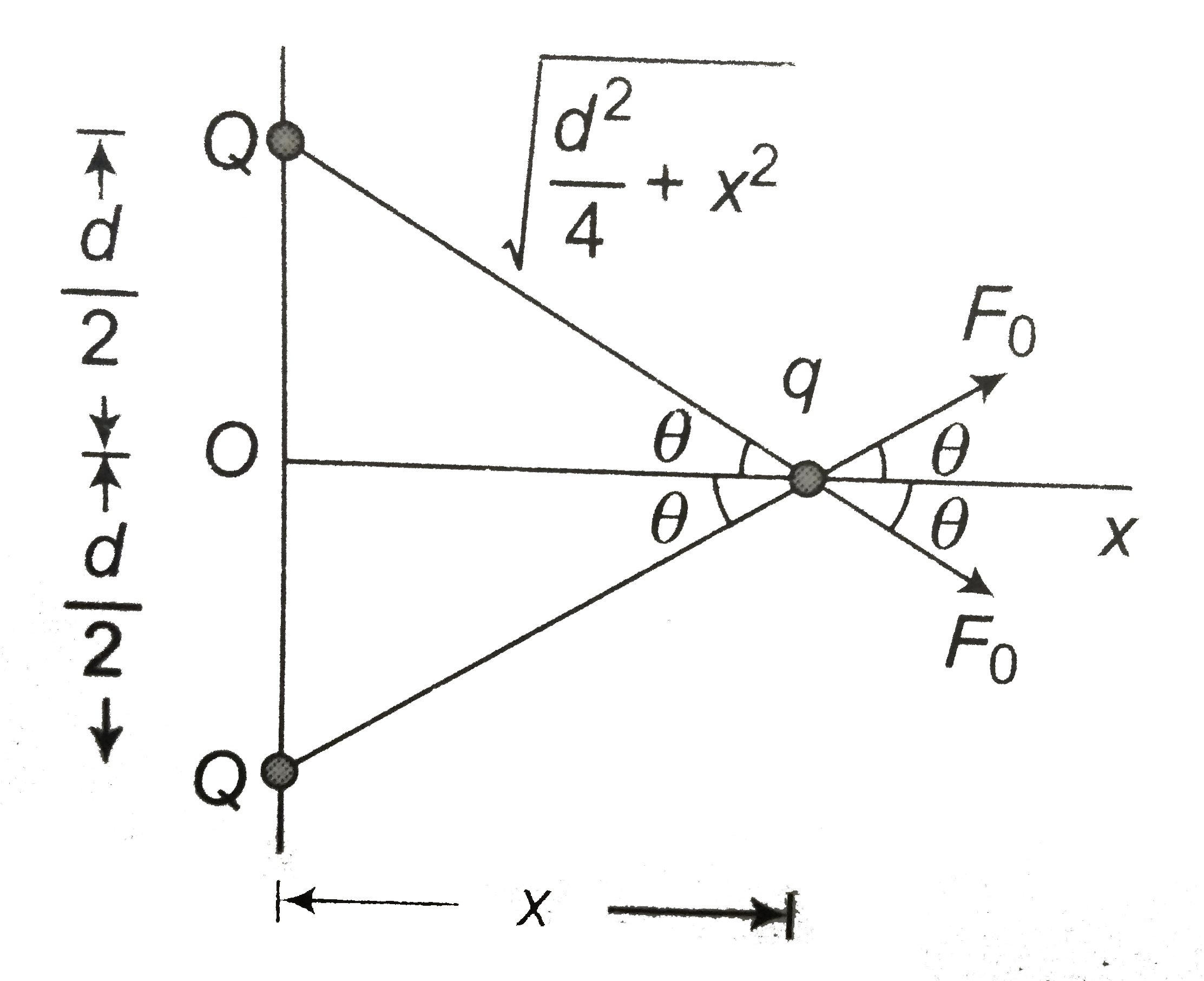 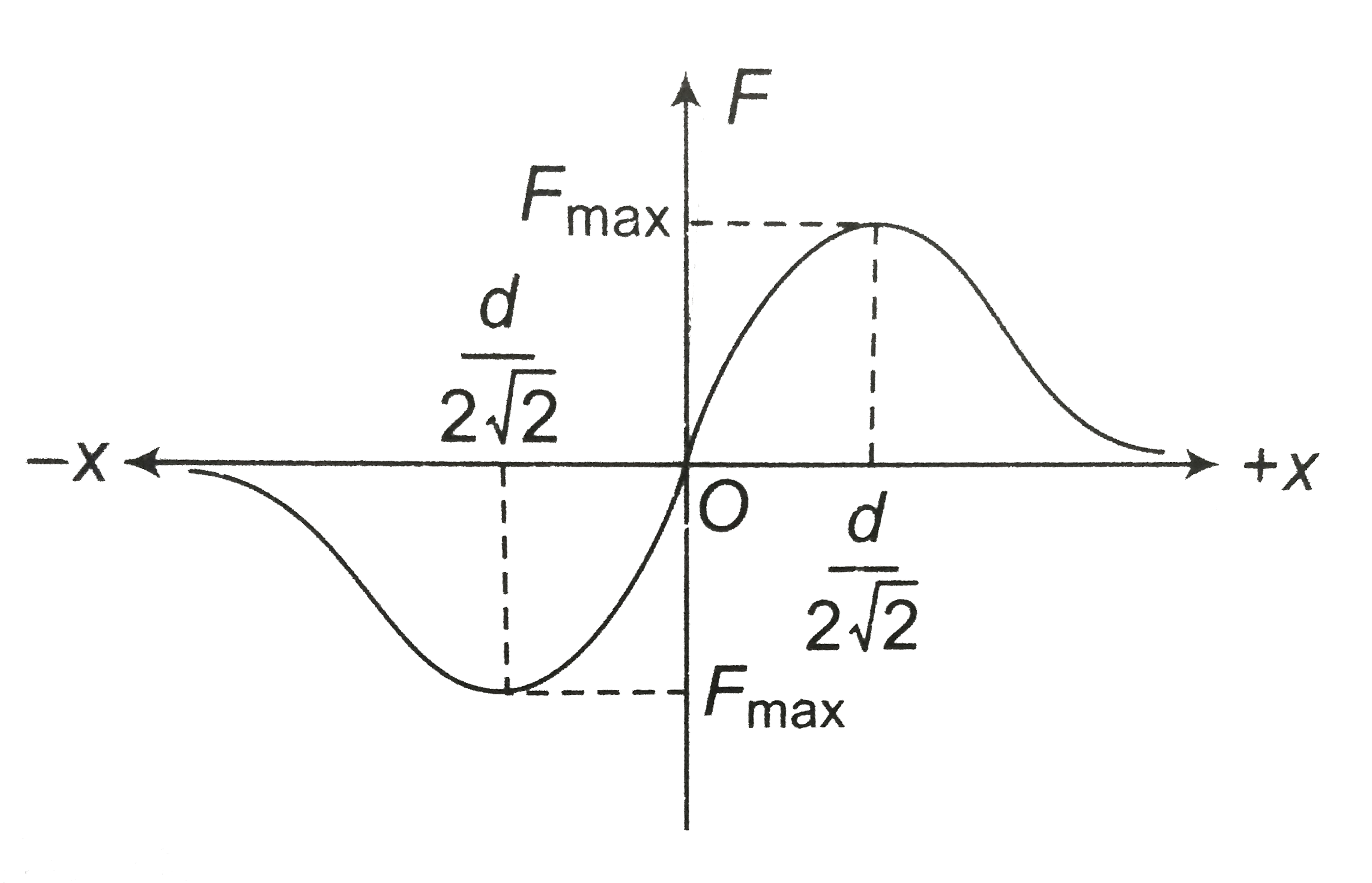
|
|