

Saved Bookmarks
| 1. |
Two point sources ofsound are placed at a distance d and a detector moves on a straight line parallel to the line joining the sources as shown in figure-6.27 at a distance D away from sources. Initially Detector is situated on the line so that it is equidistant from both the sources. Find the displacement of detector when it detects n^(th) maximum sound and also find its displacement when it detects n^(th) minimum sound. |
Answer» Solution :The situation is shown in figure-6.28. 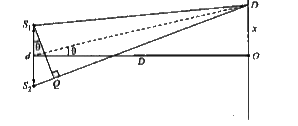 Let us consider the situation when detector move by a distance Xas shown. Let at this position the path difference between the waves from `S_(1)` and `S_(2)` to detector be `Delta` then we have `Delta = S_(2)D - S_(1)D` `cong S_(2)Q` Here if `theta` is SMALL angle as D>>d, we have `S_(2)Q = d sin theta cong d theta` = `d(x)/(D)` Thus at the position of detector, path deference is `Delta = (dx)/(D)` The expression for path difference in equation-(6.109) is an important formula for such problems. Students are advised to keep this formula in mind for FUTURE use. When detector was at point O, path difference was zero and it detects `n^(th)` a maxima, now ifdetector detects maximum then its path difference at a distance x from O can be given as `Delta = nlambda` `(dx)/(D)= lambda` `x = (nlambdaD)/(d)` Similarly if detector detects `n^(th)` minima then the path difference between two waves at detector can be given as `Delta = (2n -1)(lambda)/(2)` `(dx)/(D) = (2n - 1) (lambda)/(2)` `x = ((2n - 1)lambdaD)/(2d)` |
|