

Saved Bookmarks
| 1. |
Two pointcharges q_(1) and q_(2) of magnitude + 10^(-8) c and -10^(-8) crespectively are placed 0.1 m apart calculate the electricfields at points a, b and c |
Answer» SOLUTION :We know that direction of electric field due to a positive charge is always away from it and that due to a negative charge is always TOWARDS it. 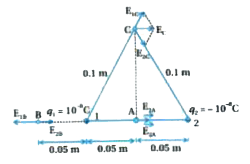 Magnitude of electric field at point A due to q, `E_(1A) = (kq_(1))/(r_(1A)^(2)) =(9 xx 10^(9))(10^(-8))/(0.05^(2)) = 3.6 xx 10^(4)` N/C (Direction: From `q_(1)` to `q_(2)`) SIMILARLY, magnitude of electric field at point A due to `q_(2)` `E_(2A) = (kq_(2))/r_(2A)^(2) = (9 xx 10^(9))(10^(-6))/(0.5)^(2) = 3.6 xx 10^(4) N//C` (Direction: From `q_(1)` to `q_(2)`) If resultant electric field at point A is: `vecE_(A) = vecE_(1A) + vecE_(2A)` `therefore E_(A) = E_(1A) + E_(2A) (therefore vecE_(1A) || vecE_(2A))` `=2E_(1A)(therefore E_(1A) || E_(2A))` `=2 xx 3.6 xx 10^(4)` `therefore E_(A) = 7.2 xx 10^(4)` N/C Magnitude of electric FIELDS at point C due to `q_(1)`and `q_2` are equal which is, `E = E_(1C) = E_(2C) = (kq_(1))/r_(1C)^(2) = (kq_(2))/(r_(2C)^(2))` `=(9 xx 10^(9))(10^(-8))/(0.1)^(2) = 9 xx 10^(3) N//C` Resultant electric field at point C is, `vecE_(C) = vecE_(1C) + vecE_(2C)` `therefore E_( C) = sqrt(2E^(2) + 2E^(2) (-1/2)) = sqrt(E^(2)) = E` `therefore E_( C) = 9 xx 10^(3)` N/C (In a direction, parallel to direction from `q_(1)`to `q_2`) (Towards right) |
|