

Saved Bookmarks
| 1. |
Two ships are 10sqrt(2)km apart on a line running south to north. The one further north is moving west with a speed of 25 km/h, while the other towards north with a speed of 25 km/h. |
|
Answer» Their distance of closest approach is `5sqrt(2)`km. 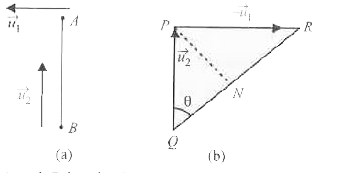 Let A and B be the initial positions of the two ships such that AB = `10sqrt(2)` km. The ship at A is moving with velocity `u_(1)`(25 km/h) westward and the ship B north ward with velocity `u_(2)`(25 km/h). The relative velocity of ship B with respect to that of ship A is GIVEN by `vecv_(BA) = vecv_(B) - vecv_(A) = vecu_(2)-vecu_(1) = vecu_(2) + (-vecu_(1))` In figure (b) `vec(OP)` and `vec(PR)`represent velocities `vecu_(2)`and `-vecu_(1)`RESPECTIVELY. Then `vec(QR)`represents the relative velocity of B with respect to A. Now, `|vec(QR)| = sqrt(PQ^(2) + PR^(2)) =sqrt(25^(2) + 25^(5)) = 25sqrt(2) km//h` and `tan theta = (PR)/(QP) = 25/25 =1 therefore theta = 45^(@)` Now, we can suppose that the ship A is at rest at P and the ship B is moving along QR with a velocity of `25sqrt(2)`km/h. The closest distance between the ships will be PN, which is the perpendicular distance of P from QR. Now, `(PN)/(PQ) = sin 45^(@) rArr PN =PQ sin 45^(@)` or `QN = PQ cos 45^(@) = 10sqrt(2) xx 1/sqrt(2) = 10 km` `therefore` time required to reach the closest distance `=(QN)/("relative velocity") = 10/(25sqrt(2)) h` `=10/(25sqrt(2)) xx 60` min = 17 min. |
|