

Saved Bookmarks
| 1. |
Two sinusoidal waves y_1, (x, t) and y_2(x, t) have the same wavelength and travel together in the same direction along a string. Their amplitudes are y_(m1)= 4.0 mm and y_(m2)= 3.0 mm, and their phase constants are 0 and pi//3 rad, respectively. What are the amplitude y_(m)', and phase constant of the resultant wave? Write the resultant wave in the form of Eq. 16-63. |
|
Answer» Solution :(1) The two waves have a number of properties in commom: Because they travel ALONG the same string, they must have the same speed v as set by the tension and incar density of the string according to Eq: 16.29 With the name WAVELENGTH, `lambda` they have the same angular wave numbe `k (=2pi//lambda)`. Also, because they have the same wave number k and speed y, they must have the same angular frequency `omega (=kv).` (2) The waves (call them waves 1 and 2) can be represented by phasors rotating at the same angular speed `omega` about an origin. Because the phase constant for wave `omega` is greater than that for wave 2 is greater than that for wave 1 by `pi//3`, PHASOR 2 must lag phasor 1 by `pi//3` rad in their clockwise rotation, as shown in Fig. 16-24a. The resultant wave due to the interference of waves 1 and 2 can then be represented by a phasor that is the vector sum of phasors 1 and 2. Calculations : To simplify the vector summation, we drew phasors 1 and 2 in Fig 16-24 a at the instant when phasor 1 lies along the horizontal axis. We then drew laging phasor 2 at positive angle `pi//3` rad. In Fig 16-24b we shifted phasor 2 so TAIL is at the 1. Then 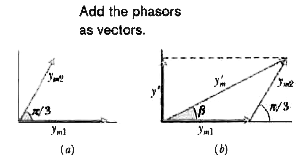 we can draw the phasor `y_(m).` of the resultant wave from the tail of phasor 1 to the head of phasor 2. The phase constant B is the angle phasor `y_m.` makes with phasor 1. To find values for `y_m. and beta`, we can sum phasors 1 and 2 as vectors on a vector-capable calculator. However, here we shall sum them by components. (They are called horizontal and vertical components, because the SYMBOLS x and y are already used for the waves themselves.) For the horizontal components we have `y_(mh).=y_(m1) cos 0 +y_(m2) cos pi//3` `=4.0 mm+(3.0 mm) cos pi//3)=5.50mm` For the vertical components we have `y_(mv).=y_(m1) cos 0+y_(m//2) sin pi//3` `=0 +(3.0 mm) sin pi//3=2.60mm`, Thus, the resultant wave has an amplitude of `y_(m).=sqrt((5.50mm)^(2) +(2.60 mm)^(2))` =6.1 mm and a phase constant of `bet=tan^(-1) (2.60 mm)/(5.50 mm)=0.44 rad` From Fig. 16-24b, phase constant `beta` is a positive angle relative to phasor 1. Thus, the resultant wave lags wave 1 in their travel by phase constant `beta=+0.44` rad. From Eq. 16 -63, we can write the resultant wave `y. (x,t) =(6.1 mm) sin (kx-omega t+0.44 rad).` |
|