

Saved Bookmarks
| 1. |
Unpolarised light of intensity I passes through an ideal polariser A. Another identical polariser B is placed behind A. The intensity of light beyond B is found to be I/2. Now another identical poariser C is placed between A and B. The intensity beyond B is now found to be I/8. The angle between polariser A and C is : |
Answer» Solution :When unpolarised light is passed through a polariser then intensity of light becomes half. Here intensity of light is `I//2` after passing through both the polarisers A and B hence axis of both of these polarisers must be PARALLEL to each other. 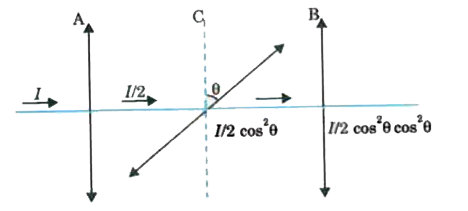 Let axis of polariser C be placed at an angle `theta` will A, then its angle with that of B will ALSO be `theta`. Let `I_0` be the intensity of unpolarised light. Intensity of light coming out from POLAROID A : `I = (I_0)/2` Intensity of light coming out from Polaroid C is `I. = (I_0)/2 cos^2 theta` Intensity of light coming out from Polaroid B : `I.. = (I_0)/2 cos^2 theta cos^2 theta` Given, `I.. = I_0//8 implies I.. = (I_0)/2 cos^2 theta = (I_0)/8` `implies cos theta = 1/(sqrt(2)) implies theta = 45^@` |
|