

Saved Bookmarks
| 1. |
Use Gauss's law to derive the expression for the electric field between two uniformly charged large parallel sheets with surface charge densities sigma and -sigma respectively. |
|
Answer» Solution :Electric field due to a uniformly charged infinite plane sheet : Suppose a thin non-conducting uniform surface charge density `sigma`. Electric field intensity `vec(E)` on either side of the sheet must be perpendicular to the plane of sheet having same magnitude at all points equidistant from sheet. Let P be any POINT at a distance r from the sheet. Let the small area element `vec(dS)=dS hat(n)`. `vec(E)` and `hat(n)` are perpendicular on the surface of imagined cylinder, so electric flux is zero. `vec(E)` and `hat(n)` are parallel on the two cylindrical edges P and Q which contributes electric flux. `:.` Electric flux over the edges PAND Q of the cylinder is `2 phi=q/epsi_(0) implies 2 oint vec(E) vec(dS). =q/epsi_(0)` 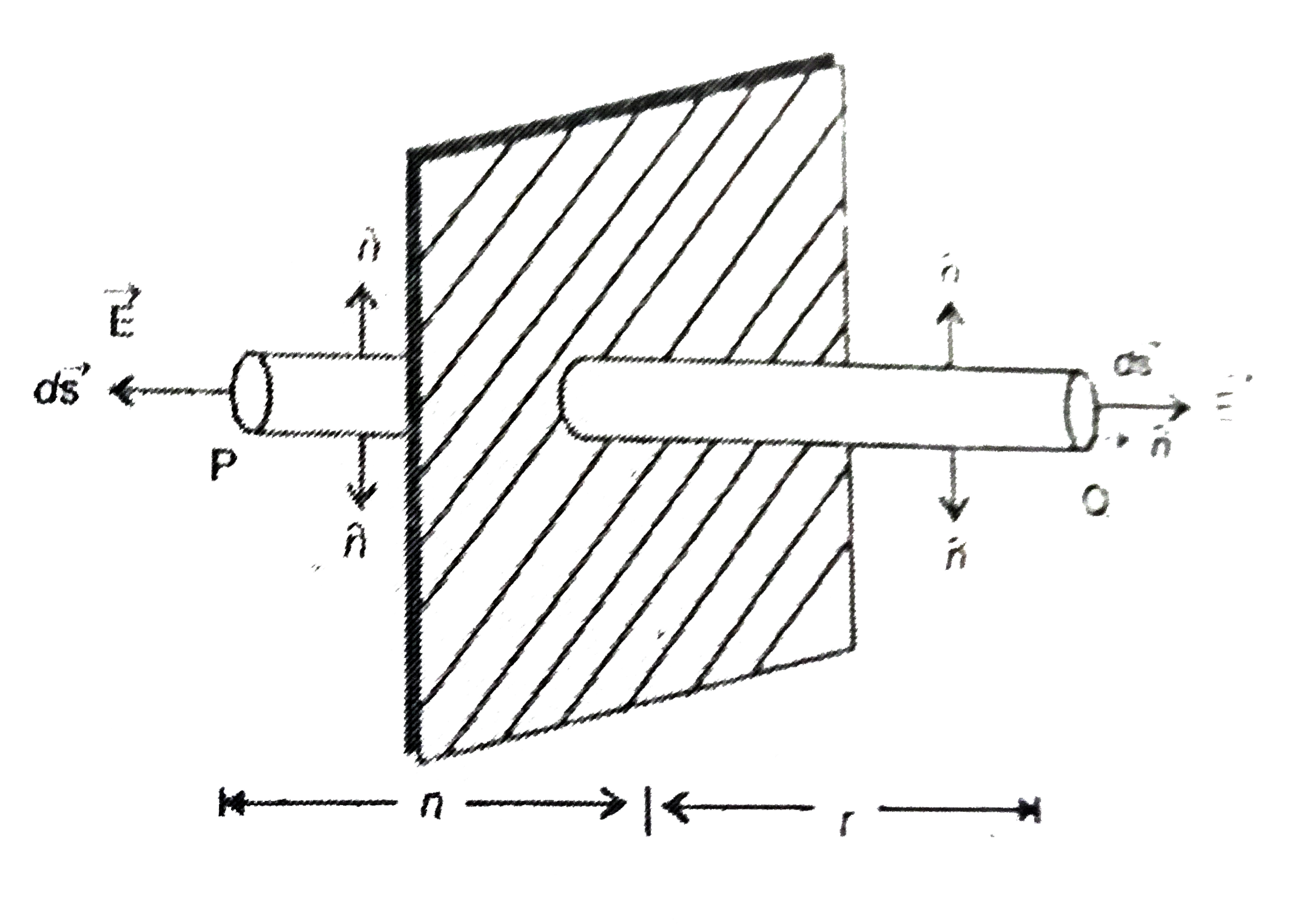 `implies 2 oint vec(E)vec(dS). = q/epsi_(0)` `implies 2 oint E dS=q/epsi_(0)``implies 2 E PI r^(2)=q/epsi_(0) implies E=q/(2pi epsi_(0) r^(2))` `:.` The charge density `sigma=q/S` `implies q= pi r^(2) sigma` `E=(pi r^(2) sigma)/(2 pi epsi_(0) r^(2))` `E= sigma/(2 epsi_(0))`, vectorically `vec(E)= sigma/(2 epsi_(0)) hat(n)` Where `hat(n)` is a unit vector normal to the plane and going away from it. where `sigma gt 0` E is directed away from both sides. Now consider two infinite plane parallel sheets of charge A and B. Let `sigma_(1)=sigma` and `sigma_(2)=- sigma` be the uniform surface density of charge on A and B RESPECTIVELY. The electric field between two PLATES is given by `E=E_(1)-E_(2)` `=sigma_(1)/(2 epsi_(0))-sigma_(2)/( 2 epsi_(0))=sigma/(2 epsi_(0))-((-sigma)/(2epsi_(0)))=(sigma+sigma)/(2epsi_(0))` `:. E=(2 sigma)/(2 epsi_(0)) implies E= sigma/epsi_(0)`. 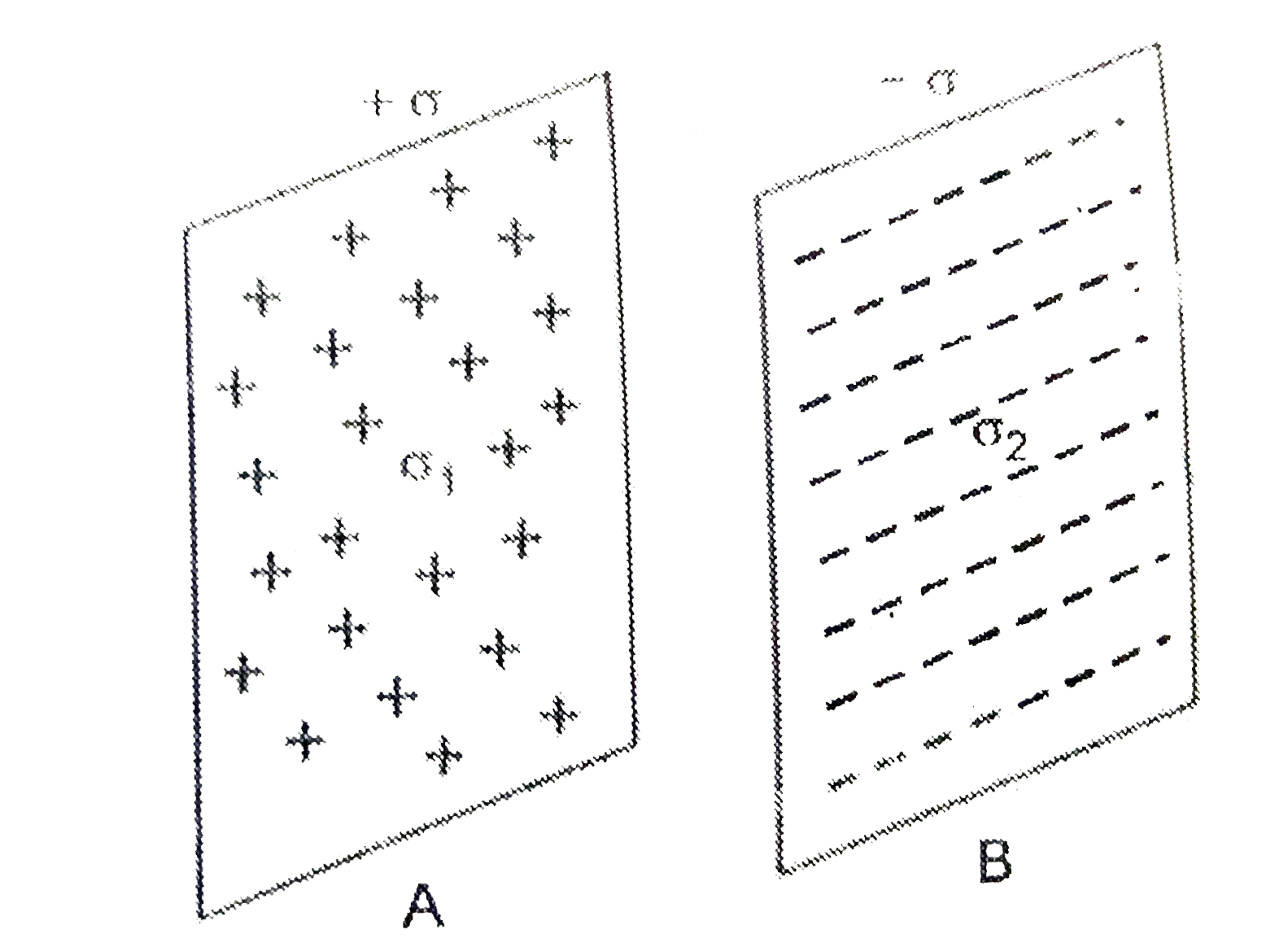
|
|