

Saved Bookmarks
| 1. |
Use (i) the Ampere's law for vecH and (ii) continuity of lines of vecB, to conclude that inside a bar magnet, (a) lines of vecH run from the N pole to S pole, while (b) lines of vecB must run from the S pole to N pole. |
|
Answer» SOLUTION :Consider a magnetic field line of `vecB` through the bar MAGNET as shown in figure. It must be a CLOSED loop. Let C be the amperian loop. Then `int_(Q)^(P) vecH.dvecl=int_(Q)^(P)(vecB)/(mu_0).dvecl gt 0` (i.e., POSITIVE) It is so because the angle between `vecB` and `dvecl` is less than `90^@` inside the bar magnet. So `vecB.dvecl` is positive. Hence, the lines of `vecB` must run from S pole to N pole inside the bar magnet. According to Ampere's law, `oint_(PQR) vecH.dvecl=0 :. oint_(PQR)vecH.dvecl=int_(P)^(Q) vecH. dvecl=int_(Q)^(P) vecH.dvecl=0` As `int_(Q)^(p) vecH.dvecl gt 0`, so `int_(P)^(Q)vecH.dvecl lt 0` (i.e., NEGATIVE) It will be so if angle between `vecH` and `dvecl` is more than `90^@`, so that `cos theta` is negative. It means the line of `vecH` must run from N pole to S pole inside the bar magnet. 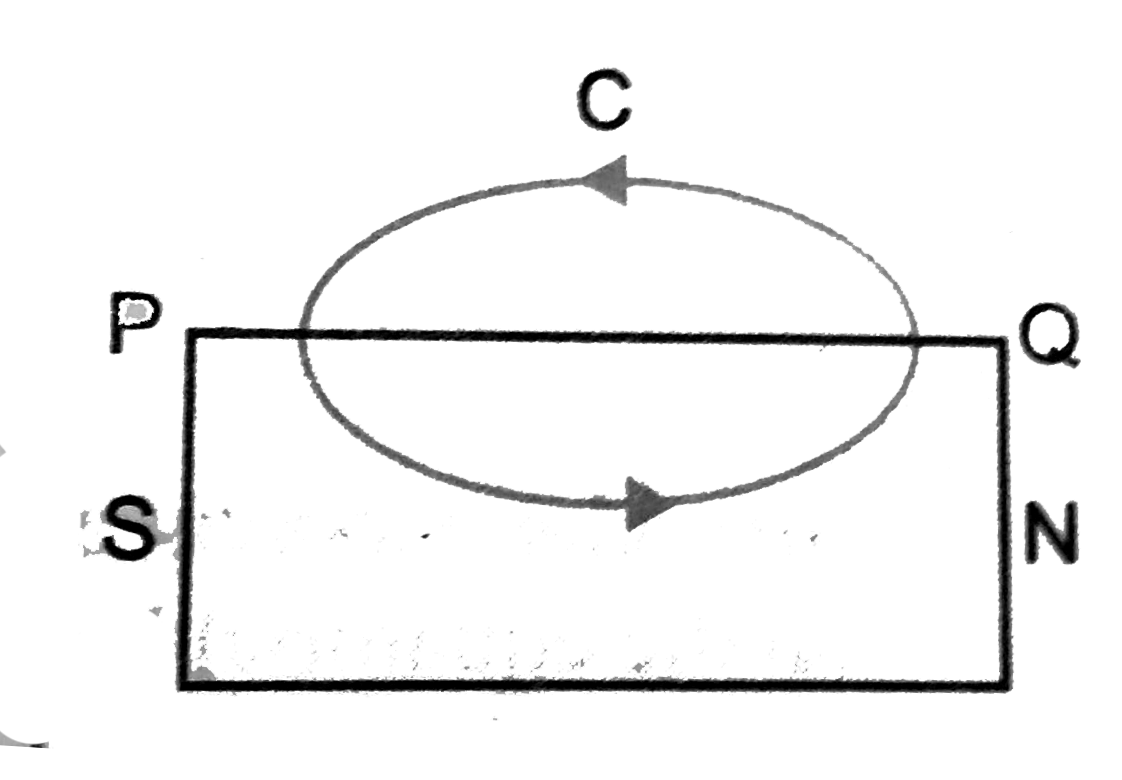
|
|