

Saved Bookmarks
| 1. |
Using a neat labelled diagram derive the mirror equation. Define linear magnification. |
|
Answer» Solution :Derivation of mirror equation : Consider an object AB is placed beyond centre of curvature of a concave mirror, on its principal axis. A ray AD parallel to principal axis incident on the mirror at point D and is reflected to pass through F. Another ray AE passing through centre of curvature C is reflected along the same path. Two rays of light intersect at point A'. Thus A'B' is real, inverted and diminished image of AB formed between C and F. `Delta^("le")"DPF and "Delta^("le")" A'B'F are similar "("B'A'")/("PD")=("B'F")/("FP")` (or) `("B'A'")/("BA")=("B'F")/("FP")"......................... (1)"(therefore PD = AB)` Since `ANGLEAPB= angleA'P'B'` The right ANGLE triangles A'B' P and ABP are similar. `("B'A'")/("BA")=("B'P")/("BP")".............................(2)"` From EQUATIONS (1) and (2), `("B'F")/("FP")=("B'P")/("BP")=(B'P-FP)/(FP)"............(3)"` Now APPLYING the sign convention. `B'P=-upsilon, FP=-f, BP=-u` `(-upsilon+f)/(-f)=(-upsilon)/(-u)` `(upsilon-f)/(f)=(upsilon)/(u) rArr (upsilon)/(f)-1=(upsilon)/(u)` `(1)/(f)=(1)/(v)+(1)/(u)` 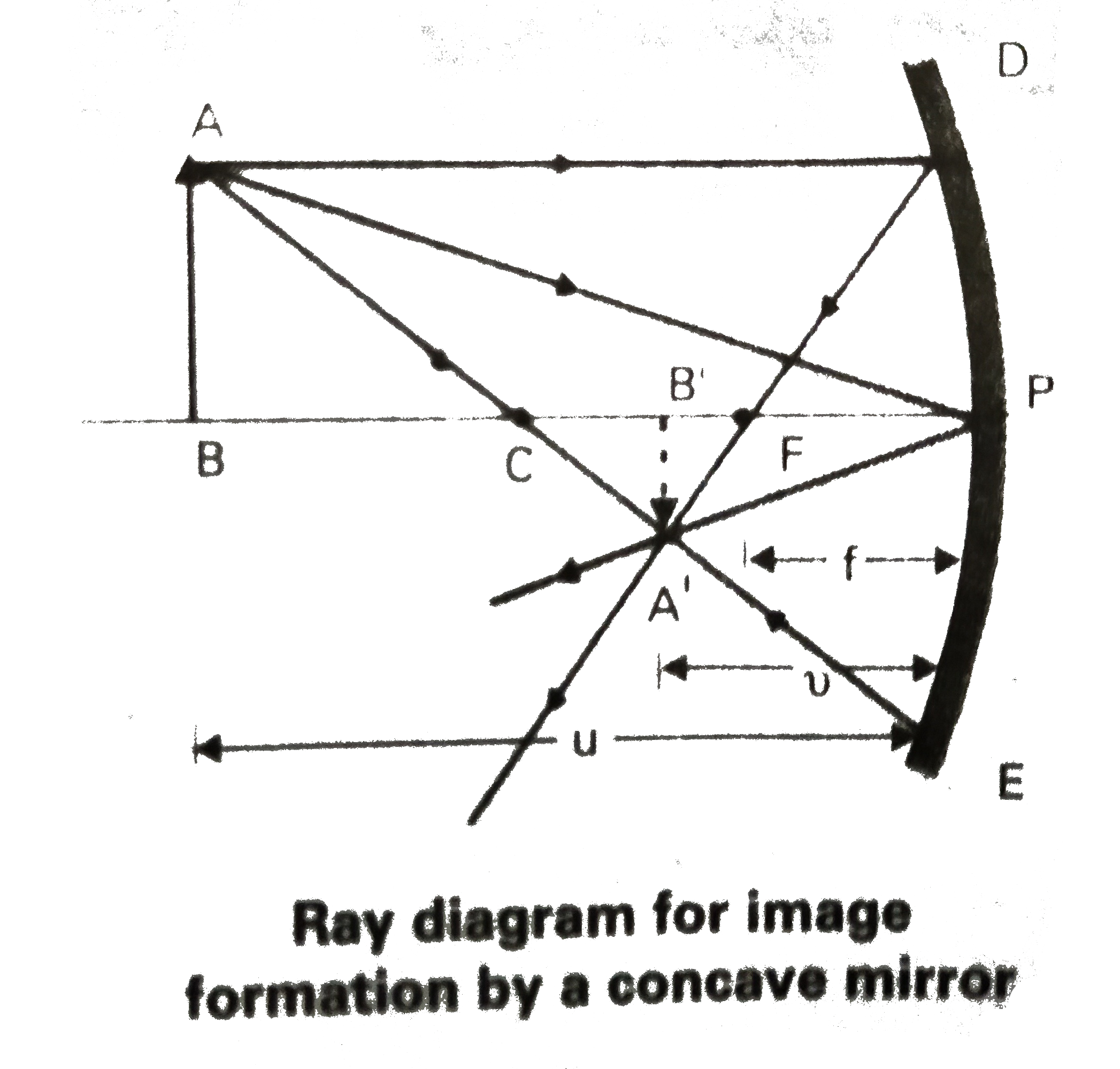 Linear magnification : Linear magnification is the ratio of the size of the image formed by the mirror to the size of the object. `m=("size of the image")/("size of the object")=(h_(2))/(h_(1))=(-upsilon)/(u)` |
|