

Saved Bookmarks
| 1. |
Using Gauss' law deduce the expression for the electric field due to a uniformly charged spericalconducting shell of radius R at apoint (i) outside and (ii) inside the shell. Plot a graph showing variation of electric field as a function of r gt R and r lt R. (r being the distance from the centre of the shell) |
|
Answer» <P> Solution :Electric field due to a uniformly charged thin spherical shell -(i) When point P lies Outside the Spherical Shell - Suppose that we have to calculate electric field at the point P at a distance `r(r gt R)` from its centre. Draw the Gaussian surface through point P so as to enclose the charged spherical shell of radius r and centre O. Let `VEC(E)` be the electric field at point P. Then, the electric flux through area element `vec(ds)` is given by, `d PHI = vec(E).vec(ds)` Since `vec(ds)` is also along normal to the surface, `d phi = Eds` `therefore` Total electric flux through the Gaussian surface is given by, `phi = oint Eds = E underset(s)oint ds` Now, `oint ds = 4 pi r^(2)` `therefore""phi = E xx 4 pi r^(2)""...(i)` Since the charge enclosed by the Gaussian surface is q, according to Gauss theorem, `phi=(q)/(epsilon_(0))""...(ii)` From equations (i) and (ii), we get `E xx 4 pi r^(2)=(q)/(epsilon_(0))` `E=(1)/(4 pi epsilon_(0)).(q)/(r^(2))""("for r" gt R)` 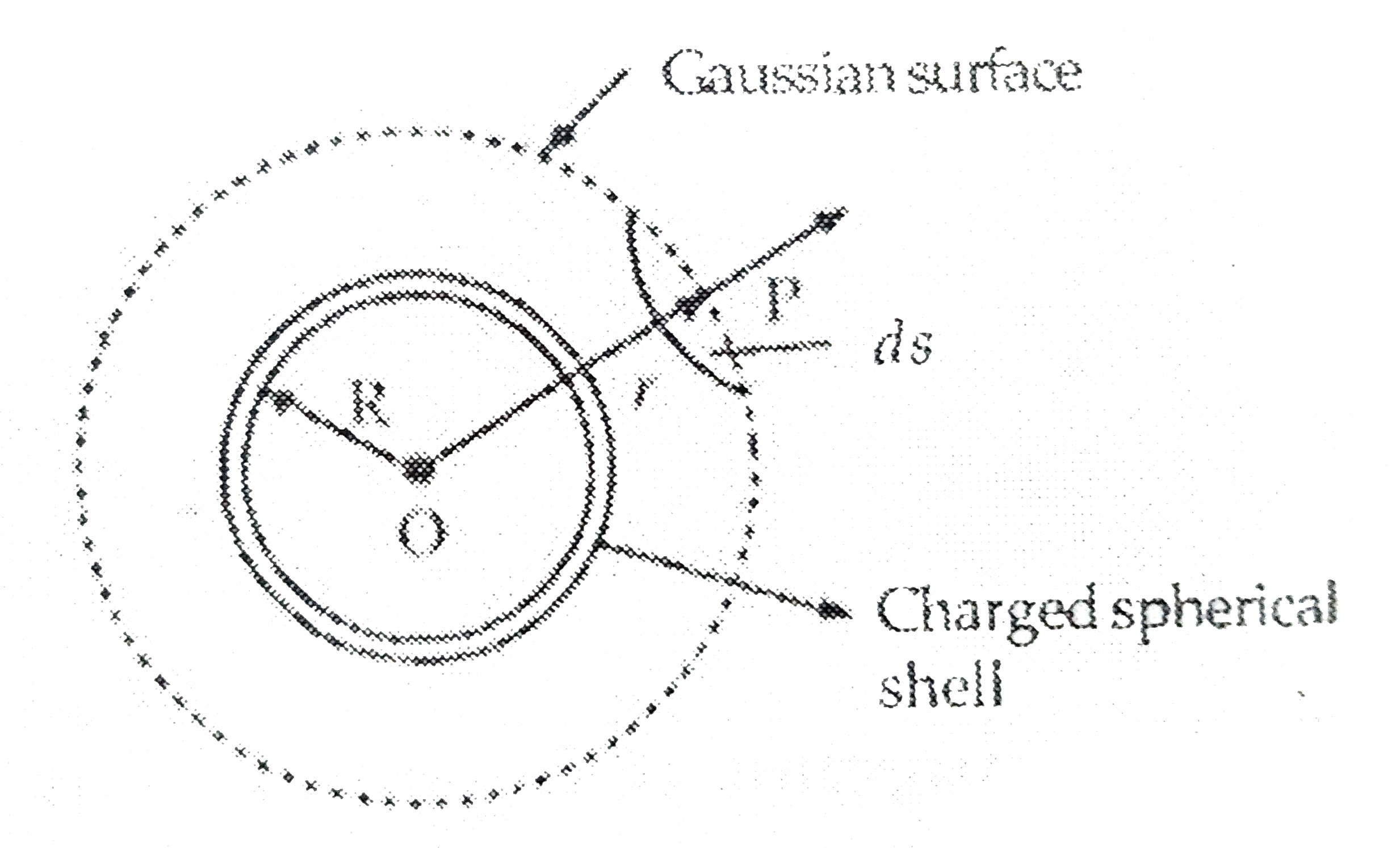 (ii) When point P lies inside the spherical shell : In such a case the Gaussian surface encloses no charge According to Gauss Law, `E xx 4 pi r^(2) = 0` i.e., `""E=0 (r LT R)` Graph showing the variation of electric field as a function of r. 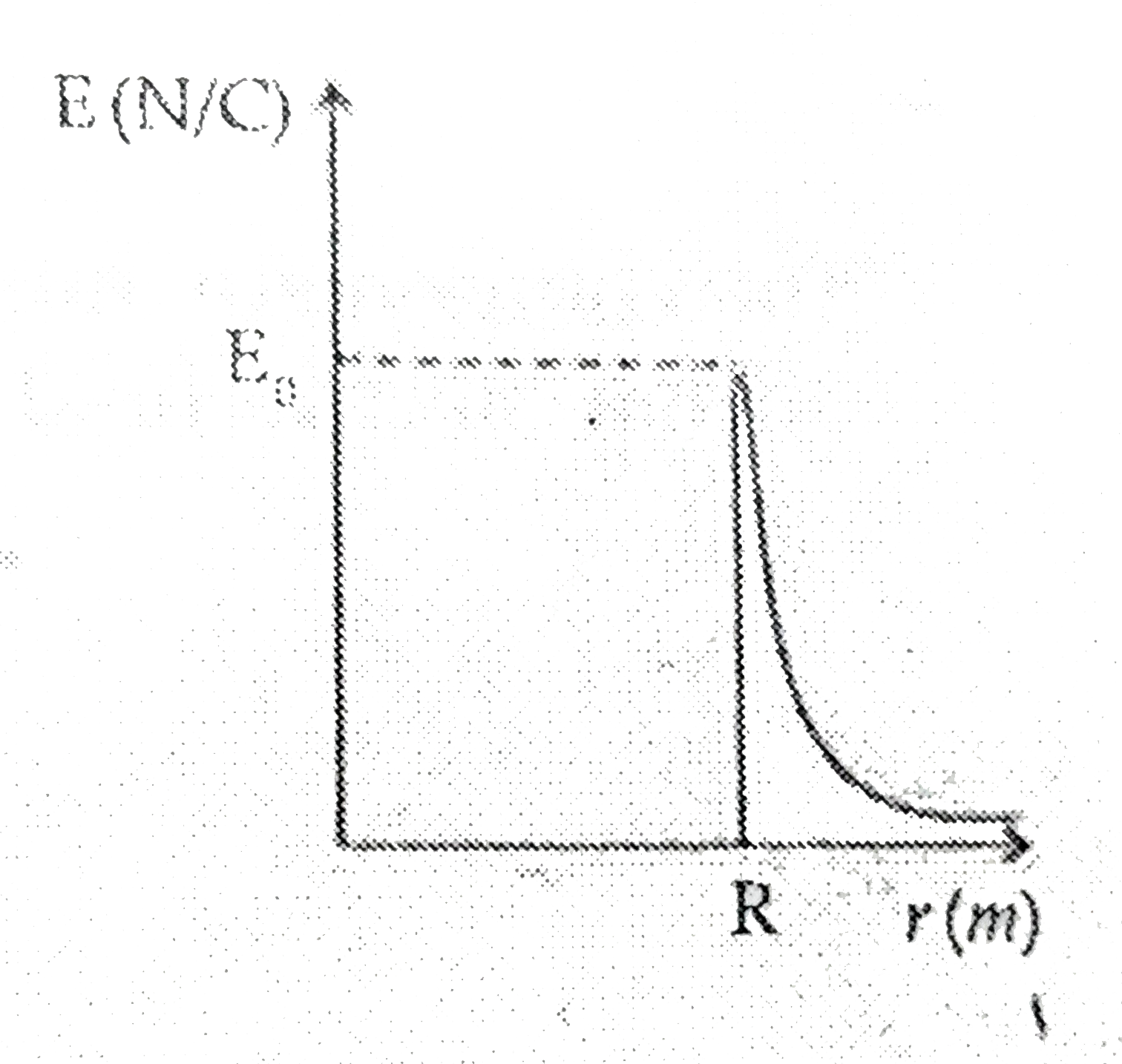
|
|