

Saved Bookmarks
| 1. |
Using Gauss' law porve that the electric field at a point due to a uniformaly charged infinite plane sheet is independent of the distance form it. How is the field directed if the sheet is (i) positively charged, (ii)negatively charged. |
|
Answer» Solution :For Gauss. theorem , see point number 47 under the heading "Chapter At A Glance"Consider an infinite thin plane sheet having a surface density ` sigma. ` To find electric field at a point Psituated at a NORMAL distance r from the sheet , consider an imaginary cylinder of cross-section ara DS around point P and length 2r, passing through the sheet ,as the GAUSSIAN surface. From symmetry consideration , only side faces1 and 2 of cylinder contribute towards the flux because here ` oversetto E and hatn ` parallel but the curved surface of cylinder does not contributed towards the flux because here `oversetto Eand hatn ` are mutually perpendicular. ` therefore ` Total electric flux ` phi_in =2 E ds` As per Gauss theorem total electric flux `pi_in =(1)/( in_0)` (CHARGE encloesd)`=(1)/( in _0) .(sigma ds) ` Comparing (i) and (ii) , we get ` 2 E ds =(sigma)/( in_0) . ds RARR E= ( sigma)/( 2 in _0)` Thus, the electric field at a point due to a uniformalycharged infinite plane sheet is independent of the distance from it . Vectorially ` oversetto (E) =(sigma)/(2 in _0) hatr ` Thus for (i)positively charged sheet electric field `oversetto E ` is directed outwards and for (ii)negatively charged sheet the field is directed inwards. 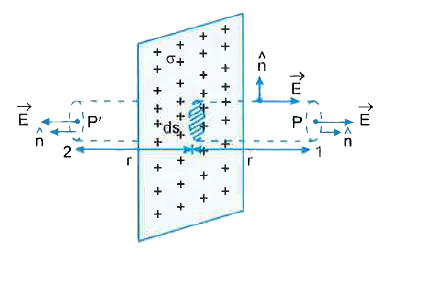
|
|