

Saved Bookmarks
| 1. |
Using Huygen's wave theoryof light , derive Snell's law of refraction. |
Answer» Solution :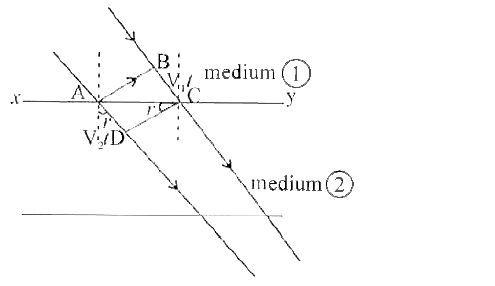 Let xy represent the surface separating medium(1) and medium (2) as shown in the figure. Let `v_1` and `v_2` REPRESENTTHE speed of light inmediums (1) and (2) respectively. A plane wave front incident on the interface xy at angle i. Let t be the time taken by the wavefront to travelthe distance BC. thenBC=`v_it`. The secondarywave from A will travel a distance `V_2t` in medium 2 , in the same time period.Draw an arc in medium 2. Then AD=`V_2t` and the TANGENT from C touches the arc at D . CD is the tangential surfacetouching all the spheres of refractedsecondary wavelets , and hence CD is the refracted wave front. `angle(BAC)=i` and `angle(DCA)=r` From triangle BAC, sin i = `(BC)/(AC)` From triangle DCA, sin r =`(AD)/(AC)` `(sin i)/(sin r) =(BC//cancel(AC))/(AD//cancel(AC))` `=(BC)/(AD)` SUBSTITUTING values of BC and AD , `therefore (sin i)/(sin r) =(V_1 cancelt)/(V_2 cancelt)=V_1/V_2 to ` (1) Now, R.I of the first medium `V_1=c//n_1` Similarly for the SECOND medium `V_2=c//n_2` Substituting in eqn.(1) , we get `(sin i)/(sin r) =(cancelc//n_1)/(cancelc//n_2)=(1//n_1)/(1//n_2)=n_2/n_1` `therefore (sin i)/(sin r)=n_1/n_2` This is the snell.s law of refraction. |
|